
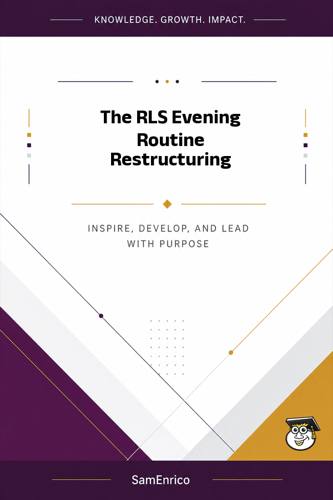
Non-FictionHealth & WellnessBehavioral Modification
The RLS Evening Routine Restructuring eBook
Teaches how to redesign pre bed activities to calm
Teaches how to redesign pre bed activities to calm sensory symptoms.
Formats
Free sample
Chapter 1: The Stillness That Bites--–- The first time Sarah felt it, she was twenty-two years old, sitting in a midnight showing of a film she no longer remembers. Her legs began to hum—not with pain, not with cramping, but with something far more strange: a deep, internal vibration, as if someone had placed a tuning fork inside her shins and struck it gently. She shifted in her seat. She crossed her legs, then uncrossed them. She stretched one leg into the aisle, then pulled it back.
Within ten minutes, the humming had become a crawling, a pulling, a sensation she could only describe as "electric ants marching through my bones." She stood up in the dark theater, walked to the back, and spent the remaining forty minutes of the film pacing in the lobby. The ticket attendant asked if she was okay. "Fine," she said. "Just restless." That word—restless—felt like a lie and a truth all at once. She wasn't restless in the way people meant when they said they needed a vacation.
She was restless in a way that felt neurological, predatory, specific. Her legs were not asking permission to move. They were demanding it.Twenty years later, Sarah is a client in my clinical practice, and she has not seen a full movie in a theater since that night. She has not sat through a wedding ceremony without excusing herself to "use the restroom" three or four times. She has not lain in bed next to her husband without the silent, exhausting negotiation between her body's demand for movement and her mind's desperate wish for stillness.
She has tried magnesium. She has tried iron. She has tried cutting out caffeine entirely, then adding it back, then cutting it again. She has tried stretching, massage, acupuncture, and a vibrating foot massager that cost three hundred dollars and now lives under her desk, gathering dust. She has been told by one doctor that she has "anxiety," by another that she has "poor circulation," and by a third that she should "try yoga." The yoga made it worse.
Of course it made it worse. Because when you lie on a mat in a quiet room and try to breathe deeply, every single sensation in your body becomes amplified. The ants become fire ants. The crawling becomes clawing.Sarah has Restless Legs Syndrome. And like the nearly ten percent of the adult population who share this diagnosis, she has been given a thousand well-meaning suggestions and almost no actionable, evening-specific protocols that actually work.This book exists because of Sarah, and because of the thousands of patients like her who have taught me something that the medical literature often misses: RLS is not a disease of the legs.
It is a disease of the transition. Specifically, the transition from wakefulness to sleep, from upright to supine, from the noisy, distracting, sensorily crowded world of the day to the quiet, still, sensorily impoverished world of the night. Your legs do not "wake up" when you lie down because something is wrong with your muscles. They wake up because your brain's sensory filters have lowered their guard, and the usual background noise of your body has suddenly become a broadcast.The Myth of the Muscle Problem Let me say this as clearly as I can: Restless Legs Syndrome is not a muscle disorder. Your calves are not weak.
Your thighs are not tight. Your feet do not have a circulation problem (though circulation issues can mimic RLS, and we will discuss how to tell the difference). The sensation you feel—the crawling, pulling, gnawing, electric, or "something is in there" feeling—originates in your central nervous system, not in your peripheral tissues. This is not opinion. This is the consensus of every major neurological organization that has studied the condition.How do we know?
Because people with complete spinal cord injuries can develop RLS below the level of their injury, in limbs they cannot voluntarily move and from which they receive no conscious sensation. The signal is not coming from the legs to the brain. The signal is being generated within the brain and spinal cord itself. Think of it this way: your brain has a "stillness thermostat." In most people, that thermostat allows them to lie down, feel the weight of the bed, and drift off. In people with RLS, the thermostat is set too low.
The moment the body becomes still, the brain interprets that stillness as a problem to be solved—and the solution it generates is the overwhelming urge to move.This is why walking provides instant, though temporary, relief. When you walk, your brain receives a flood of proprioceptive information from your joints, muscles, and skin. That sensory flood essentially "jams the signal" of the RLS sensation. Your brain becomes too busy processing the fact that you are moving to generate the false alarm of restlessness. But the moment you stop walking—the moment you lie back down—the stillness returns, and the alarm sounds again.This is also why the condition is so maddeningly specific.
You can sit on a couch at three in the afternoon, reading a book, perfectly comfortable. You can sit in an office chair at ten in the morning, typing, without a twinge. But at ten at night, when you lie down in a dark, quiet room, the sensations erupt. Why? What changes?
Two critical things: your brain's dopamine levels, and your environment's sensory input.The Dopamine Dip Dopamine is often described as the "pleasure chemical," but that is a vast oversimplification. In the context of movement and sensation, dopamine acts as a gatekeeper. It helps your brain decide which signals to pay attention to and which signals to ignore. When dopamine levels are high, your brain is excellent at filtering out irrelevant background noise—the feeling of your socks, the pressure of the mattress, the subtle twitch of a muscle fiber. When dopamine levels drop, that filter becomes less effective.
Small sensations become large. Background noise becomes foreground.Here is what almost no one tells you about RLS: your dopamine levels naturally drop at night. This is not a flaw. It is a feature of normal human biology. The drop in dopamine is part of your brain's preparation for sleep.
It reduces motor activity, quiets the basal ganglia, and allows the transition into the slow-wave sleep that restores your body and mind. For most people, this dopamine dip goes unnoticed. Their sensory filter remains strong enough to ignore the minor signals coming from their legs.But for people with RLS, the filter is already compromised. The most common cause of this compromised filter is low iron. Iron is a necessary cofactor for the production of dopamine.
Without sufficient iron in the brain (specifically in the substantia nigra, a small region deep in the basal ganglia), your neurons cannot synthesize enough dopamine to maintain a robust sensory filter. When the natural nighttime dopamine dip occurs on top of already-low baseline dopamine, the filter fails entirely. Your legs are not suddenly generating new sensations. Your brain has simply stopped being able to ignore the sensations that are always there.This is why…
This is the end of the free sample. Get the eBook to keep going. Buy now
About this book
Details
- Author
- Castle Renetta
- Publisher
- SamEnrico
- Language
- English
- Genre
- Non-Fiction, Health & Wellness, Behavioral Modification
- Released
- 2026-06-06
- Pages (approx.)
- 152
- Available as
- eBook, Audiobook

Read better in the ZLOADR app
Your eBooks on your phone or tablet. Sign in with your SamEnrico account and start reading.
More by Castle Renetta
 MBSR Teacher Training PrimerCastle Renetta$11.99
 Burnout Prevention for Remote Workers CourseCastle Renetta$11.99
 Cousteau's Flying CalypsoCastle Renetta$11.99
 Workplace Stress for NeurodivergentsCastle Renetta$11.99
 Shadows of Susa: The Forgotten Conspiracy of the Achaemenid CourtCastle Renetta$11.99
 Understanding Keratosis Palmoplantar-periodontopathyCastle Renetta$17.99
 How to Start a Olive Oil Refining Business (Beginners Guide)Castle Renetta$11.99
 Succession Planning Global GuideCastle Renetta$12.99
 SEO Content Optimization ManualCastle Renetta$12.99
 Title ClerkCastle Renetta$11.99
You may also like
 Hong Kong Handover 1997Dunn Johnnie$11.99
 Zumba For Postnatal Recovery CourseNeal Christian$11.99
 Zumba for BeginnersLadner Nikia$11.99
 YouTube Comment Mining GuideHumes Pandora$12.99
 Worry Box MeditationCarlin Rudy$11.99
 Workplace Stress MeditationNguyen Lynn$11.99
 Workplace Stress and Sleep RepairHawley Ivory$11.99
 Workplace Perfectionism CureDelaney Jeffry$11.99
 Workplace Injustice Anger GuideWallen Isabelle$11.99
 Work Addiction and Burnout LinkGreenwood Ester$11.99
 Women in Yoga and WellnessBeattie Galina$11.99
 Women in Stand Up ComedyChun Evangeline$11.99