
Non-FictionSelf-HelpClosure Rituals
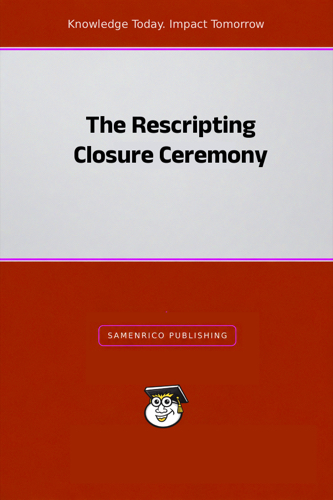
The Rescripting Closure Ceremony eBook
Ritual to mark completion of nightmare processing.
Ritual to mark completion of nightmare processing.
Formats
Free sample
Chapter 1: The 3:17 AM Alarm--If you are reading this book, there is a very good chance you know exactly what 3:17 AM feels like. Not 3:15. Not 3:20. 3:17 — that strange, liminal minute when the house is silent, when your phone has stopped buzzing hours ago, when the rest of the world is tucked into its own dreams, and you are sitting upright in bed, heart pounding, hands clammy, trying to remember if you actually screamed out loud or if the scream only happened inside the dream. Your throat is dry.
Your pillow is damp. The sheets are tangled around your legs like something tried to hold you down. And somewhere in the fog between the nightmare and the waking world, a voice inside you whispers: Not again.You check your phone. 3:17 AM. Every time.This is not a coincidence.
It is not bad luck. It is not a sign that you are broken, cursed, or somehow weaker than people who sleep peacefully through the night. What you just experienced — and what you may have experienced hundreds of times before — is the result of a very specific, very predictable mechanism inside your brain. A mechanism that was designed to keep you alive, not to torture you. A mechanism that, once you understand it, you can learn to redirect, retrain, and finally retire.This chapter is called The 3:17 AM Alarm because that is what a recurring nightmare really is: an alarm system that forgot to turn off.
And like any alarm, it has a source, a wiring diagram, and a reset button. You are about to learn all three.The Arithmetic of Awakening Let us begin with a question you have probably asked yourself in the dark: Why does the same nightmare keep happening?Not similar nightmares. Not nightmares on the same theme. The exact same nightmare — the same hallway, the same shadow, the same feeling of your legs moving through wet cement, the same face leaning in at the same moment. It is as if your brain is playing a recording on a loop, and someone has lost the remote control.The answer lies in a process called memory reconsolidation.
Every time you remember something — a birthday, a breakup, a nightmare — your brain does not simply play back a perfect recording. Instead, it rebuilds that memory from scratch, using fragments stored in different regions of your brain. For a brief window of time — usually one to two hours — that memory is "unlocked." It becomes malleable. Changeable. It can be edited, updated, or even deleted before it is filed away again.Here is the catch: your brain only knows how to rebuild a memory using the information you give it.
If you wake up from a nightmare and do nothing — if you lie there trembling until you fall back asleep — your brain rebuilds the nightmare exactly as it was. Nothing changes. The loop continues.But if you do something different — if you engage with the nightmare while awake, if you rewrite even one detail, if you rehearse a new version — your brain has no choice but to incorporate that new information the next time it rebuilds the memory. That is the promise of this book. And it is not wishful thinking.
It is neuroscience.The Smoke Alarm in Your Skull To understand why nightmares feel so relentless, you need to meet a small, almond-shaped structure deep inside your brain called the amygdala. The amygdala is your body's smoke alarm. Its job is to scan every incoming piece of information — every sound, every image, every half-formed thought — for potential danger. When it detects a threat, it does not wait for permission. It floods your system with cortisol and adrenaline.
It speeds up your heart. It primes your muscles to run or fight. It does all of this in milliseconds, because in the environment where your brain evolved, a delay of even one second could mean being eaten.Here is the problem: the amygdala cannot tell the difference between a real threat and a remembered threat. It cannot tell the difference between a tiger in the room and a tiger in a dream. It cannot tell the difference between a trauma that happened twenty years ago and a nightmare that happened twenty minutes ago.
To the amygdala, everything is happening right now.When you have a nightmare, your amygdala treats it as a genuine survival event. It flags that dream memory as "unfinished danger" — a threat that was not successfully resolved. And because the amygdala's job is to keep you alive, it does something that feels like cruelty but is actually logic: it makes you replay the nightmare. Not to torture you. To solve it.
Your brain is running a simulation over and over, hoping that this time, you will find a way to survive.You have survived every single time. You have woken up every single time. But your amygdala does not know that. It only knows that the dream ended without a clear victory. So it keeps running the simulation.
And running it. And running it.This is called threat-simulation theory. It is the leading scientific explanation for why nightmares occur, and it has one radical implication: your nightmares are not proof that something is wrong with you. They are proof that your survival instincts are working exactly as designed — just in the wrong context. You do not need to destroy your amygdala.
You need to teach it that the threat has been handled.What Does Not Work Before we talk about what does work, let us clear the table of what does not. You have probably tried some of these strategies. They are not bad because you are bad. They are bad because they are fighting against the way your brain actually works.Strategy One: Ignore it and go back to sleep. This is the most common response to a nightmare.
You wake up, you tell yourself it was just a dream, you roll over, and you close your eyes. On the surface, this seems reasonable. But remember memory reconsolidation. When you fall back asleep without engaging the nightmare, your brain rebuilds it exactly as it was — and because you woke up in distress, the amygdala flags the memory as "still unresolved." You are training your brain to repeat the nightmare more efficiently.Strategy Two: Stay awake until you are too exhausted to dream. This might reduce the number of nightmares in the short term, but it comes with a devastating cost.
Sleep deprivation amplifies the amygdala's reactivity. You become more anxious during the day, more prone to intrusive thoughts, and more likely to experience vivid, bizarre dreams when you finally do sleep. This is not a solution. It is a trade — nightmares for anxiety — and you lose on both sides.Strategy Three: Drink alcohol before bed. Alcohol suppresses REM sleep, the stage where most nightmares occur.
This is why heavy drinkers often report dreamless sleep. But when the alcohol wears off in the middle of the night, your brain rebounds into REM with a vengeance — a phenomenon called REM rebound. The result is often more intense, more bizarre, and more frightening dreams than you would have had otherwise. Alcohol is not a nightmare…
This is the end of the free sample. Get the eBook to keep going. Buy now
About this book
Details
- Author
- Thornton Randal
- Publisher
- SamEnrico
- Language
- English
- Genre
- Non-Fiction, Self-Help, Closure Rituals
- Released
- 2026-06-06
- Pages (approx.)
- 131
- Available as
- eBook, Audiobook

Read better in the ZLOADR app
Your eBooks on your phone or tablet. Sign in with your SamEnrico account and start reading.
More by Thornton Randal
 Resilience Journal WorkbookThornton Randal$11.99
 Fiverr Studio Service ExpansionThornton Randal$11.99
 Visa Lottery EntrepreneurThornton Randal$11.99
 The Overcoming Resistance GuideThornton Randal$11.99
 Outdoor Speaking GuideThornton Randal$11.99
 Pelvic Master GuideThornton Randal$11.99
 Freddie Mercury LifeThornton Randal$11.99
 Darren Scott: The Unstoppable Rise of Britain's Ballet PhenomThornton Randal$11.99
 How to Produce an Atv TrailerThornton Randal$11.99
 How to Produce Nuts and SeedsThornton Randal$11.99
 Three Country Remote Team Hybrid ModelThornton Randal$12.99
 Earnings Before Tax FormulaThornton Randal$12.99
You may also like
 Hong Kong Handover 1997Dunn Johnnie$11.99
 Zumba For Postnatal Recovery CourseNeal Christian$11.99
 Zumba for BeginnersLadner Nikia$11.99
 YouTube Comment Mining GuideHumes Pandora$12.99
 Worry Box MeditationCarlin Rudy$11.99
 Workplace Stress MeditationNguyen Lynn$11.99
 Workplace Stress and Sleep RepairHawley Ivory$11.99
 Workplace Perfectionism CureDelaney Jeffry$11.99
 Workplace Injustice Anger GuideWallen Isabelle$11.99
 Work Addiction and Burnout LinkGreenwood Ester$11.99
 Women in Yoga and WellnessBeattie Galina$11.99
 Women in Stand Up ComedyChun Evangeline$11.99