
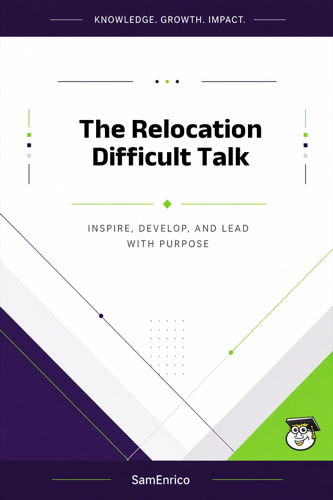
The Relocation Difficult Talk eBook
Discuss moving for a job or family reasons with yo
by Finch Carola
Discuss moving for a job or family reasons with your partner.
Formats
Free sample
Chapter 1: The Cost Before The Box...--–- The call came on a Tuesday afternoon. Sarah was folding laundry in the Denver townhouse she had painted herself, the one with the garden she had nurtured for six summers. Her husband, Mark, walked through the door with the expression she had learned to recognize over twelve years of marriage: the face that meant everything was about to change. He had been promoted. The job was in Austin.
They needed to decide by Friday.For three days, they did not decide. They argued about schools, about housing prices, about the distance to her aging parents. They argued about moving companies, about selling the sofa, about whether the dog could survive the drive. They did not argue about what Sarah was losing. They did not argue about the fact that she would leave a job she loved, a book club that had sustained her through her father's death, a running partner who knew when to talk and when to be silent.
They argued about logistics because logistics were safe. Logistics had answers. The cost of relocation did not.On Thursday night, sitting on the floor of their empty living room—the movers were coming in the morning—Sarah said something she had not planned to say. "I don't know who I am if I'm not here." Mark heard accusation. He said, "You knew my career would take us places." She heard dismissal.
They did not speak again until the movers arrived.This is not a story about a marriage that failed. This is a story about a marriage that almost failed, saved only by a delayed flight and a conversation in an airport bar with a stranger who had moved eleven times in twenty-two years. The stranger said, "You're fighting about boxes. But the fight is about your identity. You haven't had the one conversation that matters." Sarah and Mark had not had that conversation.
Most couples never do.This chapter is that conversation.The 34 Million Americans Who Don't Talk About What Matters Every year, more than 34 million Americans relocate. Susan Miller, in After the Boxes Are Unpacked, documents that relocation is consistently ranked among the top three predictors of divorce, trailing only infidelity and financial collapse. Robin Pascoe, author of A Moveable Marriage, spent fifteen years interviewing relocating couples and found a pattern so consistent it became her book's central thesis: couples spend weeks researching school districts and mortgage rates, but they spend almost no time discussing the psychological cost of the move. They talk about where they will live. They do not talk about who they will become.The research bears this out.
A 2019 study published in the Journal of Social and Personal Relationships followed 432 couples who relocated for a job. After eighteen months, nearly 40 percent reported significant relationship distress. The primary predictor of distress was not financial strain, not distance from family, not children's adjustment problems. It was the failure to have a single, structured conversation about the emotional cost of the move before the moving truck arrived.Pascoe calls this the "Cost Silence." Couples avoid the conversation because it feels disloyal. The partner with the job opportunity fears that naming the cost will sound like ingratitude.
The partner who will leave everything behind fears that naming the cost will sound like selfishness. So both remain silent, and the silence becomes resentment, and the resentment becomes the third person in the marriage.This chapter breaks the silence.The Catalyst vs. The Cost: A Framework Every relocation has two components, and they are not the same thing. The catalyst is the reason to move: the promotion, the sunshine, the better schools, the proximity to family. The cost is what each partner gives up: the career pause, the social network, the geographic identity, the daily routines that made a life feel like a life.Most couples make a catastrophic error.
They try to negotiate the cost using the language of the catalyst. The working partner says, "But the salary increase is forty percent." The trailing partner hears, "Your career is worth forty percent of my life." The working partner says, "The schools are better." The trailing partner hears, "Your friends are less important than our children's test scores." Neither is wrong. Neither is hearing the other.The catalyst and the cost are not opposing arguments to be won. They are separate realities to be acknowledged. You cannot negotiate the logistics until you validate the emotions.
This is not a soft skill. It is a structural necessity. Pascoe's research found that couples who spent at least ninety minutes in a structured conversation about costs—before any discussion of logistics—were three times more likely to report satisfaction with the relocation after one year.The Catalyst vs. Cost framework is simple. Each partner writes two lists privately.
The left column is the catalyst: every benefit of the move, from the obvious (salary, weather) to the subtle (a fresh start, escape from a difficult family member, a chance to reinvent oneself). The right column is the cost: every loss, from the concrete (a job, a house) to the existential (identity, belonging, the feeling of being known).Then they share. The rule is this: the partner who is not reading listens without interrupting, without defending, without offering solutions. The only permitted response is, "I hear you. That loss is real.
Tell me more."This sounds simple. It is not. Most people cannot do it without practice. The rest of this chapter provides that practice.The Working Partner's Blind Spot: Defensiveness Disguised as Problem-Solving When Sarah told Mark she did not know who she was without Denver, Mark heard an attack on his career. He said, "You knew my career would take us places." He was being defensive.
He did not know he was being defensive because his defensiveness was wrapped in the language of practicality. He was not saying, "Your identity matters less than my job." He was saying, "We agreed to this life." But agreement does not erase loss.The working partner's blind spot is the assumption that previous agreement negates current pain. This is a logical error. A person can agree to a move and still grieve what they leave behind. A person can be excited about the future and terrified of the present.
These are not contradictions. They are the human condition.Pascoe documents this blind spot across hundreds of interviews. Working partners consistently report that they "did not see the resentment coming" because they "thought we had agreed." The trailing partners report that they "did agree" but also "did not know how to say that agreeing didn't mean I wasn't losing everything."The solution is the Validation Protocol. When the trailing partner names a cost, the working partner does three things, in order:Repeat the cost back. "I hear you saying you're losing your running partner."Acknowledge its reality.
"That is a real loss."Ask for more. "What else are you losing that I haven't heard?"That is all. No solutions. No perspective. No "but think about the schools." Just validation.
The trailing partner does not need the problem solved. The trailing partner needs the loss seen.This is counterintuitive for most working…
This is the end of the free sample. Get the eBook to keep going. Buy now
About this book
Details
- Author
- Finch Carola
- Publisher
- SamEnrico
- Language
- English
- Genre
- Non-Fiction, Self-Help, Moving
- Released
- 2026-06-11
- Pages (approx.)
- 143
- Available as
- eBook, Audiobook

Read better in the ZLOADR app
Your eBooks on your phone or tablet. Sign in with your SamEnrico account and start reading.
More by Finch Carola
 Antipsychotics Bipolar WorkbookFinch Carola$11.99
 Talent Competitive MappingFinch Carola$11.99
 Self Esteem and Being OverlookedFinch Carola$11.99
 Spontaneity Exercises at WorkFinch Carola$11.99
 Joy of Present MomentFinch Carola$11.99
 Public Speaking for Wedding ToastsFinch Carola$11.99
 The Silk and Shadow Conspiracy: Victorian Blackmail in High SocietyFinch Carola$11.99
 Baba Yaga's Bone House: The Witch Who Feeds on the LostFinch Carola$11.99
 Birmans: The Sacred Cat of BurmaFinch Carola$11.99
 A Collector's Handbook to the Talbot 110Finch Carola$11.99
 Family Leave Law Traps for Small FirmsFinch Carola$12.99
 UAE VAT on Digital ServicesFinch Carola$12.99
You may also like
 Hong Kong Handover 1997Dunn Johnnie$11.99
 Zumba For Postnatal Recovery CourseNeal Christian$11.99
 Zumba for BeginnersLadner Nikia$11.99
 YouTube Comment Mining GuideHumes Pandora$12.99
 Worry Box MeditationCarlin Rudy$11.99
 Workplace Stress MeditationNguyen Lynn$11.99
 Workplace Stress and Sleep RepairHawley Ivory$11.99
 Workplace Perfectionism CureDelaney Jeffry$11.99
 Workplace Injustice Anger GuideWallen Isabelle$11.99
 Work Addiction and Burnout LinkGreenwood Ester$11.99
 Women in Yoga and WellnessBeattie Galina$11.99
 Women in Stand Up ComedyChun Evangeline$11.99