
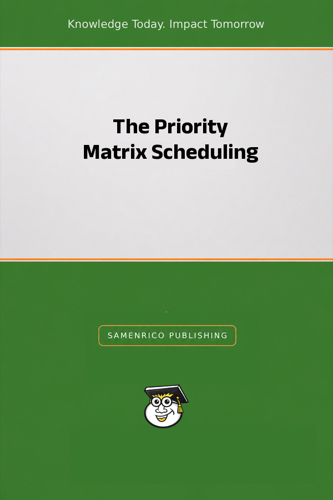
Non-FictionSelf-HelpEisenhower Matrix
The Priority Matrix Scheduling eBook
Blocks time based on urgent important quadrants.
by Blunt Lesia
Blocks time based on urgent important quadrants.
Formats
Free sample
Chapter 1: The Busyness Epidemic--We have been sold a lie. The lie is this: if you could just get faster, work harder, and squeeze more tasks into every hour, you would finally feel in control. You would finally feel peaceful, accomplished, and fully alive. The self-help industry has spent decades refining this lie, packaging it as “productivity hacks,” “life hacks,” and “morning routines.” Billion-dollar software companies have built entire empires on the promise of helping you check off more boxes per minute than the person sitting next to you. And yet, despite all of this speed, all of these apps, and all of the frantic optimization, most people have never felt busier, more anxious, or less fulfilled.Welcome to the Busyness Epidemic.If you are reading this book, you already know the symptoms.
You wake up tired, reach for your phone before your feet touch the floor, and immediately confront a river of emails, messages, and notifications. You rush through breakfast—if you eat breakfast at all. You commute in a fog, mentally rehearsing the day’s fire drills. You arrive at work already behind. Your calendar is a patchwork of back-to-back meetings, each one bleeding into the next.
You eat lunch at your desk, if you remember to eat at all. You answer emails during your child’s soccer practice. You scroll through social media in bed, telling yourself it’s “wind-down time,” but your heart rate tells a different story. You fall asleep exhausted, only to do it all again tomorrow. And somewhere beneath the exhaustion, a quiet voice whispers: Is this really it?The Busyness Epidemic is not a failure of effort.
It is not a failure of intelligence or ambition. It is a failure of distinction—the inability to tell the difference between what is merely urgent and what is truly important. And because most people have never been taught this distinction, they spend their lives running on a hamster wheel of reactivity, mistaking motion for progress.The purpose of this chapter is to name the disease before we prescribe the cure. You cannot solve a problem you refuse to see. And the problem is not that you are lazy or disorganized.
The problem is that you have been trained to prioritize the loudest voice in the room rather than the most meaningful one. By the end of this chapter, you will understand the fundamental difference between speed and direction, between being busy and being effective. And you will be ready to abandon the exhausting chase for “getting more done” in favor of a far more radical goal: doing what actually matters.The Productivity Trap: Why Faster Isn't Better In 2019, researchers at the University of California, Irvine, published a study that should have stopped the productivity industry in its tracks. They found that the average knowledge worker checks email seventy-seven times per day and switches between tasks every three minutes and five seconds. But here is the devastating part: after each interruption, it takes an average of twenty-three minutes to return to the original task with the same level of focus.
Do the math. A three-minute distraction costs nearly half an hour of cognitive recovery. If you are interrupted fifteen times in a workday—a conservative estimate for most office workers—you have lost nearly six hours not to the interruptions themselves, but to the transition cost of trying to get back on track.This is the Productivity Trap. It is the belief that if you just optimize your keystrokes, automate your workflows, and batch your emails more efficiently, you will eventually outrun the chaos. But optimization without prioritization is like polishing a sinking ship.
You can make the brass fixtures shine, but the vessel is still going down.The Productivity Trap has three toxic effects that most self-help books refuse to acknowledge.First, it creates Time Poverty—the subjective feeling of having too much to do and not enough time to do it. Time Poverty is not a function of actual hours in the day. Everyone has the same 168 hours per week. Time Poverty is a function of mismatch: the gap between what you are doing and what you value. When you spend your days responding to other people’s emergencies, your internal compass spins wildly, and time feels scarce even when the clock says otherwise.Second, the Productivity Trap rewards trivial completion.
A dopamine hit arrives every time you check off a small, easy task—replying to a simple email, moving a file to a folder, marking a meeting as accepted. Your brain learns that speed feels good. But speed on trivial tasks does not move your life forward. You can clear a hundred low-value items from your to-do list and still be exactly where you started in terms of your health, your relationships, or your career trajectory.Third, the Productivity Trap confuses effort with results. We have been raised on the Protestant work ethic: hard work is virtuous.
But hard work in the wrong direction is simply wasted energy. A farmer who plows the same field twenty times in a day is working very hard, but the crop will not grow faster. In fact, over-tilling damages the soil. The same is true for your attention. Relentless effort without strategic direction leads to burnout, not breakthrough.The solution is not a better to-do list app.
The solution is not waking up at 4:00 AM. The solution is not a new note-taking system or a color-coded folder hierarchy. These are all improvements at the efficiency level. They make you faster at doing what you are already doing. But if what you are doing is wrong, faster only accelerates disaster.What you need is not efficiency.
What you need is effectiveness.Efficiency Versus Effectiveness: The Critical Distinction In 1967, the management thinker Peter Drucker published a book called The Effective Executive. It contained a distinction that has been largely ignored by the productivity industry ever since. Drucker wrote that efficiency is “doing things right,” while effectiveness is “doing the right things.” These are not two versions of the same activity. They are entirely different orientations toward work and life.Efficiency is a mechanical virtue. It asks: How quickly can I complete this task?
How many units per hour? How can I reduce waste and friction? Efficiency is wonderful when applied to the right targets. Henry Ford’s assembly line was a triumph of efficiency. But efficiency applied to the wrong targets is a tragedy.
If you are building a car that nobody wants to drive, making that car faster and cheaper only multiplies your losses.Effectiveness is a strategic virtue. It asks: Is this task worth doing at all? Does it move me toward my deepest values and long-term goals? Am I climbing the right mountain, or just climbing faster? Effectiveness sometimes looks inefficient from the outside.
A CEO who spends two hours thinking quietly in a chair looks lazy compared to an employee who answers eighty emails in that same two hours. But the CEO is practicing effectiveness: choosing which mountain to climb. The email-answering employee is practicing efficiency: climbing the wrong mountain faster.Most people are drowning in effectiveness problems while searching for efficiency solutions. They buy a…
This is the end of the free sample. Get the eBook to keep going. Buy now
About this book
Details
- Author
- Blunt Lesia
- Publisher
- SamEnrico
- Language
- English
- Genre
- Non-Fiction, Self-Help, Eisenhower Matrix
- Released
- 2026-06-06
- Pages (approx.)
- 136
- Available as
- eBook, Audiobook

Read better in the ZLOADR app
Your eBooks on your phone or tablet. Sign in with your SamEnrico account and start reading.
More by Blunt Lesia
 Nobel Chemistry SuperstarsBlunt Lesia$11.99
 Credit Taking Anger Management WorkbookBlunt Lesia$11.99
 Dick Cavett Intellectual TalkBlunt Lesia$11.99
 Living Paycheck to Paycheck FixBlunt Lesia$11.99
 Marathon: The Birth of Western FreedomBlunt Lesia$11.99
 Understanding Pyruvate Decarboxylase DeficiencyBlunt Lesia$17.99
 How to Start a Percolators Made of Metal (non-electric) Business (Beginners Guide)Blunt Lesia$11.99
 Zoom PLG Analysis GuideBlunt Lesia$12.99
 Multi Currency Accounts AfricaBlunt Lesia$12.99
 Galloway Cattle BreedingBlunt Lesia$11.99
You may also like
 Hong Kong Handover 1997Dunn Johnnie$11.99
 Zumba For Postnatal Recovery CourseNeal Christian$11.99
 Zumba for BeginnersLadner Nikia$11.99
 YouTube Comment Mining GuideHumes Pandora$12.99
 Worry Box MeditationCarlin Rudy$11.99
 Workplace Stress MeditationNguyen Lynn$11.99
 Workplace Stress and Sleep RepairHawley Ivory$11.99
 Workplace Perfectionism CureDelaney Jeffry$11.99
 Workplace Injustice Anger GuideWallen Isabelle$11.99
 Work Addiction and Burnout LinkGreenwood Ester$11.99
 Women in Yoga and WellnessBeattie Galina$11.99
 Women in Stand Up ComedyChun Evangeline$11.99