
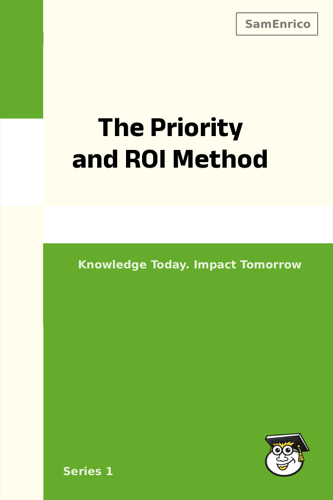
The Priority and ROI Method eBook
Rank tasks by return on time investment using Eise
Rank tasks by return on time investment using Eisenhower matrix.
Formats
Free sample
Chapter 1: The Billionaire’s Secret--–- The first time I watched a billionaire refuse a $10,000 check, I thought he was insane.It was 2016, and I was consulting for a tech founder who had just sold his second company for nine figures. A young entrepreneur had tracked him down at a coffee shop in Palo Alto, practically trembling as he offered a cashier’s check for ten thousand dollars in exchange for thirty minutes of advice. The billionaire didn’t even look up from his espresso. “I’d love to help you,” he said, “but I can’t. My time is already invested elsewhere.” The young man walked away crushed.
I walked away confused. Ten thousand dollars for half an hour? That was the equivalent of $20,000 per hour. How could anyone say no to that?The billionaire saw the confusion on my face. He set down his cup and said something I have never forgotten: “That check isn’t ten thousand dollars.
It’s ten thousand dollars plus the thirty minutes I would lose. And those thirty minutes are already promised to a meeting that will generate four hundred thousand dollars in value. So his offer isn’t $20,000 per hour. Compared to what I’m already doing, it’s a loss of $380,000.” Then he added the line that became the foundation of this book: “Most people calculate the value of their time wrong. They ask ‘How much money can I make?’ They should ask ‘What is the return on every minute I invest?’”That conversation changed everything for me.
For the previous decade, I had been a slave to busyness. I wore my sixty-hour workweek like a medal. I answered emails at dinner, took calls on vacation, and bragged about sleeping four hours a night. I thought I was productive. I was wrong.
I was just active. Activity and productivity are not the same thing. In fact, they are often opposites.The Great Deception of Modern Work Let me ask you a brutal question: What did you actually accomplish yesterday?Not what did you do. What did you accomplish? How many of your tasks moved you measurably closer to a meaningful goal?
How many hours did you spend on work that will still matter a year from now? If you are like the thousands of professionals I have interviewed, surveyed, and coached, your answer is somewhere between humbling and terrifying. Most knowledge workers spend 60 to 80 percent of their time on activities that generate zero lasting value. They are busy. They are exhausted.
And they are bankrupt—not financially, but temporally.We have been sold a lie. The lie is that busyness is a virtue. The lie is that more hours equal more output. The lie is that if you are not exhausted, you are not working hard enough. This lie is perpetuated by hustle culture gurus who have never measured the return on their own time, by corporate environments that reward presence over performance, and by our own psychological need to feel important.
“I’m so busy” has become a status symbol, a way of saying “I matter.” But busyness is not a badge of honor. It is a tax on your life.Consider the data. A landmark study by the management consulting firm Mc Kinsey & Company found that the average knowledge worker spends only 2.5 hours per day on truly productive work—work that creates value, drives results, and moves the needle. The rest is email, meetings, administrative tasks, context switching, and recovery from context switching. Gloria Mark, a professor at the University of California, Irvine, has spent two decades studying attention in the workplace.
Her research reveals that the average worker switches tasks every three minutes and five seconds. And each time you switch, it takes approximately twenty-three minutes to fully refocus. Do the math. If you switch tasks forty times per day, you lose nearly fifteen hours to the cognitive cost of switching alone.We are not machines. We are not built for constant interruption.
But we have built workplaces—and lives—that demand exactly that. And we have no vocabulary for measuring what matters. We know how to track dollars. We know how to track hours. We do not know how to track the return on those hours.
Until now.Why Efficiency Is a Trap Most productivity advice focuses on efficiency. Get faster. Optimize your workflow. Use keyboard shortcuts. Automate your email filtering.
These are not bad suggestions, but they are incomplete to the point of danger. Efficiency is doing things right. Effectiveness is doing the right things. And if you are doing the wrong things with great efficiency, you are not succeeding. You are just accelerating toward the wrong destination.Let me give you a concrete example.
Early in my consulting career, I worked with a marketing director named Sarah. Sarah was a efficiency machine. She had seventeen productivity apps. She used a mechanical keyboard to type faster. She had email templates for every conceivable situation.
She could produce a slide deck in half the time of anyone on her team. By every efficiency metric, Sarah was a superstar. But Sarah was failing. Her campaigns consistently missed targets. Her team had high turnover.
Her boss was “concerned about her strategic contribution.” Sarah was doing things right. She was not doing the right things.We did a time audit together. Over one week, Sarah tracked every minute of her work. The results were staggering. She spent twenty-two hours on email—most of which was answering questions that should have been answered by a FAQ document or delegated to a junior team member.
She spent twelve hours in meetings that she admitted “could have been emails.” She spent eight hours polishing slide decks that were already fine. And she spent exactly three hours on strategic planning, customer research, and campaign design—the work that actually generated revenue. Sarah was efficient at being ineffective. Her efficiency was not a solution. It was a magnifying glass for her misalignment.This is the trap.
We optimize what we measure. And we measure what is easy to count. Hours are easy to count. Emails are easy to count. Completed tasks are easy to count.
But value is not easy to count. Return on time is not easy to count. So we optimize for the countable and ignore the meaningful. The result is a workforce that is busier than ever and less effective than ever.The Birth of Return on Time (ROT)After my conversation with the billionaire, I became obsessed with a single question: How do you measure the value of a minute? Not the cost of a minute—that is trivial.
Divide your salary by 2,080 hours, and you have your hourly rate. But value is not the same as cost. A heart surgeon might cost $200 per hour to employ. But the value of her minute during surgery could be a human life. An artist might cost nothing to employ.
But the value of her minute creating a masterpiece could be centuries of cultural impact.We need a metric that captures this distinction. I call it Return on Time (ROT) —although throughout this book, you will see it used interchangeably with ROI-Time, Return on…
This is the end of the free sample. Get the eBook to keep going. Buy now
About this book
Details
- Author
- Newell Corinna
- Publisher
- SamEnrico
- Language
- English
- Genre
- Non-Fiction, Self-Help
- Released
- 2026-06-10
- Pages (approx.)
- 137
- Available as
- eBook, Audiobook

Read better in the ZLOADR app
Your eBooks on your phone or tablet. Sign in with your SamEnrico account and start reading.
More by Newell Corinna
 Breaking The Yelling Cycle GuideNewell Corinna$11.99
 The Vet Who Cared for All CreaturesNewell Corinna$11.99
 Pelvic Floor for Multiple SclerosisNewell Corinna$11.99
 Breath Awareness For GriefNewell Corinna$11.99
 Self Worth After Divorce of ParentsNewell Corinna$11.99
 Pomodoro For CommutingNewell Corinna$11.99
 Antwerp Heist EconomicsNewell Corinna$11.99
 The Lost Treasures of Benin: The Great British Museum Heist of 1938Newell Corinna$11.99
 The Great Fire Fraud: The Scandal That Burned New ZealandNewell Corinna$11.99
 Mastering The Art of Lama Pai (喇嘛派)Newell Corinna$11.99
 How to Produce Hand Percussion InstrumentsNewell Corinna$11.99
 Italian Student Job HandbookNewell Corinna$12.99
You may also like
 Hong Kong Handover 1997Dunn Johnnie$11.99
 Zumba For Postnatal Recovery CourseNeal Christian$11.99
 Zumba for BeginnersLadner Nikia$11.99
 YouTube Comment Mining GuideHumes Pandora$12.99
 Worry Box MeditationCarlin Rudy$11.99
 Workplace Stress MeditationNguyen Lynn$11.99
 Workplace Stress and Sleep RepairHawley Ivory$11.99
 Workplace Perfectionism CureDelaney Jeffry$11.99
 Workplace Injustice Anger GuideWallen Isabelle$11.99
 Work Addiction and Burnout LinkGreenwood Ester$11.99
 Women in Yoga and WellnessBeattie Galina$11.99
 Women in Stand Up ComedyChun Evangeline$11.99