
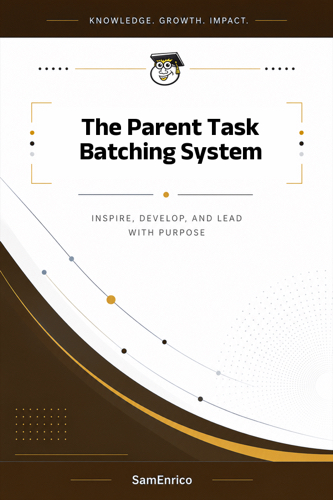
The Parent Task Batching System eBook
Groups similar chores like calls, emails, and bill
by Pitts Maida
Groups similar chores like calls, emails, and bills.
Formats
Free sample
Chapter 1: The Popcorn Parent--–- You check your email while stirring macaroni. You sign a permission slip while waiting for a conference call to start. You pay a bill while helping with spelling words. You unload the dishwasher while listening to a voicemail from the pediatrician. Then you walk into the kitchen, open the refrigerator, and have absolutely no idea why you are standing there.This is not a failure of character.
This is not laziness, forgetfulness, or a sign that you are somehow less capable than the parents who seem to have everything under control. This is a structural problem. And like most structural problems, it has been hiding in plain sight, disguised as normal life.You are a Popcorn Parent.The term describes exactly what it sounds like: the constant, explosive, unpredictable popping of attention from one task to another, never staying in one place long enough to finish anything before jumping to the next hot kernel. Popcorn parents do not lack hours in the day. They lack continuity.
They lack the ability to stay in a single cognitive mode long enough to complete a sequence of related tasks. And they pay for this fragmentation with something far more valuable than time: they pay with their attention, their patience, and their sense of being present in their own lives.This chapter will show you why task-switching is secretly exhausting you more than any to-do list ever could. You will learn about a hidden cost called attention residue, take a diagnostic quiz to measure your own Popcorn Parent score, and discover the single most important shift in thinking that will make the rest of this book possible. By the end, you will understand that the problem is not your motivation, your organization skills, or your willpower. The problem is that you have been trained to believe that doing a little bit of everything all the time is normal.
It is not. And you can stop.The Myth of the Busy Parent For decades, parenting advice has been built on a foundation of admirable but fundamentally broken assumptions. The first broken assumption is that you need better systems. Buy the right planner. Download the right app.
Color-code your calendar. The second broken assumption is that you need more discipline. Wake up earlier. Go to bed later. Just push through.
The third broken assumption, the most insidious one, is that feeling constantly overwhelmed is simply the price of being a good parent.None of these assumptions are true. The parents who seem to have it together do not have better systems or more discipline. They have not made a secret bargain with exhaustion. What they have is something far simpler and far more difficult to achieve in a culture that rewards busyness: they have learned to protect their attention.Here is what the research actually shows. The average parent switches between tasks every two to three minutes.
That is not a guess. That is data from time-use studies tracking parents across normal days. Every two to three minutes, a parent interrupts one thing to do another thing. And every time they do, they leave behind a residue of attention that makes the next task harder.Consider a typical morning. You pour cereal, then check your phone for a work email.
You answer the email, then notice the laundry is finished. You move the laundry to the dryer, then your child asks for help with a shoe. You tie the shoe, then remember you forgot to sign the permission slip. You sign the permission slip, then the phone rings. By the time you sit down to actually start your workday, you have switched tasks seven or eight times in less than thirty minutes.
You have accomplished almost nothing measurable. And you are already exhausted.This is not a time management problem. This is an attention management problem. And the solution is not to do more things faster. The solution is to stop switching.Attention Residue: The Hidden Tax on Your Brain In the early 2000s, researchers at the University of Michigan made a discovery that should have changed the way we think about work and parenting.
They asked people to perform a series of cognitive tasks, but they interrupted some people in the middle and made them switch to a different type of task before returning to the original one. The results were striking. People who were interrupted and forced to switch performed significantly worse on both tasks. But the most important finding was not about performance. It was about what happened inside the brain.When you switch from Task A to Task B, your brain does not immediately let go of Task A.
A residual portion of your attention remains stuck on the first task, even as you try to focus on the second. This is called attention residue. It is the cognitive equivalent of a dropped call that stays connected in the background, consuming bandwidth and creating static. The more interesting or demanding Task A was, the more residue it leaves behind. And the more residue you carry, the worse you perform on Task B.For parents, attention residue is catastrophic.
Because parents do not switch tasks twice an hour. They switch tasks every two to three minutes. Each switch leaves a small residue. Those residues accumulate. By mid-afternoon, your brain is carrying the ghost of twenty different unfinished tasks, each one pulling a tiny thread of your attention away from whatever you are trying to do right now.This explains a common experience that has no name until now.
You are playing with your child, but part of you is thinking about the work email you did not finish. You are cooking dinner, but part of you is worrying about the permission slip you have not signed. You are lying in bed, but your mind is scrolling through the bills you need to pay. You are never fully present because your attention is always split between the task in front of you and the residue of the tasks you left behind.Attention residue is not a personality flaw. It is a neurological fact.
And the only way to reduce it is to stop switching. You cannot willpower your way out of residue. You cannot meditate it away. You cannot outsource it to an app. You can only reduce the number of times you switch.
Every switch costs you. Every time you group similar tasks together, you save.The Six-Hundred-Dollar Hour Most parents have no idea how much task-switching actually costs them. They assume that answering one quick email while stirring the pasta takes no additional time because they were standing there anyway. This assumption is catastrophically wrong.Let us do the math together. Research on attention residue suggests that each switch between unrelated tasks costs about twenty minutes of lost focus.
Not lost time. Lost focus. The clock keeps ticking. You are still moving. But your cognitive efficiency drops dramatically for the next twenty minutes because your brain is still partially occupied with the previous task.If you switch tasks ten times in a day—and most parents switch far more often than that—you are losing more than three hours of…
This is the end of the free sample. Get the eBook to keep going. Buy now
About this book
Details
- Author
- Pitts Maida
- Publisher
- SamEnrico
- Language
- English
- Genre
- Non-Fiction, Self-Help, Task Management
- Released
- 2026-06-06
- Pages (approx.)
- 147
- Available as
- eBook, Audiobook

Read better in the ZLOADR app
Your eBooks on your phone or tablet. Sign in with your SamEnrico account and start reading.
More by Pitts Maida
 The Letting Go BreathworkPitts Maida$11.99
 Attempt Survivor Sibling LossPitts Maida$11.99
 Alcohol Sleep Recovery GuidePitts Maida$11.99
 The Pain And Dignity MeditationPitts Maida$11.99
 How to Become a Compounder HelperPitts Maida$11.99
 Project SurveyorPitts Maida$11.99
 Honda Manufacturing SWOTPitts Maida$12.99
 College Essay Feedback SystemPitts Maida$12.99
 Understanding Nivelon–nivelon–mabille SyndromePitts Maida$17.99
You may also like
 To Do List Overhaul GuideGerman Bernetta$11.99
 Multitasking Myth Recovery GuideJasper Faustino$11.99
 Task List Daily ReviewChristy Wilda$11.99
 Task Batching Time Management GuideMarquis Karan$11.99
 Remote Task Batching GuideEscamilla Amada$11.99
 ABCDE Method Task RankingFelton Viki$11.99
 ABCDE Method Priority SystemKowalski Shena$11.99
 Burnout Prevention Task RotationBranch Josette$11.99
 Task Batching Strategies CourseYamamoto Leann$11.99
 Interruption Proof To-Do List GuideBennett Ginger$11.99
 ABC Prioritization RulesGuillen Stevie$11.99
 Loci Method For To Do ListsMasters Elvera$11.99