
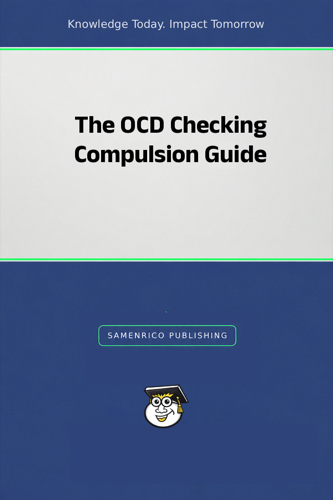
The OCD Checking Compulsion Guide eBook
Repeatedly verifying locks, appliances, or safety.
by Wagner Jody
Repeatedly verifying locks, appliances, or safety.
Formats
Free sample
Chapter 1: The Seventh Pull...--–- You are standing in front of your own front door. Your hand is wrapped around the cold metal handle. You have already locked it. You know you have locked it. You remember inserting the key, feeling the satisfying resistance of the bolt sliding home, hearing that unmistakable click that signals safety.
And yet, here you are, pulling on the handle for the seventh time. Your partner is sitting in the running car, engine idling, watching you through the windshield with a mixture of patience and exhaustion that you have learned to read all too well. The neighbor across the street has paused their gardening and is now openly staring. Your coffee, sitting in the car's cup holder, has gone cold. You are going to be late for work again.
Your knuckles are white from gripping the handle. Your chest feels tight, compressed by an invisible vise. Sweat gathers at your temples despite the cool morning air. And circling through your mind, over and over, like a trapped bird beating against the walls of a cage, is not the question "Is the door locked?" You already know the answer to that question with the same certainty you know your own name. The thought burrowing into your brain is something far more insidious, far more corrosive: "But am I absolutely, positively, one-hundred-percent certain that I know?"This is not a moment of genuine safety concern.
You are not a careless person who frequently leaves doors unlocked. In fact, you are the opposite. You are meticulously careful. You have never, in your entire adult life, left this door unlocked overnight or unattended. The evidence of your own memory—the sight of the key turning, the sound of the bolt, the feel of the metal under your fingers—should be more than sufficient for any reasonable person.
But it is not sufficient for you. Not because you are unreasonable. Not because you are weak. But because you are not suffering from a memory problem. You are suffering from a certainty problem.
And the cruelest irony of this particular disorder, the detail that makes it feel like a carefully designed trap, is that the more you check, the less certain you become.Welcome to the "Doubting Disease." This is what clinicians call the specific subtype of Obsessive-Compulsive Disorder that attacks your confidence in your own past actions with surgical precision. Unlike the popular image of OCD that dominates movies and television—the germophobe who cannot touch a doorknob, the symmetry-seeker who must align every object on a desk, the counter who taps light switches in patterns of three—the checker looks perfectly normal from the outside. You do not have raw, bleeding hands. You do not perform elaborate rituals in public. You do not wear gloves or carry hand sanitizer.
You simply... check. One more time. Just to be absolutely sure. And then again.
And again. Each check feels like the responsible thing to do, the prudent choice, the action of someone who cares about safety and refuses to be careless. Each check feels like the last one you will ever need, the final verification that will finally silence the doubt. And yet, the checks accumulate like compound interest. Hours disappear into the void of repetition.
Relationships strain under the weight of shared lateness and unspoken frustration. And the quiet, humiliating question follows you everywhere you go, whispering in your ear at the most inconvenient moments: Why can't I just trust myself? What is wrong with me?The answer, as this chapter will reveal with clarity and compassion, is not that you are broken, weak, lazy, or morally deficient. The answer lies in the specific way that OCD hijacks the brain's "memory confidence" system—a sophisticated neural mechanism that most people never even know exists until it breaks. By the end of this chapter, you will understand exactly what the Doubting Disease is, how to distinguish it from normal caution with surgical precision, why your repeated checking has actually made your memory worse (yes, worse—this is not your imagination), and how to take the first brave step toward reclaiming your time, your relationships, and your fundamental trust in yourself.The Spectrum of Caution: Where Do You Fall?Every human being on this planet checks things.
This is not a disorder. This is not a flaw. This is normal, adaptive, and often necessary for survival. Before we can understand the disorder, we must first map the territory of normal checking behavior and identify precisely where you fall on that spectrum.Normal Checking looks like this: You lock your front door. You pull the handle once—maybe twice if you were distracted by a phone call or a crying child—and you feel a distinct sense of closure.
Your brain registers the action as complete. You walk to your car. If, halfway down the street, a sudden thought pops into your head ("Wait, did I actually lock it, or did I just think about locking it?"), you might briefly experience a flicker of doubt. This is normal. But then you pause.
You mentally replay the action. You recall the feel of the key in your hand, the resistance of the lock, the sound of the bolt. You conclude, with reasonable confidence, "Yes, I definitely locked it." The doubt fades within seconds, often before you have taken another five steps. You continue with your day. You do not turn around.
You do not go back. The total time spent on the entire process of locking and verifying is under ten seconds. This is normal caution. This is how human beings have functioned for millennia.Heightened Caution might occur after a specific, identifiable trigger. Perhaps your home was burgled last year, and the memory still carries emotional weight.
Perhaps a neighbor posted on social media about a break-in on your street, and the sense of threat feels immediate. Perhaps you recently watched a true crime documentary that left you feeling vulnerable. In these cases, you might check the door two or three times. You might take a photo of the locked door for a few days. You might ask your partner to double-check before bed.
This is still within the range of normal reactive caution—a temporary increase in vigilance in response to a real or perceived threat in the environment. Importantly, this heightened caution diminishes over time as the threat fades from memory and the brain recalibrates to baseline. It does not expand to new targets (from the front door to the back door to the windows to the garage). It does not consume hours of your day. It does not persist for months or years after the triggering event has passed.Clinical OCD Checking is fundamentally different in three measurable ways: frequency, distress, and spread.
Clinical checking is not a response to a real threat in the external world; it is a response to an internal feeling of doubt that exists independently of any evidence. The clinical checker does not check because the lock feels loose or because there was a recent burglary in the neighborhood or because the door looks different than usual. The clinical checker checks because the…
This is the end of the free sample. Get the eBook to keep going. Buy now
About this book
Details
- Author
- Wagner Jody
- Publisher
- SamEnrico
- Language
- English
- Genre
- Non-Fiction, Health & Wellness, OCD
- Released
- 2026-06-06
- Pages (approx.)
- 141
- Available as
- eBook, Audiobook

Read better in the ZLOADR app
Your eBooks on your phone or tablet. Sign in with your SamEnrico account and start reading.
More by Wagner Jody
 Choral Conductor Vocal WisdomWagner Jody$11.99
 HIIT For Seniors Safe GuideWagner Jody$11.99
 Sleep Coach MeditationWagner Jody$11.99
 Assertiveness with In Laws GuideWagner Jody$11.99
 Spice and Steel: The Portuguese Struggle for the MoluccasWagner Jody$11.99
 Go to Market Strategy ManagerWagner Jody$11.99
 How to Start a Hobby in AikidoWagner Jody$11.99
 Social Network Free to PaidWagner Jody$12.99
 Customer Success Team GuideWagner Jody$12.99
 The Breeder's Guide to Hamburg ChickensWagner Jody$11.99
You may also like
 The OCD Family Support GuideDukes Pok$11.99
 The Postpartum OCD GuideMallory Earlie$11.99
 Gut Brain Axis and OCDLandis Cara$11.99
 Bipolar And OCD ComorbidityHardesty Jay$11.99
 The OCD Mental Ritual GuideEscobedo Deirdre$11.99
 The OCD Intrusive Thoughts GuideSkidmore Giuseppe$11.99
 The OCD ERP Therapy GuideRector Brook$11.99
 The OCD Contamination Fear GuideCharles Torri$11.99
 Postpartum OCD SignsNeedham Wilford$11.99
 The OCD Symmetry and Ordering GuideJay Ninfa$11.99
 The OCD Relationship GuideHerron Shanika$11.99
 The OCD Perinatal GuideMcfarlane Melina$11.99