
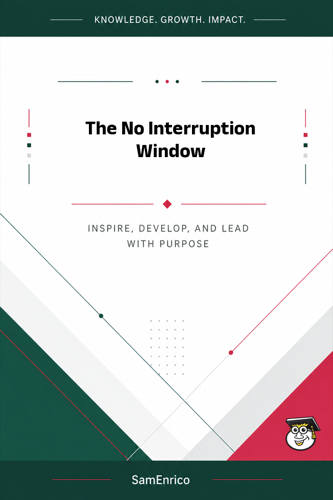
Non-FictionSelf-HelpScheduling
The No Interruption Window eBook
Negotiates and schedules a recurring 90-minute pro
Negotiates and schedules a recurring 90-minute protected block with team and family.
Formats
Free sample
Chapter 1: The Fragmented Mind--–- Sarah’s Tuesday had started like any other. By 7:45 AM, she had already answered fourteen emails, replied to six Slack messages, and reviewed a document her team needed by noon. She was proud of this responsiveness. In fact, she considered it her superpower. While other product managers let things slip, Sarah was known as the person who always got back to you within minutes.
Her boss called her “reliable.” Her colleagues said she was “on top of everything.”Then, at 8:15 PM that same evening, her eight-year-old daughter, Mia, asked a question that stopped her cold.They were sitting on the couch. Mia was showing Sarah a drawing she had made at school—a colorful sketch of their family standing in front of their house. Sarah was holding her phone in her right hand, scanning a thread about a delayed software release. She had not actually looked at the drawing. She had nodded, said “That’s nice, honey,” and kept scrolling.Mia tugged her sleeve.
“Mom.”“One second,” Sarah said, finishing a sentence in her reply.“Mom.” Louder this time.Sarah looked up. Mia’s lower lip was trembling. “Why do you look at your phone more than you look at me?”The room went quiet. Sarah opened her mouth to say something—maybe “That’s not true” or “I’m working hard for our family”—but the words didn’t come. Because she knew, in that gut-level way that bypasses all self-deception, that Mia was right.
She could not remember a single detail from the bedtime conversation they had shared fifteen minutes earlier. She could not recall the last time she had looked at Mia’s face for more than a few seconds without her phone buzzing, lighting up, or vibrating in her peripheral vision.She set the phone down. Face down. On the cushion beside her. “You’re right,” she said softly.
“I’m sorry. Show me the drawing again.”Mia did. And for three whole minutes—Sarah counted—she looked at nothing but her daughter’s art and her daughter’s face. No phantom buzzes. No mental to-do lists.
Just presence.Those three minutes felt like a vacation.Then the phone buzzed again. And Sarah picked it up.The Lie We Have Been Sold This book is not a manifesto against technology. It is not a call to throw your smartphone into the ocean and move to a cabin in the woods. Sarah does not need to abandon her career or stop using Slack. Neither do you.What Sarah—and what you—need is something far more practical, far more achievable, and far more radical than digital detoxes or weekend retreats.You need a weapon against fragmentation.The lie we have been sold is that responsiveness equals reliability.
We have been taught that answering emails within minutes makes us heroes, that replying to Slack messages at 9 PM shows dedication, that being “always on” is a badge of honor. This myth accelerated during the early 2010s “hustle culture” movement, when founders bragged about four hours of sleep and employees wore their burnout like a medal. Then remote work arrived, and the expectation became even worse. Without physical offices to contain work, the boundaries dissolved entirely. Now, the ping can come at any hour.
And we answer. Because we have been trained to believe that speed is virtue.It is not. It is theft.The late 2010s and early 2020s saw a flood of research on what happens to the human brain when it is constantly interrupted. The results are unequivocal: constant task-switching does not make you more productive. It makes you slower, more error-prone, and less creative.
Yet most knowledge workers continue to operate as if every notification is an emergency. They have confused motion with progress. They have confused availability with effectiveness.This chapter will name the enemy. It will give you a single, shocking number that will change how you see every interruption. And it will introduce the core promise of this entire book: that you can build a protected, recurring 90-minute window of deep focus—without losing your job, alienating your team, or disappointing your family.But first, you have to understand what constant interruption is actually doing to you.The Twenty-Minute Heist Let us begin with the most important research finding in this entire book.Dr.
Gloria Mark, a professor at the University of California, Irvine, has spent decades studying how people work in real-world environments. Her team observed employees in their natural habitats—cubicles, open offices, and later, home offices—and tracked every single interruption. They measured how long it took people to return to their original task after being interrupted. The results were published in peer-reviewed journals and have been replicated across multiple industries.Here is the finding: after a single interruption—a ping, a knock, a phone buzz, a colleague tapping your shoulder—it takes an average of twenty minutes to return to the original depth of focus. Twenty minutes.Let that land.An interruption does not just steal the five seconds you spend glancing at the notification.
It does not just steal the two minutes you spend replying. It steals the entire cognitive ramp-up time required to re-enter deep focus. Your brain does not have a pause button. When you are pulled away, your working memory flushes. Your train of thought derails.
The contextual cues that told your brain “I am solving Problem X” dissipate. To get back to where you were, you have to reload everything—usually by retracing your mental steps, re-reading the last few paragraphs, or re-examining the data you were analyzing.Twenty minutes. This is the standard figure used throughout this book. (Research ranges from 20 to 25 minutes depending on task complexity and individual differences; we use 20 minutes as a consistent, conservative estimate.) Now do the math.If you have four interruptions in a 90-minute block of time—which is fewer than one interruption every twenty-two minutes—you lose eighty minutes of cognitive potential. That is nearly the entire block.
You have essentially worked for ninety minutes while achieving almost nothing that requires deep thought. You have been busy. You have been responsive. But you have not been effective.This is the Twenty-Minute Heist. And it is happening to you every single day.Sarah, our product manager from the opening, was interrupted an average of nine times per hour during her workday.
That is one interruption every six to seven minutes. By her own estimate, she lost over three hours of cognitive recovery time every single day. She felt exhausted at 5 PM not because she had done a lot of work, but because she had switched tasks so many times that her brain was operating like a computer with thirty browser tabs open—slow, hot, and on the verge of crashing.The Three Costs of Constant Interruption The Twenty-Minute Heist is not the only cost. Interruptions exact a toll on your cognition, your emotions, and your relationships. Understanding these three costs will give you the motivation to fight for your No Interruption Window.Cognitive Cost: The Error Multiplier When you task-switch, you do not just lose time.
You lose accuracy.Research on multitasking has consistently shown that humans are terrible at doing two cognitive tasks at once. What…
This is the end of the free sample. Get the eBook to keep going. Buy now
About this book
Details
- Author
- Simmons Percy
- Publisher
- SamEnrico
- Language
- English
- Genre
- Non-Fiction, Self-Help, Scheduling
- Released
- 2026-06-09
- Pages (approx.)
- 147
- Available as
- eBook, Audiobook

Read better in the ZLOADR app
Your eBooks on your phone or tablet. Sign in with your SamEnrico account and start reading.
More by Simmons Percy
 Sleep Inducing Affirmations CourseSimmons Percy$11.99
 Growth Hormone and Joint HealthSimmons Percy$11.99
 Norwegian Telemark Heavy WaterSimmons Percy$11.99
 Goal Rewards SystemSimmons Percy$11.99
 Burnout Recovery Cold ExposureSimmons Percy$11.99
 Language Goal SettingSimmons Percy$11.99
 Grief and Books After Child LossSimmons Percy$11.99
 Love and Gunpowder: The Forbidden Romance of the Russo-Japanese WarSimmons Percy$11.99
 Chu-Han Contention: The War That Forged an EmpireSimmons Percy$11.99
 How to Produce Wireless NetworkingSimmons Percy$11.99
 Growing AeschynanthusSimmons Percy$11.99
 A Collector's Handbook to the Oldsmobile Six (1938-39)Simmons Percy$11.99
You may also like
 Hong Kong Handover 1997Dunn Johnnie$11.99
 Zumba For Postnatal Recovery CourseNeal Christian$11.99
 Zumba for BeginnersLadner Nikia$11.99
 YouTube Comment Mining GuideHumes Pandora$12.99
 Worry Box MeditationCarlin Rudy$11.99
 Workplace Stress MeditationNguyen Lynn$11.99
 Workplace Stress and Sleep RepairHawley Ivory$11.99
 Workplace Perfectionism CureDelaney Jeffry$11.99
 Workplace Injustice Anger GuideWallen Isabelle$11.99
 Work Addiction and Burnout LinkGreenwood Ester$11.99
 Women in Yoga and WellnessBeattie Galina$11.99
 Women in Stand Up ComedyChun Evangeline$11.99