
Non-FictionSelf-HelpTime Boxing
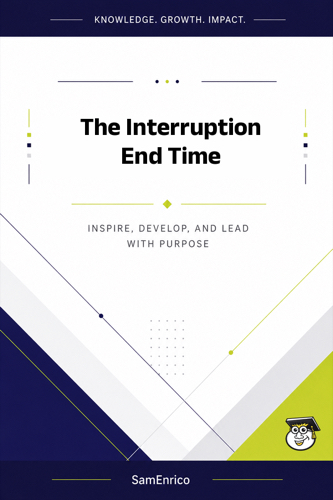
The Interruption End Time eBook
Communicates firm end time for all interruptions b
by Stahl Yen
Communicates firm end time for all interruptions before starting new task.
Formats
Free sample
Chapter 1: The Twenty-Three Minute Ghost--It was 10:14 on a Tuesday morning when Sarah lost $40,000.Not in a single dramatic moment—no crashing servers, no screaming clients, no apocalyptic email from the CEO. She lost it in seventeen separate "quick looks" across three hours. A Slack message here. A colleague tapping her shoulder there. A five-second glance at a phone notification.
Seventeen interruptions, none lasting longer than ninety seconds. By 1:47 PM, her client proposal was still unfinished, her focus was shattered, and the deadline she had promised—the one tied to a $40,000 contract renewal—had come and gone."I was working," she told me later. "I was busy all morning. I just wasn't finishing anything."Sarah is not lazy. She is not disorganized.
She is not addicted to her phone in the way that term usually means. Sarah is a senior designer at a mid-sized creative agency, she is exceptionally good at her job, and she has exactly the same problem you have: she believes, with all her heart, that a quick look costs nothing.This belief is wrong. And it is costing you more than you know.The Most Expensive Lie We Tell Ourselves Let me state the central problem of this book as directly as possible: An interruption is not a break. It is a contract with an invisible expiration date.When you say "sure, what's up?" to a colleague, you have just signed a contract that says "I will give you my attention indefinitely, with no specified end point, and I will pay the cognitive price of switching tasks without knowing when I will return." When you glance at your phone "just for a second," you have signed the same contract with yourself. And like most contracts signed without reading the fine print, the terms are terrible for you.The fine print is called attention residue, and it is one of the most rigorously documented phenomena in the psychology of work.
First named by researcher Sophie Leroy in her 2009 study "Why Is It So Hard to Do My Work?", attention residue describes what happens when you switch from Task A to Task B: a portion of your cognitive capacity remains stuck on Task A, like a phantom limb of focus. Even after you have physically stopped working on Task A, your brain continues to process it, evaluate it, and worry about it. This residue reduces your performance on Task B by as much as 40 percent.Here is what that looks like in real life. You are writing a report. A Slack message arrives.
You tell yourself, "I'll just see who it's from." That glance takes two seconds. But when you return to your report, you are not fully back. Your brain is still holding the open loop of that message—who sent it, what it might say, whether it requires a response. Even if you decide not to open it, the residue remains. You type more slowly.
You make more errors. You lose your chain of reasoning.Now multiply that by seventeen times, as Sarah did. Seventeen residues, each clinging to your cognitive engine like barnacles to a ship. By the eleventh interruption, you are not working at 60 percent capacity. You are working at something closer to 20 percent, but you cannot feel the drag because it has become your normal.The most chilling part of the research: subjects in these studies consistently overestimate their performance after interruptions.
They report feeling "mostly focused" when objective measures show they are operating at half capacity. The interruption tax is invisible, which is why we keep paying it.The Twenty-Three Minute Ghost Let me give you a number that will change how you see every "quick look" for the rest of your life: 23 minutes and 15 seconds.That is the average time required to fully return to a state of deep focus after a single interruption. Not the time to resume typing—the time for your brain to reach the same level of cognitive immersion you had before the interruption. The research, compiled by Gloria Mark at the University of California, Irvine, tracked knowledge workers in real-world environments and found that even brief interruptions create a recovery period that far exceeds the interruption itself.Consider what this means. A thirty-second interruption costs twenty-three minutes.
The ratio is 46 to 1. For every minute someone steals from you, they are actually stealing forty-six. This is not a rounding error. This is the difference between finishing your work at 4 PM and finishing it at 7 PM while feeling twice as exhausted.I call this the Twenty-Three Minute Ghost because it haunts every workspace, every home office, every kitchen table where someone is trying to think. The ghost is invisible.
You cannot see it. You cannot feel it dragging on your sleeve. But it is always there, growing heavier with every "quick look," every "one sec," every "I'll just answer this real quick."The ghost is why Sarah lost $40,000. Not because she was slow or stupid or unfocused. Because she was haunted seventeen times in one morning, and she never even knew it.The Second Cost You Cannot See Attention residue is one half of the problem.
The other half is something David Allen, the author of Getting Things Done, calls open loops. An open loop is any unfinished commitment that your brain is trying to track subconsciously. An unanswered email. A promised call. A question from a colleague that you said you would look into.
A task you told yourself you would do "later" without specifying when.Open loops are not interruptions themselves. They are the result of interruptions that you never properly closed. When you say "I'll deal with this later" without scheduling a specific time, you create a psychic drag that reduces your working memory by up to 40 percent, according to research on cognitive load theory. Your brain, which is a remarkably loyal servant, keeps trying to close those loops in the background. It reminds you.
It worries. It checks.This is why you can finish a full day of work, close your laptop, and still feel unsettled. Your conscious mind is done, but your subconscious is still running through the list of open loops: Did I respond to that client? When was I supposed to call the contractor? What was that thing my boss asked me to look up?The cruel irony is that most open loops are created by the very interruptions we accept in the name of responsiveness.
You stop writing your report to answer a colleague's question. You give a partial answer. You say "I'll send you the full data later." That "later" is an open loop. It now lives in your brain, not theirs. You have taken their interruption and turned it into your homework.The Difference Between Busy and Effective Let me ask you a question that will sting: When was the last time you finished your most important task of the day before 11 AM?Not the most urgent task.
Not the one that was due at 10 AM and you scrambled to complete. The most important task—the one that moves your long-term goals forward, the one that only you can do, the one that, if done well, makes everything else…
This is the end of the free sample. Get the eBook to keep going. Buy now
About this book
Details
- Author
- Stahl Yen
- Publisher
- SamEnrico
- Language
- English
- Genre
- Non-Fiction, Self-Help, Time Boxing
- Released
- 2026-06-09
- Pages (approx.)
- 126
- Available as
- eBook, Audiobook

Read better in the ZLOADR app
Your eBooks on your phone or tablet. Sign in with your SamEnrico account and start reading.
More by Stahl Yen
 Empathy For Yourself NVC GuideStahl Yen$11.99
 The Workaholic's Social RecoveryStahl Yen$11.99
 The Koresh ChildrenStahl Yen$11.99
 LGBTQ Workplace Self EsteemStahl Yen$11.99
 Cash Flow for AgenciesStahl Yen$11.99
 Teresa's TransverberationStahl Yen$11.99
 Sustainable Success Anti Burnout GuideStahl Yen$11.99
 Tornado Basement SurvivorStahl Yen$11.99
 The Wyvern’s Bargain: A Beast’s Last Stand in the Black ForestStahl Yen$11.99
 The Jaguar Warriors of the Olmec: Masters of the Mesoamerican BattlefieldStahl Yen$11.99
 Operation Fast and Furious: The Cartel's Secret WeaponStahl Yen$11.99
 Growing Origanum (Marjoram, Oregano)Stahl Yen$11.99
You may also like
 Hong Kong Handover 1997Dunn Johnnie$11.99
 Zumba For Postnatal Recovery CourseNeal Christian$11.99
 Zumba for BeginnersLadner Nikia$11.99
 YouTube Comment Mining GuideHumes Pandora$12.99
 Worry Box MeditationCarlin Rudy$11.99
 Workplace Stress MeditationNguyen Lynn$11.99
 Workplace Stress and Sleep RepairHawley Ivory$11.99
 Workplace Perfectionism CureDelaney Jeffry$11.99
 Workplace Injustice Anger GuideWallen Isabelle$11.99
 Work Addiction and Burnout LinkGreenwood Ester$11.99
 Women in Yoga and WellnessBeattie Galina$11.99
 Women in Stand Up ComedyChun Evangeline$11.99