
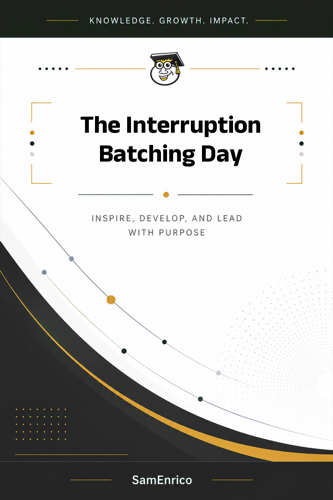
Non-FictionSelf-HelpWeekly Planning
The Interruption Batching Day eBook
Designates one day weekly for all interruptions, l
by Culver Chong
Designates one day weekly for all interruptions, leaving other days for deep work.
Formats
Free sample
Chapter 1: The Attention Tax--–- The email arrived at 9:14 AM. By 9:17, Sarah had already switched tasks four times. She was drafting a quarterly report when a Slack message pinged. She answered it. Then her phone buzzed with a text from her boss.
She replied. Then she remembered she hadn't checked the sales dashboard. She opened it. Then the email notification popped up again. She clicked it.
By 9:22, she had accomplished nothing of substance. She felt exhausted. She felt busy. She felt, in some strange way, like a hero—juggling, multitasking, holding it all together.But she was not a hero. She was a victim of a lie.The Most Expensive Lie in the Modern Workplace For the past thirty years, knowledge workers have been sold a seductive story: that the ability to handle multiple things at once is a skill, a competitive advantage, a mark of high performance.
We have glorified the person who can answer emails while sitting in a meeting while chatting on Slack while eating lunch. We have rewarded the colleague who replies fastest, who is always online, who never lets a notification go unanswered.This story is wrong. It is not merely inaccurate—it is dangerously, expensively wrong.The research is unequivocal: what we call multitasking is a myth. The human brain cannot process two attention-requiring tasks simultaneously. What we are actually doing is rapid task-switching, and each switch carries a cost.
A cognitive tax. A hidden drain on our mental resources that accumulates over hours, days, and years.This chapter will introduce you to that tax. You will learn its name, its mechanism, and its true cost. You will learn why the busiest people in your office are often the least productive. And you will learn the first step toward escaping the trap: understanding exactly what is stealing your attention.By the end of this chapter, you will never look at your inbox the same way again.The Science of Attention Residue In 2005, a University of Washington researcher named Sophie Leroy made a breakthrough discovery that would reshape how we understand productivity.
Leroy was studying how people transition between tasks—specifically, what happens to the brain when it leaves one task unfinished and starts another.Her findings were startling.Leroy discovered that when you switch from Task A to Task B, your brain does not fully disengage from Task A. A portion of your cognitive capacity remains tied up in the previous task, still processing it, still worrying about it, still holding it in working memory. She called this phenomenon attention residue.The more incomplete Task A is, the stronger the residue. The more cognitively demanding Task A is, the stickier the residue. And the more frequently you switch, the more residue accumulates—like static electricity building up on a surface until it interferes with everything it touches.In her landmark study, Leroy found that people who switched tasks before completing their first task performed significantly worse on the second task—not because they lacked skill, but because their brains were still partially occupied by the ghost of the first task.Let me say that again: your brain continues to work on a task you have already stopped doing.This is not a metaphor.
This is measurable brain activity. Functional MRI studies show that the neural networks associated with an incomplete task remain active even when you have consciously shifted your attention elsewhere. Your brain is literally multitasking against your will.The IQ Drop No One Talks About The cost of attention residue is not theoretical. It has been quantified.In a series of studies conducted at the University of London, researchers found that subjects who attempted to multitask while performing cognitive tasks experienced IQ drops comparable to staying up all night or smoking marijuana. The average drop was 10 points.
For context, a 10-point IQ drop is the difference between being in the top 30 percent of the population and the top 60 percent.Think about that. Checking your email while working on a report does not make you slightly less effective. It makes you cognitively impaired. It is the equivalent of showing up to work after a sleepless night and expecting to perform at your best.Gloria Mark, a professor at the University of California, Irvine, has spent decades studying attention in the workplace. Her research reveals a devastating pattern: the average knowledge worker switches tasks every eleven minutes.
And once interrupted, it takes an average of twenty-three minutes to fully return to the original task.Let me translate those numbers into real life.If you are interrupted at 9:00 AM, you will not be fully back on track until 9:23 AM. If you are interrupted again at 9:34 AM, you will not be fully back until 9:57 AM. By noon, you have spent more time recovering from interruptions than actually working. By 5 PM, you have lost nearly three hours of cognitive capacity—not to the interruptions themselves, but to the residue they leave behind.This is the hidden math of the modern workplace. And it is brutal.Introducing the Disruption Taxonomy Before we go any further, we need to be precise about what we are talking about.
The word "interruption" has become so overused that it has lost its meaning. Is a scheduled meeting an interruption? Is checking your email an interruption? Is your phone buzzing with a news alert an interruption?To build a system that actually works, we need clarity. So let me introduce a taxonomy that will guide this entire book.
Every disruption to your attention falls into one of two categories:Category One: Unexpected Interruptions These are unscheduled, uninvited disruptions initiated by external sources. A colleague tapping your shoulder. A Slack message marked "urgent." An email notification popping up while you are in flow. A phone call. A text message.
A fire alarm. A drive-by question at your desk.Unexpected interruptions are the most damaging because they are uncontrolled. You cannot predict them. You cannot prepare for them. They hijack your attention without warning, leaving residue that lingers long after the interruption itself has ended.Category Two: Expected Shallow Work These are low-cognitive-load tasks that you have committed to in advance.
Scheduled meetings. Email processing. Administrative work. Updating project management tools. Filing expenses.
Attending company-wide updates. Reviewing documents that require minimal thinking.Expected shallow work is less damaging than unexpected interruptions because you can predict and prepare for it. But it is still a disruption to deep work. It still fragments your attention. The difference is that you can control when it happens—if you have a system.Here is the crucial insight of this book: unexpected interruptions and expected shallow work are different problems that require different solutions.
But they share a common enemy: your attention. And they share a common solution: batching.You cannot eliminate unexpected interruptions entirely. But you can contain them. You cannot eliminate expected shallow work entirely. But you can schedule it.
The 4+1 system, introduced in Chapter 3, does both.The Busyness Trap There is a reason we have fallen for the multitasking myth. It is not because we are stupid or lazy. It is because the modern workplace has been optimized for visibility, not output.Let me explain.In most organizations…
This is the end of the free sample. Get the eBook to keep going. Buy now
About this book
Details
- Author
- Culver Chong
- Publisher
- SamEnrico
- Language
- English
- Genre
- Non-Fiction, Self-Help, Weekly Planning
- Released
- 2026-06-07
- Pages (approx.)
- 141
- Available as
- eBook, Audiobook

Read better in the ZLOADR app
Your eBooks on your phone or tablet. Sign in with your SamEnrico account and start reading.
More by Culver Chong
 Loneliness Senior Center GuideCulver Chong$11.99
 Preventing Parent BurnoutCulver Chong$11.99
 Vehicle Recurring Dream GuideCulver Chong$11.99
 Grandparent Self EsteemCulver Chong$11.99
 Hypnotic Calm InductionCulver Chong$11.99
 Talking About MoneyCulver Chong$11.99
 Unmaking The Antwerp ThievesCulver Chong$11.99
 The Sasquatch ConnectionCulver Chong$11.99
 The Last Message: The Enigma of the Wow! SignalCulver Chong$11.99
 The Fire Below: Harcourt and the Birth of Modern VolcanologyCulver Chong$11.99
 The Ballad of the Last Outlaw: The Untold Tale of Belle StarrCulver Chong$11.99
 Madrid Protocol Priority ClaimsCulver Chong$12.99
You may also like
 Hong Kong Handover 1997Dunn Johnnie$11.99
 Zumba For Postnatal Recovery CourseNeal Christian$11.99
 Zumba for BeginnersLadner Nikia$11.99
 YouTube Comment Mining GuideHumes Pandora$12.99
 Worry Box MeditationCarlin Rudy$11.99
 Workplace Stress MeditationNguyen Lynn$11.99
 Workplace Stress and Sleep RepairHawley Ivory$11.99
 Workplace Perfectionism CureDelaney Jeffry$11.99
 Workplace Injustice Anger GuideWallen Isabelle$11.99
 Work Addiction and Burnout LinkGreenwood Ester$11.99
 Women in Yoga and WellnessBeattie Galina$11.99
 Women in Stand Up ComedyChun Evangeline$11.99