
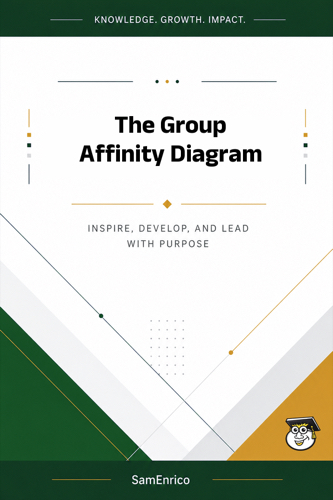
Non-FictionSelf-HelpData Synthesis
The Group Affinity Diagram
Organizes many ideas into thematic clusters for in
by Bottoms Dona
Organizes many ideas into thematic clusters for insight and action.
Formats
About this book
Free sample
Chapter 1: The $47,000 Hour--–- Megan had been staring at the same spreadsheet for three hours. Her team had generated 247 customer complaints, feature requests, and bug reports from their latest user study. The data sat in a sprawling Google Sheet—eighteen columns, twelve rows of color-coded priority rankings that nobody agreed on, and a “vote” column where the product team had arbitrarily assigned numbers based on who yelled loudest in the last meeting. Her boss, Daniel, had already sent three Slack messages asking for “the top five insights by end of day.” Megan had no idea what the top five were. Neither did anyone else.Forty-five feet away, in a cramped conference room on the other side of the building, a hardware engineer named Priya was experiencing the exact same problem.
Her team had just finished a post-mortem on a failed sensor module. Sixty-two people had submitted 400+ root cause hypotheses through an online form. The quality manager had printed them all out and taped them to the wall in chronological order—which meant the wall was just a long, sad timeline of complaints, not a structure. Priya’s boss wanted “clusters of issues” by the next morning. She had no idea how to turn four hundred sticky notes into anything coherent before the 9 a.m.
standup.Both Megan and Priya were suffering from the same modern organizational disease: data paralysis. They had plenty of information. They had motivated teams. They had urgent deadlines. What they didn’t have was a method for turning chaos into clarity—a way to let the data organize itself, rather than forcing it into preconceived categories that reflected politics, seniority, or last week’s arguments.This book is the cure.The $47,000 Hour: Why Your Meetings Are Bankrupting Your Company Let’s start with a provocative calculation.
The average product team of eight people, each earning a fully-loaded cost of $150,000 per year (salary, benefits, overhead, office space), costs approximately $600 per hour to run. A typical “brainstorm prioritization” meeting runs two hours. That’s $1,200 per meeting. Most teams run at least two such meetings per week.…
This is the end of the free sample. Get the eBook to keep going. Buy now
Contents
- Chapter 1
- Chapter 2
- Chapter 3
- Chapter 4
- Chapter 5
- Chapter 6
- Chapter 7
- Chapter 8
- Chapter 9
- Chapter 10
- Chapter 11
- Chapter 12
Details
- Author
- Bottoms Dona
- Publisher
- SamEnrico
- Language
- English
- Genre
- Non-Fiction, Self-Help, Data Synthesis
- Released
- 2026-06-09
- Pages (approx.)
- 135
- Available as
- eBook, Audiobook

Read better in the ZLOADR app
Your eBooks on your phone or tablet. Sign in with your SamEnrico account and start reading.
More by Bottoms Dona
 Insurance Payout Diamond HeistBottoms Dona$11.99
 Understanding Bipolar Spectrum ContinuumBottoms Dona$11.99
 Name Memory MethodBottoms Dona$11.99
 Gacy's Execution WitnessesBottoms Dona$11.99
 College Stress Relief HandbookBottoms Dona$11.99
 Retirement Assets ABLE AccountsBottoms Dona$11.99
 RLS Work AccommodationsBottoms Dona$11.99
 Birth Control PMS EffectsBottoms Dona$11.99
 The Architect of the Cosmos: Imhotep and the Birth of Egyptian ScienceBottoms Dona$11.99
 The Last Broadcast: How Radio Silence Shattered a NationBottoms Dona$11.99
 Echoes from the Edge: The Kitt Peak Telescope and the Cosmic Frontier (1980s-1990s)Bottoms Dona$11.99
 How to Become a Mine InspectorBottoms Dona$11.99
You may also like
 Hong Kong Handover 1997Dunn Johnnie$11.99
 Zumba For Postnatal Recovery CourseNeal Christian$11.99
 Zumba for BeginnersLadner Nikia$11.99
 YouTube Comment Mining GuideHumes Pandora$12.99
 Worry Box MeditationCarlin Rudy$11.99
 Workplace Stress MeditationNguyen Lynn$11.99
 Workplace Stress and Sleep RepairHawley Ivory$11.99
 Workplace Perfectionism CureDelaney Jeffry$11.99
 Workplace Injustice Anger GuideWallen Isabelle$11.99
 Work Addiction and Burnout LinkGreenwood Ester$11.99
 Women in Yoga and WellnessBeattie Galina$11.99
 Women in Stand Up ComedyChun Evangeline$11.99