
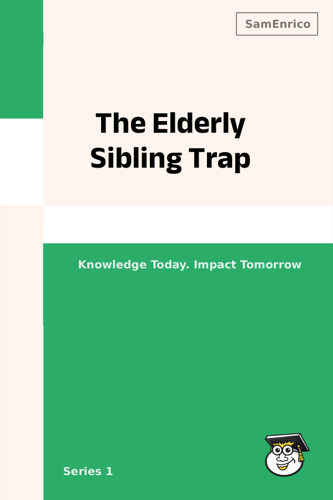
The Elderly Sibling Trap eBook
Caring for disabled sibling while being controlled
Caring for disabled sibling while being controlled by relative.
Formats
Free sample
Chapter 1: The Unspoken Contract...--–- The summer I turned twelve, my mother sat me down at the kitchen table, placed her hands over mine, and said, “You’re the responsible one. Your brother needs you. Promise me you’ll always look after him.” I promised. I was eating a peanut butter sandwich. I had a scraped knee from falling off my bike.
I did not know that I was signing a forty-year prison sentence with a single nod.This chapter is not about blame. It is about excavation. Beneath every exhausted elderly caregiver who resents a controlling relative lies a buried promise—made in childhood, reinforced through adolescence, and never renegotiated in adulthood. That promise is the foundation of the trap. If you do not understand how it was made, you cannot dismantle it.
You will spend the rest of your life trying to prove you are still “the good one,” while the controller uses your own virtue as a leash.The Anatomy of a Childhood Vow The promises that trap us are rarely spoken as legal contracts. They are whispered at funerals. They are shouted during arguments. They are implied in the way a parent looks at one child and not the other. In families with a disabled sibling, a specific ritual plays out with remarkable consistency across cultures, income levels, and generations.
One child—almost always a daughter, but sometimes a son—is singled out as “the one who will take care of things.”This is called parentification. It is a clinical term for a common family dysfunction: when a parent delegates adult responsibilities to a child. Not chores. Not occasional babysitting. But the emotional and logistical weight of caring for another human being, often for life.Parentification takes two forms.
Instrumental parentification is the visible work: changing diapers, preparing meals, missing school plays to stay home with a sibling who is having a seizure or a meltdown. Emotional parentification is the invisible work: being told “Don’t upset your brother,” “You know how he gets,” “You’re the only one he listens to.” The child learns that their own feelings are secondary. Their job is to regulate the disabled sibling’s environment and, by extension, the entire family’s peace.Consider the case of Elaine, now sixty-seven, who has cared for her younger brother David, now sixty-five, since she was fourteen. Their mother died when Elaine was twenty-two. On her deathbed, the mother said, “You won’t put him in a home, will you?” Elaine promised.
She has kept that promise for forty-five years. She has never married. She has no retirement savings. Her brother lives in her spare bedroom, and her older sister—who moved to Arizona at nineteen—calls every Sunday to tell Elaine she is doing it wrong.Elaine’s story is not unique. It is archetypal.
The promise was not a choice. It was a trap laid in the language of love.The Three Family Roles That Never Expire Family systems theory, developed by psychiatrist Murray Bowen, argues that families operate as emotional units. Each member is assigned a role that maintains the system’s equilibrium. When a disabled sibling is present, the roles become rigid and often persist for decades after the parents die.The Responsible One – This is you reading this book. You were told, explicitly or implicitly, that you are the capable one, the dependable one, the one who does not complain.
You were praised for your maturity as a child. That praise felt good. It was also a weapon. Because once you are the Responsible One, you cannot stop being responsible without becoming “selfish.” The controlling relative will use this against you forever. “You’ve always been so good with him.
What changed? Are you getting cold-hearted in your old age?”The Golden Child – This sibling is excused from duty. Often, they are the disabled sibling themselves, but not always. In families with one disabled child and two nondisabled children, the second nondisabled child is frequently anointed as the Golden Child—the one who will “go out and live a normal life.” They are told not to worry about the disabled sibling. They are encouraged to move away, pursue careers, have families.
They are never asked to change a diaper or attend a medical appointment. Later in life, this Golden Child often becomes the controller. They have no lived experience of caregiving, but they have strong opinions about how it should be done. Their moral authority comes from having been “the one who got out.”The Invisible Child – This sibling disengages entirely. They are not the Responsible One and not the Golden Child.
They simply disappear—emotionally, geographically, or both. They may send a card once a year. They do not answer when the controller calls to complain about you. Their absence is a form of permission for the controller to intensify pressure on you, because you are the only one left standing.These roles are not permanent because families choose them. They are permanent because families stop evolving after a certain point.
The parents die, but the roles live on. The Responsible One remains responsible. The Golden Child remains golden. The Invisible Child remains invisible. And the trap snaps shut.The Guilt Anchor: Why Your Best Quality Is Used Against You Here is the cruelest mechanism of the elderly sibling trap: the controlling relative uses your own goodness as a weapon.
They do not attack your weaknesses. They attack your strengths.Think about what makes you a good caregiver. You are patient. You are loyal. You keep promises.
You feel guilty when you let people down. You have spent decades proving that you are not selfish. Now, the controller says things like:“After everything your parents sacrificed, you’re really going to stop now?”“I always knew you were the one with the big heart. Don’t lose that now.”“Your brother loves you so much. Imagine how confused he would be if you weren’t there.”These are not compliments.
They are manipulations wrapped in flattery. The controller is not praising you. They are reminding you that your identity is bound up in being the Responsible One. If you step back, you are not just changing a care plan. You are becoming a different person.
And that is terrifying.This is called moral identity threat. Psychologists have found that people will endure extraordinary suffering to avoid contradicting a core self-concept. If you believe you are “a person who keeps promises,” breaking a promise—even a promise made under duress, even a promise made when you were twelve—feels like dying. The controller knows this. They do not need to threaten you.
They just need to remind you who you are.The Difference Between a Vow and a Coerced Obligation Let us be precise about language. A vow is a promise made freely, with full information, and with the opportunity to renegotiate or exit over time. A coerced obligation is a demand placed on a child or a vulnerable adult, enforced by guilt, and never revisited.The promise you made was almost certainly coerced. Consider these questions:Were you under eighteen when you first agreed to “always” care for your…
This is the end of the free sample. Get the eBook to keep going. Buy now
About this book
Details
- Author
- Ford Clifford
- Publisher
- SamEnrico
- Language
- English
- Genre
- Non-Fiction, True Crime, Family
- Released
- 2026-06-07
- Pages (approx.)
- 134
- Available as
- eBook, Audiobook

Read better in the ZLOADR app
Your eBooks on your phone or tablet. Sign in with your SamEnrico account and start reading.
More by Ford Clifford
 Receiving Empathy GuideFord Clifford$11.99
 Hackathon Planning Creativity GuideFord Clifford$11.99
 Migraine and Anxiety ConnectionFord Clifford$11.99
 Tribe Influencer StoryFord Clifford$11.99
 The Solar Panel ArrayFord Clifford$11.99
 The Fatigue Stress ConnectionFord Clifford$11.99
 Blue Zone Garden CultivationFord Clifford$11.99
 Pilot Nap Cockpit GuideFord Clifford$11.99
 The Star Chasers of the Nile: Ancient Egypt's Celestial NavigatorsFord Clifford$11.99
 The Last Broadcast of Radio Luxembourg: The Secret Cold War Signals That Never StoppedFord Clifford$11.99
 Crowns and Chaos: The Unlikely Reign of Queen LiliʻuokalaniFord Clifford$11.99
 The Mineral Guide to MiniumFord Clifford$11.99
You may also like
 Hong Kong Handover 1997Dunn Johnnie$11.99
 Zumba For Postnatal Recovery CourseNeal Christian$11.99
 Zumba for BeginnersLadner Nikia$11.99
 YouTube Comment Mining GuideHumes Pandora$12.99
 Worry Box MeditationCarlin Rudy$11.99
 Workplace Stress MeditationNguyen Lynn$11.99
 Workplace Stress and Sleep RepairHawley Ivory$11.99
 Workplace Perfectionism CureDelaney Jeffry$11.99
 Workplace Injustice Anger GuideWallen Isabelle$11.99
 Work Addiction and Burnout LinkGreenwood Ester$11.99
 Women in Yoga and WellnessBeattie Galina$11.99
 Women in Stand Up ComedyChun Evangeline$11.99