
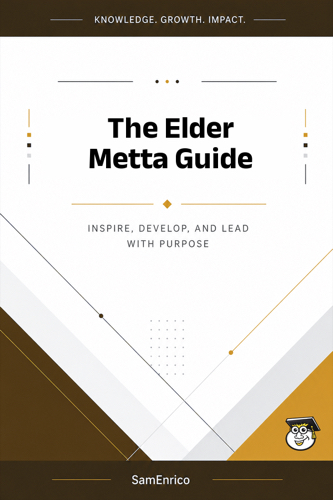
The Elder Metta Guide eBook
Adapt loving kindness practice for seniors with li
Adapt loving kindness practice for seniors with limited mobility.
Formats
Free sample
Chapter 1: The Cushionless Permission--–- Most meditation books begin with an image of a person sitting cross-legged on a round cushion, spine perfectly straight, hands resting on knees, eyes serenely closed. That image is a lie. Not a malicious lie, but a lie nonetheless. It excludes everyone whose body cannot fold itself into that shape—and that exclusion is particularly cruel for seniors, whose bodies have spent decades working, carrying children, digging gardens, walking miles, and eventually, simply enduring. If you cannot sit on a cushion without pain, the unspoken message of most meditation guides is clear: This practice is not for you.This book exists to burn that message to the ground.You are reading The Elder Metta Guide because you or someone you love has limited mobility.
Perhaps you use a walker or a cane. Perhaps you spend most of your day in a recliner or a wheelchair. Perhaps you are bedbound, and the ceiling has become your primary view. Perhaps your breath comes through an oxygen tube, and each inhalation requires effort your younger self could never have imagined. You have been told, directly or indirectly, that meditation requires a straight spine, a quiet room, and the ability to sit still for twenty minutes.
You have been told, by your own frustrated attempts, that you are "bad at meditation."You are not bad at meditation. Meditation has been bad at including you.This chapter—and this entire book—offers a radical alternative. It is called the Cushionless Permission, and it rests on a single, unshakeable foundation: loving-kindness requires no posture, no flexibility, and no perfect health. Loving-kindness (the ancient Pali word is Metta, pronounced "MET-tah") is simply the wish for well-being. Not the achievement of well-being.
Not the feeling of well-being. The wish. And a wish costs you nothing. A wish requires no movement. A wish can be made from a hospital bed, an oxygen chair, or a recliner that has become your entire world.Before we go any further, let us name the thing that has likely been hovering in the background of your mind as you picked up this book: Is it selfish to focus on my own kindness when my family is stressed, my caregivers are exhausted, and the world seems to be falling apart?
That question is the single greatest barrier to Metta practice for seniors. You have spent a lifetime caring for others. You have defined yourself by your roles—parent, spouse, worker, friend. Now, when you can no longer fulfill those roles in the same way, the idea of turning inward and wishing yourself peace feels like a betrayal.It is not a betrayal. It is the oxygen mask principle, applied to the soul.On an airplane, the safety instruction is clear: secure your own oxygen mask before helping others.
Why? Because a person who is gasping for air cannot assist anyone effectively. The same is true for kindness. A senior who is drowning in self-criticism, guilt, or exhaustion cannot radiate genuine warmth to the people around them. The grumpy elder, the resentful patient, the exhausted parent—these are not failures of character.
They are the natural result of pouring from an empty cup. Self-Metta is not indulgence. It is the foundation upon which all other kindness rests.This chapter will give you the permission you have been waiting for. It will reframe Metta not as a spiritual exercise for the flexible elite, but as a radical act of survival for the aging body. It will introduce the Four Brahma Viharas—the four "divine abodes" of loving-kindness, compassion, appreciative joy, and equanimity—but with a crucial difference: each one will be translated directly into the language of limited mobility, chronic pain, and the unique emotional landscape of growing older in a body that no longer obeys you.
And it will end with a practice so simple that you can do it right now, from wherever you are reading this, without moving a single muscle except the ones required to breathe or to touch.Welcome to the Cushionless Permission. You belong here. You have always belonged here. You were just waiting for someone to say it.What Metta Is Not (And Why That Matters)Before we can understand what Metta is, we must first clear away the misconceptions that have kept so many seniors from trying it. These misconceptions are not your fault.
They are the result of a wellness industry that worships youth, flexibility, and the appearance of effortlessness.Metta is not a feeling. This is the most important distinction in the entire book. Most people hear "loving-kindness" and imagine a warm, glowing sensation in the chest—something akin to the feeling of holding a grandchild or watching a sunset. When that feeling does not arise, they assume they are doing it wrong. But Metta is not an emotion.
It is an intention. It is the deliberate wish for well-being, regardless of whether that wish produces any particular sensation. You can feel completely neutral, or even irritable, while silently whispering "May I be at ease"—and you are still practicing Metta. The feeling may come later, or it may never come. Both are acceptable.Metta is not toxic positivity.
You will never be asked in this book to "just think positive" or "look on the bright side." Those instructions are cruel to anyone living with chronic pain, progressive illness, or the accumulated losses of a long life. Metta does not require you to pretend that everything is fine. It requires only that you hold what is fine and what is not fine with the same kind attention. You can acknowledge that your knee hurts, that you miss your late spouse, that you are afraid of the future—and then, in the same breath, whisper "May I be at ease." The acknowledgment and the wish are not contradictions. They are companions.Metta is not a performance.
There is no one watching you. There is no scorecard. There is no "good meditation" and "bad meditation." If you spend five minutes saying the phrases and get distracted for four of them, you have still practiced Metta for one minute. If you fall asleep during the practice, you have still practiced Metta (and perhaps you needed the sleep more than the meditation). If you forget the phrases entirely and simply sit in silence, you have still practiced Metta by showing up.
The only way to fail is to not try at all—and even then, you can try again tomorrow.Metta is not religious (unless you want it to be). The word "Metta" comes from the Buddhist tradition, but the practice of loving-kindness transcends any single religion. Christians have practiced "charity" (from the Latin caritas, meaning unconditional love). Muslims have practiced rahmah (compassion). Jews have practiced chesed (loving-kindness).
Atheists and agnostics have practiced simple goodwill. You do not need to believe in anything other than the possibility that wishing well for yourself and others is a worthwhile activity. The door is open to everyone.Why does it matter to clear away these misconceptions? Because they have likely stopped you from trying Metta before. You may have attempted a loving-kindness meditation from an app or a book…
This is the end of the free sample. Get the eBook to keep going. Buy now
About this book
Details
- Author
- Mallory Abbey
- Publisher
- SamEnrico
- Language
- English
- Genre
- Non-Fiction, Self-Help
- Released
- 2026-06-08
- Pages (approx.)
- 128
- Available as
- eBook, Audiobook

Read better in the ZLOADR app
Your eBooks on your phone or tablet. Sign in with your SamEnrico account and start reading.
More by Mallory Abbey
 The Courtroom Body Language GuideMallory Abbey$11.99
 Rh Incompatibility Loss GuideMallory Abbey$11.99
 The Sequential Lineup ReformMallory Abbey$11.99
 Airlines ESG ScorecardMallory Abbey$11.99
 The Phantom of the Andes: Colombia's Elusive Serial KillerMallory Abbey$11.99
 Understanding Schaefer–Stein–oshman SyndromeMallory Abbey$17.99
 Week One LinkedIn Mentor PrepMallory Abbey$12.99
 China to Ghana Dropshipping GuideMallory Abbey$12.99
 How to Become a Organ-pipe VoicerMallory Abbey$11.99
 Pit (Precision Immobilization Technique) ManeuverMallory Abbey$11.99
You may also like
 Hong Kong Handover 1997Dunn Johnnie$11.99
 Zumba For Postnatal Recovery CourseNeal Christian$11.99
 Zumba for BeginnersLadner Nikia$11.99
 YouTube Comment Mining GuideHumes Pandora$12.99
 Worry Box MeditationCarlin Rudy$11.99
 Workplace Stress MeditationNguyen Lynn$11.99
 Workplace Stress and Sleep RepairHawley Ivory$11.99
 Workplace Perfectionism CureDelaney Jeffry$11.99
 Workplace Injustice Anger GuideWallen Isabelle$11.99
 Work Addiction and Burnout LinkGreenwood Ester$11.99
 Women in Yoga and WellnessBeattie Galina$11.99
 Women in Stand Up ComedyChun Evangeline$11.99