
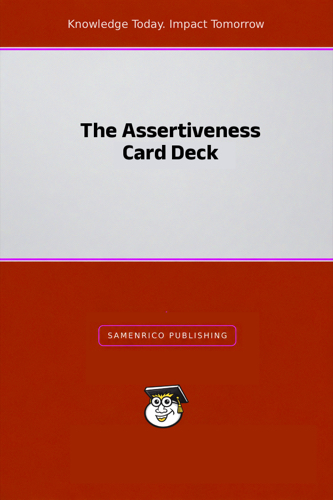
The Assertiveness Card Deck eBook
Practice daily with flash cards of scripts and tec
by Sena Lavette
Practice daily with flash cards of scripts and techniques for any situation.
Formats
Free sample
Chapter 1: Your Hidden Operating System–- Most people who buy an assertiveness book have already decided they aren't assertive enough. They feel it in their chest when they say yes when they mean no. They hear it in their own voice when they apologize for existing. They see it in the rearview mirror after every conversation that left them feeling small. But here is what the bestselling books don't tell you on page one: you already have an assertiveness system.
It is running right now, in every conversation, whether you know it or not. The question is not whether you need to learn assertiveness from scratch. The question is whether your current system is passive, aggressive, or assertive—and whether you are willing to replace a system that isn't working with one that does.This is not a book you read once and place on a shelf. This is a 90-day cognitive-behavioral training program disguised as a deck of flash cards. Each chapter contains six cards.
Each card is a script, a technique, or a tool. You will draw one card each day, practice it aloud three times, and use it once in a real conversation. By day 90, you will not need to remember these scripts. They will remember themselves. Your mouth will say the right words before your brain has time to talk you out of it.But before you can use any of the scripts in this book, you need to know what you are working with.
You need to diagnose your default communication style. You need permission to take up space. You need a physical anchor in your body. And you need a personalized map of your fear—a ladder from the easiest assertive act to the hardest. That is what this chapter delivers.
By the time you finish these six cards, you will know exactly who you are in a conversation, what you are allowed to say, how to stand while saying it, and where to begin your practice.The Three Styles: Passive, Aggressive, and Assertive The foundational insight of every major assertiveness text—from Your Perfect Right to The Assertiveness Workbook—is that human communication falls into three predictable patterns. You are not a mystery. You are not uniquely broken. You are running one of three operating systems.The Passive Style prioritizes others' rights above your own. The passive person speaks quietly, looks down, hedges every statement with "just" and "maybe" and "I don't know." They apologize when someone bumps into them.
They say "sorry" before asking a question. They believe, somewhere beneath conscious awareness, that their needs are less important than everyone else's. The passive person does not get what they want because they never ask for it. And worse: they often do not even know what they want because they have trained themselves not to feel desire. The body language of passivity is small: shoulders curled forward, voice trailing off at the end of sentences, eyes scanning the floor.The Aggressive Style prioritizes your rights above others'.
The aggressive person speaks loudly, interrupts, points fingers, uses "you always" and "you never" accusations. They get what they want—in the moment—but at the cost of relationships. People comply with aggressive people out of fear, not respect. And eventually, they leave, sabotage, or retaliate. The aggressive person confuses volume with conviction and domination with confidence.
The body language of aggression is large but rigid: chest puffed, jaw clenched, finger pointed, personal space invaded.The Assertive Style treats rights as equal. The assertive person states their needs clearly, without apology or attack. They say "I think" instead of "It's just my opinion, but." They say "I feel" instead of "You make me feel." They maintain eye contact, speak at an audible volume, and stand with their weight balanced. They do not win every battle—because assertiveness is not about winning. It is about showing up as a full person in every conversation.
The body language of assertiveness is open: shoulders back, chin level, hands relaxed, feet planted.Here is the uncomfortable truth: most people who think they are assertive are actually aggressive. And most people who think they are nice are actually passive. Aggression is not assertiveness with volume. Passivity is not politeness. The first card in this deck forces you to name your default style.
Not the style you want. Not the style you tell yourself you have. The style you actually use when someone catches you off guard.Card 1: The Three Styles – "Passive = Others' rights > My rights. Aggressive = My rights > Others' rights. Assertive = My rights = Others' rights."Keep this card in your pocket for the first week.
Read it before every conversation. Ask yourself: Which style am I about to use? You cannot change what you will not name.The Words That Give You Away: Passive and Aggressive Scripts to Replace Once you know your style, the next step is surgical. You must identify the specific phrases that announce your passivity or aggression to everyone in the room—phrases you probably use without thinking. The best-selling assertiveness books all include some version of a "word audit," because language is not neutral.
The words you choose shape how others perceive you and, more importantly, how you perceive yourself.Passive phrases to banish:"It's just my opinion, but..." (No. It is your opinion. Own it.)"I'm sorry to bother you, but..." (You are not a bother. You are a person with a need.)"I kind of think maybe we should..." (You think. Stop hedging.)"This might be a stupid question, but..." (It is not stupid.
Ask it.)"I'll try to..." (You will either do it or you will not. "Try" is a shelter for failure.)Each of these phrases serves the same function: they give the listener permission to ignore you. You have already discounted your own words before the other person has a chance to respond. The passive script card gives you direct replacements. "It's just my opinion, but" becomes "I think." "I'm sorry to bother you" becomes "Do you have two minutes?" "I kind of think maybe" becomes "I believe." The replacement scripts feel rude at first.
That is the addiction to passivity talking. You are not being rude. You are being clear.Aggressive phrases to reframe:"You always..." (Replace with: "When you do X, I feel Y.")"You never..." (Replace with: "In the past three times, you have not done X.")"What is wrong with you?" (Replace with: "I am confused about why this happened.")"That's stupid." (Replace with: "I see it differently.")"Calm down." (Replace with silence, or "I will wait until you are ready.")Aggressive language escalates conflict because it attacks the person rather than addressing the behavior. The aggressive person believes they are being "direct." They are being contemptuous. Contempt is the single best predictor of relationship failure—not conflict, not disagreement, but contempt.
The aggressive script card teaches you to separate the person from the action, to describe rather than judge, and to use "I feel" statements (which you will learn thoroughly in Chapter 2) instead of "you" accusations.Card 2: Passive Scripts to Banish – "It's just my opinion, but..." becomes "I think."Card 3: Aggressive Scripts to Reframe…
This is the end of the free sample. Get the eBook to keep going. Buy now
About this book
Details
- Author
- Sena Lavette
- Publisher
- SamEnrico
- Language
- English
- Genre
- Non-Fiction, Self-Help, Tools
- Released
- 2026-06-06
- Pages (approx.)
- 146
- Available as
- eBook, Audiobook

Read better in the ZLOADR app
Your eBooks on your phone or tablet. Sign in with your SamEnrico account and start reading.
More by Sena Lavette
 TM Distraction ManagementSena Lavette$11.99
 Road Rage And Legal ConsequencesSena Lavette$11.99
 The Back Pain and Weight Link GuideSena Lavette$11.99
 Real Estate Analytics GuideSena Lavette$11.99
 The Desert Roses: How the Middle East Redefined Women's Football (2007-2023)Sena Lavette$11.99
 Unique Value Proposition GuideSena Lavette$12.99
 Semiconductor Competition MapSena Lavette$12.99
 Understanding Pfeiffer–kapferer SyndromeSena Lavette$17.99
 Youth Leader InstructorSena Lavette$11.99
 How to Start a Cable Conduit Made of Clay Business (Beginners Guide)Sena Lavette$11.99
You may also like
 Hong Kong Handover 1997Dunn Johnnie$11.99
 Zumba For Postnatal Recovery CourseNeal Christian$11.99
 Zumba for BeginnersLadner Nikia$11.99
 YouTube Comment Mining GuideHumes Pandora$12.99
 Worry Box MeditationCarlin Rudy$11.99
 Workplace Stress MeditationNguyen Lynn$11.99
 Workplace Stress and Sleep RepairHawley Ivory$11.99
 Workplace Perfectionism CureDelaney Jeffry$11.99
 Workplace Injustice Anger GuideWallen Isabelle$11.99
 Work Addiction and Burnout LinkGreenwood Ester$11.99
 Women in Yoga and WellnessBeattie Galina$11.99
 Women in Stand Up ComedyChun Evangeline$11.99