
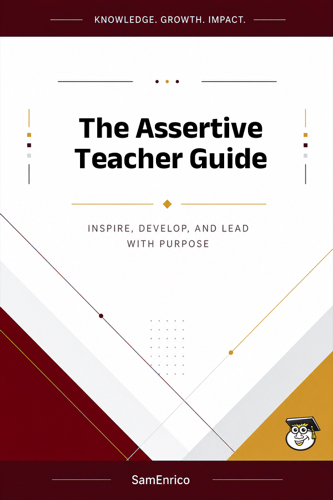
The Assertive Teacher Guide eBook
Manage classrooms with firm fairness not aggressiv
by Lennon Rico
Manage classrooms with firm fairness not aggressive discipline.
Formats
Free sample
Chapter 1: The Crying Car...--–- The first time I cried in my car after school, I told myself it was a fluke. The second time, I told myself it was just a hard week. By the tenth time, I had stopped lying. I was a good teacher—I knew my content, I cared about my students, I had graduated at the top of my program—but I could not manage my classroom. And it was destroying me.This is how the vast majority of teachers experience their first years in the classroom.
Not with dramatic explosions or administrative hearings, but with a slow, grinding erosion of confidence that happens between the hours of 8 AM and 3 PM. You try being nice. You try being mean. You try being fair. Nothing works consistently.
And somewhere along the way, you start to believe that maybe you just weren't cut out for this.That belief is wrong. The problem is not you. The problem is that you were never taught how to be assertive. You were taught your subject matter. You were taught lesson planning and assessment design and differentiated instruction.
But no one ever taught you the specific, observable, repeatable skills of assertive classroom management. This chapter is where that changes.The Two Traps That Swallow Teachers Whole After observing thousands of classrooms over decades of research, behavioral specialists have identified two dominant patterns of ineffective teaching. Lee and Marlene Canter, whose groundbreaking work Assertive Discipline (1976) remains the foundational text in this field, named these patterns the Nonassertive Teacher and the Hostile Teacher. A third pattern—the Assertive Teacher—represents the alternative.Let us examine each pattern in detail, because before you can change your behavior, you must first name it.Trap One: The Nonassertive Teacher The nonassertive teacher is the nice one. The one who says "please" and "would you mind" and "could you maybe try to..." The one who gives a direction, then looks away, then gives it again with less conviction, then finally gives up.
The nonassertive teacher wants to be liked. More than that, they are afraid of being seen as mean. They confuse assertiveness with aggression, and so they avoid any behavior that might feel uncomfortable—even when that behavior is necessary for learning to happen.Here is what the nonassertive teacher sounds like:"Okay everyone, let's settle down. Please? I really need you to listen.
Guys? I'm waiting. Okay, I'll wait. No, please don't throw that. Come on, we have so much to get through today.
Please?"The voice rises at the end of sentences, turning statements into questions. The teacher's posture is collapsed—shoulders hunched, eyes darting, hands fidgeting. When a student refuses a direction, the nonassertive teacher gives another direction. When that direction is refused, they give a warning they have no intention of enforcing. When the warning is ignored, they either do nothing or they escalate directly to a consequence that feels wildly out of proportion to the offense—because they have burned through all their credibility and now have nothing left but panic.The outcomes of nonassertive teaching are predictable and devastating.
Students learn that the teacher's words are optional. They learn that "no" does not actually mean no. They learn that they can talk over the teacher, ignore directions, and face no real consequences. The classroom becomes chaotic. The teacher becomes exhausted.
And the students who want to learn—the ones who came to school actually hoping to gain something—are betrayed by a system that refuses to protect their right to an education.But here is what the nonassertive teacher does not understand: being nice is not the same as being good. A teacher who refuses to set and enforce clear limits is not being kind. They are being neglectful. They are abandoning their students to the chaos of the mob. The kindest thing you can do for a child is to create a predictable environment where they know exactly what to expect.
The nonassertive teacher fails at this because they are afraid of being disliked.Trap Two: The Hostile Teacher The hostile teacher is the mean one. The one who yells first and asks questions never. The one who uses sarcasm as a primary instructional strategy and public shame as a motivational tool. The hostile teacher confuses fear with respect. They believe that if students are scared of them, the classroom will be orderly.
And in the short term, they are correct—fear does produce compliance. But it is brittle compliance that shatters the moment the teacher's back is turned.Here is what the hostile teacher sounds like:"Sit down and shut up right now! I am so tired of you people. No, I don't want to hear your excuse. I don't care what happened at lunch.
You think this is a joke? You want to go to the office? Keep talking and I'll send you there myself."The voice is loud, choppy, and sarcastic. The teacher's posture is aggressive—leaning forward, pointing, invading personal space. Consequences are delivered as threats rather than as logical outcomes.
The teacher takes misbehavior personally, responding with anger rather than with procedure. And most dangerously, the hostile teacher uses public shaming as a tool: writing names on the board, calling students out in front of their peers, mocking mistakes.The outcomes of hostile teaching are also predictable, but in a different direction. Students comply when watched, but the moment the teacher looks away, they act out with doubled intensity. Resentment builds. The teacher becomes the enemy rather than the leader.
Students who are shamed publicly either shut down completely or escalate their defiance to prove they are not afraid. And the teacher burns out just as surely as the nonassertive teacher—because maintaining anger requires enormous energy, and because deep down, most hostile teachers know they have become something they never wanted to be.The hostile teacher made the opposite mistake of the nonassertive teacher. They set limits, but they set them with anger. They enforce consequences, but they enforce them with humiliation. And in doing so, they create a classroom where students learn to fear authority rather than to respect it.The Third Way: The Assertive Teacher Between the nonassertive and the hostile lies a third path.
The assertive teacher is neither a pushover nor a tyrant. They are calm, clear, and insistent. They hold limits without anger. They enforce consequences without shame. And they do all of this while maintaining positive relationships with their students—because they understand that rules without relationship breed rebellion, but relationship without rules breeds chaos.Here is what the assertive teacher sounds like:"Juan, you need to return to your seat now.""But I was just—""I understand.
You still need to return to your seat.""That's not fair.""Return to your seat now, please."The voice is moderate in volume, slightly lower in pitch than normal speech, and completely fluent—no hesitations, no ums, no upward inflections that turn statements into questions. The teacher's posture is upright and relaxed. Eye contact is direct but not aggressive. The teacher does not argue, does not plead, does not threaten. They simply state the expectation, acknowledge any response without being derailed, and…
This is the end of the free sample. Get the eBook to keep going. Buy now
About this book
Details
- Author
- Lennon Rico
- Publisher
- SamEnrico
- Language
- English
- Genre
- Non-Fiction, Self-Help, Education
- Released
- 2026-06-08
- Pages (approx.)
- 131
- Available as
- eBook, Audiobook

Read better in the ZLOADR app
Your eBooks on your phone or tablet. Sign in with your SamEnrico account and start reading.
More by Lennon Rico
 Cult Survivor Dream ProcessingLennon Rico$11.99
 Vulnerability Factors DBTLennon Rico$11.99
 DBT For ArtistsLennon Rico$11.99
 The School Memory Palace GuideLennon Rico$11.99
 The Great Kiwi Gold Swindle: New Zealand's First Major Fraud TrialLennon Rico$11.99
 Horse BoardingLennon Rico$11.99
 Chinese Team Negotiation GuideLennon Rico$12.99
 Funding Without PublicationsLennon Rico$12.99
 Ultimate Handbook Guide to Abidjan : (Ivory Coast) Travel GuideLennon Rico$11.99
 Understanding Synovitis Granulomatous Uveitis Cranial NeuropathiLennon Rico$17.99
You may also like
 Hong Kong Handover 1997Dunn Johnnie$11.99
 Zumba For Postnatal Recovery CourseNeal Christian$11.99
 Zumba for BeginnersLadner Nikia$11.99
 YouTube Comment Mining GuideHumes Pandora$12.99
 Worry Box MeditationCarlin Rudy$11.99
 Workplace Stress MeditationNguyen Lynn$11.99
 Workplace Stress and Sleep RepairHawley Ivory$11.99
 Workplace Perfectionism CureDelaney Jeffry$11.99
 Workplace Injustice Anger GuideWallen Isabelle$11.99
 Work Addiction and Burnout LinkGreenwood Ester$11.99
 Women in Yoga and WellnessBeattie Galina$11.99
 Women in Stand Up ComedyChun Evangeline$11.99