
Non-FictionSelf-HelpNarrative Therapy
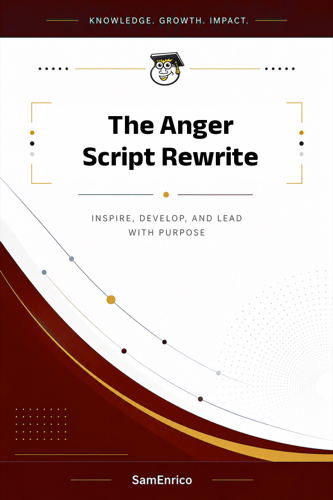
The Anger Script Rewrite eBook
Replaces the internal narrative that fuels rage wi
by Weed Ula
Replaces the internal narrative that fuels rage with a more compassionate relationship story.
Formats
Free sample
Chapter 1: The Messenger You've Been Punching--–- Every morning for the past eleven years, David has woken up at 4:47 a.m. Not because he wants to. Not because his job requires it. Because at 4:47 a.m., his body decides it's time to replay the argument from three days ago, the one about the dishwasher, the one that ended with his wife crying in the bathroom and his fist through the drywall in the garage. He lies there in the dark, heart already pounding, jaw already clenched, and runs the tape again.
She should have loaded it properly. He should not have had to ask. She knew he had an early meeting. She does this on purpose. By 5:15 a.m., he has worked himself into a state of righteous fury that would be appropriate if someone had set his car on fire.
A dishwasher. A $1.29 plastic basin with a spinning arm. And his marriage is bleeding out on the floor because of it.This is not a story about a dishwasher. This is a story about a messenger that David has been shooting on sight for eleven years. The messenger shows up every time he feels disrespected, unseen, or afraid.
The messenger carries a piece of information—something about a boundary, a wound, a terror—and David, like most of us, has been trained to punch the messenger instead of reading the note.This book is called The Anger Script Rewrite because you do not have an anger problem. You have an old script running on a loop. And scripts can be rewritten.But before we can rewrite anything, we have to stop treating your anger like a monster under the bed. We have to start treating it like a smoke alarm.The Smoke Alarm on Your Kitchen Wall Imagine, for a moment, that every time your smoke alarm went off, you responded by smashing it with a hammer. You would feel better for about three seconds.
The noise would stop. The flashing light would go dark. And then your house would burn down.This is what most anger management advice does. It teaches you to smash the alarm. Count to ten.
Take a deep breath. Punch a pillow. Go for a walk. These techniques are not wrong; they are just incomplete. They address the noise without addressing the fire.
They train you to suppress the symptom while the actual threat—the boundary violation, the unmet need, the buried grief, the unspoken terror—continues to smolder in the walls of your life.Here is the truth that the top ten bestselling books on anger have been circling for years but rarely state this plainly: Anger is not a malfunction. Anger is a biological alarm system, as evolved and essential as the pain reflex in your hand. When you touch a hot stove, pain signals "damage occurring." When someone violates your boundary, threatens your dignity, or ignores your needs, anger signals "threat detected."The problem is not that you have an alarm system. The problem is that your alarm system has been calibrated wrong, your response to the alarm has been destructive, and you have never learned to read the message the alarm is trying to deliver.Consider the alternative. What if you had no anger at all?
What if someone could take your money, insult your children, violate your body, and you felt nothing but mild curiosity? That is not enlightenment. That is a traumatic brain injury. Anger is not the enemy of a good life. Anger is the guardian of a decent one.The Three Lies the Old Narrator Tells You There is a voice inside your head that I want you to meet.
We are going to call it the Old Narrator. You know this voice well, though you may not have named it before. The Old Narrator is the one that says, "You're right to be furious. They deserve it. Don't let them get away with this.
If you don't get angry, you're weak. If you don't fight back, you'll lose everything."The Old Narrator feels like your ally. It feels like the voice of self-respect, of justice, of standing up for yourself. And that is precisely why it is so dangerous. The Old Narrator has been running your internal script for years, feeding you three specific lies that keep you trapped in the cycle of rage and shame.Lie Number One: Your anger is always justified.This is the seduction of righteousness.
The Old Narrator points at every situation and says, "See? You have a right to be angry." And you do. Almost always, you do. Someone was inconsiderate. Someone was late.
Someone was dismissive. Someone should have known better. The Old Narrator is technically correct about the facts, and that technical correctness is a trap. Because being right is not the same thing as being free. Being justified is not the same thing as being connected.
The Old Narrator would rather be right than happy, and it will keep you angry about a dishwasher while your marriage dissolves because being angry feels better than being heartbroken.Lie Number Two: Your anger protects you.This is the lie of safety. The Old Narrator tells you that if you drop your anger, you will be vulnerable. People will walk all over you. You will become a doormat. The anger is your armor, your shield, your sword.
And this is partially true—anger does create distance. Anger does signal "do not approach." But the Old Narrator never tells you the cost of wearing armor all the time. Armor is heavy. Armor isolates you. Armor prevents you from feeling the very thing you most need to feel: the grief underneath the rage, the fear underneath the grief, the human need for connection that the armor is actually protecting you from.Lie Number Three: You cannot control your anger.This is the lie of helplessness.
The Old Narrator wants you to believe that anger is a force of nature, like a hurricane or a flood, and that you are simply its victim. "I couldn't help it," you say after an explosion. "I saw red." "I lost control." The Old Narrator loves these phrases because they absolve you of responsibility while keeping you trapped in the cycle. But here is the truth that will change everything: You cannot control your anger in the moment it arrives. But you can absolutely control your anger in the moments before it arrives.
You can learn to recognize the physical pre-trigger signs. You can learn to intervene physiologically before your amygdala hijacks your prefrontal cortex. You can learn to rewrite the script so that the automatic response of "attack" becomes the chosen response of "pause and inquire."The Old Narrator is not your enemy in the sense that it wants to harm you. The Old Narrator is your enemy in the sense that it is a terrible manager. It has been running the show with outdated information and destructive strategies, and it is time to promote someone else to the position.
That someone else is the Compassionate Editor—the version of you who can observe the anger, interview the messenger, and choose a response rather than being…
This is the end of the free sample. Get the eBook to keep going. Buy now
About this book
Details
- Author
- Weed Ula
- Publisher
- SamEnrico
- Language
- English
- Genre
- Non-Fiction, Self-Help, Narrative Therapy
- Released
- 2026-06-07
- Pages (approx.)
- 143
- Available as
- eBook, Audiobook

Read better in the ZLOADR app
Your eBooks on your phone or tablet. Sign in with your SamEnrico account and start reading.
More by Weed Ula
 Chunking for Creative BrainstormingWeed Ula$11.99
 Self Hypnosis For Confidence Building WorkbookWeed Ula$11.99
 Naked in Public Dream CourseWeed Ula$11.99
 Interruption Tracking Log WorkbookWeed Ula$11.99
 Midnight Glitch: The Last Broadcast of Radio Free Y2KWeed Ula$11.99
 The Unstoppable Comeback: How a 1998 Underdog Team Defied All OddsWeed Ula$11.99
 Gas Shutoff Valve Location TrainingWeed Ula$11.99
 SAFe for Boeing StartupsWeed Ula$12.99
 Understanding Englemann DiseaseWeed Ula$17.99
 How to Start a Dairy Machinery and Plant (not Agricultural) Business (Beginners Guide)Weed Ula$11.99
You may also like
 Hong Kong Handover 1997Dunn Johnnie$11.99
 Zumba For Postnatal Recovery CourseNeal Christian$11.99
 Zumba for BeginnersLadner Nikia$11.99
 YouTube Comment Mining GuideHumes Pandora$12.99
 Worry Box MeditationCarlin Rudy$11.99
 Workplace Stress MeditationNguyen Lynn$11.99
 Workplace Stress and Sleep RepairHawley Ivory$11.99
 Workplace Perfectionism CureDelaney Jeffry$11.99
 Workplace Injustice Anger GuideWallen Isabelle$11.99
 Work Addiction and Burnout LinkGreenwood Ester$11.99
 Women in Yoga and WellnessBeattie Galina$11.99
 Women in Stand Up ComedyChun Evangeline$11.99