
Non-FictionSelf-HelpTask Management
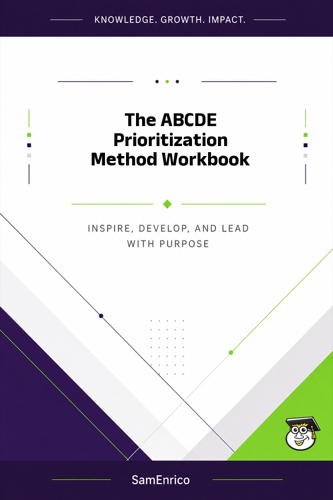
The ABCDE Prioritization Method Workbook eBook
Provides daily exercises to rank tasks from A (mos
Provides daily exercises to rank tasks from A (most important) to E (eliminate).
Formats
Free sample
Chapter 1: The 5% That Changes Everything--–- You have 1,440 minutes today. By the time you finish reading this sentence, you have used approximately three of them. The question is not whether you will use those minutes. You will. The question is whether you will use them on something that matters.Look at your to-do list right now.
Not the one in your head—the real one, written down somewhere, even if it is just a scrap of paper or a notes app on your phone. Count how many items are on it. Be honest. If you are like most people, there are between fifteen and thirty tasks staring back at you. Some are urgent.
Some are important. Some are neither. And here is the problem that no productivity system has ever solved for you: on that list, every item looks equally important. The email from your boss looks as urgent as the project that could change your career. The quick social media check looks as productive as the deep work that actually moves the needle.
Your brain cannot tell the difference, so it defaults to whatever is easiest, whatever is fastest, whatever gives the quickest hit of dopamine.This workbook is not another productivity system. It is a scalpel. It will teach you to cut away the 80 percent of your tasks that do not matter so you can focus on the 20 percent that do. And within that 20 percent, it will teach you to identify the single task—the 5 percent—that produces 95 percent of your results.The ABCDE method is deceptively simple. You have probably encountered it before.
You may have even tried it and abandoned it. That is not because the method does not work. It is because you were taught the letters without understanding the principle that makes them powerful. The principle is consequences. Not urgency.
Not importance as a vague concept. Consequences. What actually happens if you do a task? What actually happens if you do not? The answers to those two questions are the difference between a life spent reacting to emergencies and a life spent building something meaningful.The 1,440-Minute Problem Let us start with a hard truth.
You are going to waste time today. Not because you are lazy. Not because you lack willpower. Because your brain was not designed for the modern world. Your brain evolved to respond to immediate threats—the rustle in the grass that might be a predator, the face of someone who might harm you.
It did not evolve to prioritize a quarterly report due in three weeks or a strategic plan that will pay off in six months. Those things do not trigger the threat response. They feel abstract. They feel optional. They feel like they can wait.Meanwhile, your email inbox triggers a dopamine response with every new message.
Your phone notifications trigger a threat-or-reward calculation dozens of times per hour. The quick, easy, low-stakes tasks feel urgent because they are immediate. The slow, hard, high-stakes tasks feel optional because their consequences are delayed.This is the 1,440-minute problem. You have exactly the same number of minutes as everyone else. But your brain is constantly pulling you toward tasks that do not matter because they feel good in the moment.
The ABCDE method is a tool for overriding that ancient wiring. It is not natural. It is not intuitive. It is a skill you must learn, practice, and eventually automate.Urgency Versus Importance: The Critical Distinction Before we dive into the five categories, we need to establish two concepts that will appear throughout this workbook. These concepts are not the same, and confusing them is the primary reason most prioritization systems fail.Urgency is about time.
An urgent task has a deadline looming. It demands attention now. Urgency triggers your brain's threat response. An urgent task feels important even when it is not.Importance is about consequences. An important task has serious consequences if it is not done.
Importance may or may not be urgent. The most important tasks in your life—building your career, strengthening your relationships, improving your health—almost never feel urgent. Their consequences are delayed. That is why they are so easy to postpone.Here is the insight that will change how you work: the ABCDE method prioritizes by importance first and urgency second. Urgency is a tiebreaker, not the main event.
An A task is not A because it is due tomorrow. An A task is A because something bad will happen if you do not do it. The deadline just tells you when that bad thing will occur.Let me give you an example. Filing your taxes is an A task. The consequence of not filing is serious: penalties, interest, possibly legal trouble.
The deadline is April 15. On April 14, the task is urgent and important. On January 15, it is not urgent, but it is still important. The ABCDE method would label it A on both days. The only difference is ranking—on April 14, it might be A-1.
On January 15, it might be A-3.Most people never learn to distinguish urgency from importance because their to-do lists do not require them to. Every item sits in a vertical list, each looking equally urgent. The ABCDE method forces the distinction by asking one question: what are the consequences?The Five Categories: Your New Decision Framework The ABCDE method organizes tasks into five categories. Each category is defined by consequences, not by feelings. Learn these definitions now.
They will be referenced throughout this workbook but stated fully only once.A Tasks: Very Important These tasks have serious consequences if you do them or fail to do them. Think of these as your "frogs"—the biggest, most demanding tasks you need to accomplish. If you do not do an A task, something bad will happen. You might lose money, damage a relationship, miss a deadline, or harm your career. Examples include completing a project with a tight deadline, paying a bill that is due tomorrow, preparing for a critical client presentation, or addressing a health concern.When you have multiple A tasks—and you will—you must rank them.
A-1 is the most important. A-2 is the second most important. A-3 is the third. The ranking is not arbitrary. It is based on the severity of consequences.
Which task, if left undone, would cause the most damage? That is your A-1.B Tasks: Important These tasks should be done but have only mild or moderate consequences if delayed. A B task left undone will not derail your life, but it may become an A task if you wait too long. Examples include responding to a non-urgent email, studying for an exam that is two weeks away, scheduling a routine appointment, or organizing your files.The golden rule of the ABCDE method, stated once here and referenced throughout: never do a B task when an A task is left undone. This sounds simple.
It is violated constantly. The reason is psychological: B tasks are often easier, more pleasant, or less anxiety-provoking than A tasks. Doing a B task feels like progress, but it is actually avoidance.C Tasks: Nice to Do These tasks have no negative consequences if you…
This is the end of the free sample. Get the eBook to keep going. Buy now
About this book
Details
- Author
- Lafferty Mauricio
- Publisher
- SamEnrico
- Language
- English
- Genre
- Non-Fiction, Self-Help, Task Management
- Released
- 2026-06-05
- Pages (approx.)
- 115
- Available as
- eBook, Audiobook

Read better in the ZLOADR app
Your eBooks on your phone or tablet. Sign in with your SamEnrico account and start reading.
More by Lafferty Mauricio
 Incarcerated Suicide Attempt Recovery GuideLafferty Mauricio$11.99
 Polish Catholic Shelter for JewsLafferty Mauricio$11.99
 The Immigrant Founder JourneyLafferty Mauricio$11.99
 Telegram Addiction RecoveryLafferty Mauricio$11.99
 The Volcanic Voyages of Abubakari II: The Lost King of Mali’s Great ExpeditionLafferty Mauricio$11.99
 Understanding Maternally Inherited Diabetes and DeafnessLafferty Mauricio$17.99
 Time Blocking for Executive AssistantsLafferty Mauricio$12.99
 German Raise Negotiation Culture GuideLafferty Mauricio$12.99
 Paragonite MiningLafferty Mauricio$11.99
 How to Become a Distributor-cleanerLafferty Mauricio$11.99
You may also like
 Hong Kong Handover 1997Dunn Johnnie$11.99
 Zumba For Postnatal Recovery CourseNeal Christian$11.99
 Zumba for BeginnersLadner Nikia$11.99
 YouTube Comment Mining GuideHumes Pandora$12.99
 Worry Box MeditationCarlin Rudy$11.99
 Workplace Stress MeditationNguyen Lynn$11.99
 Workplace Stress and Sleep RepairHawley Ivory$11.99
 Workplace Perfectionism CureDelaney Jeffry$11.99
 Workplace Injustice Anger GuideWallen Isabelle$11.99
 Work Addiction and Burnout LinkGreenwood Ester$11.99
 Women in Yoga and WellnessBeattie Galina$11.99
 Women in Stand Up ComedyChun Evangeline$11.99