
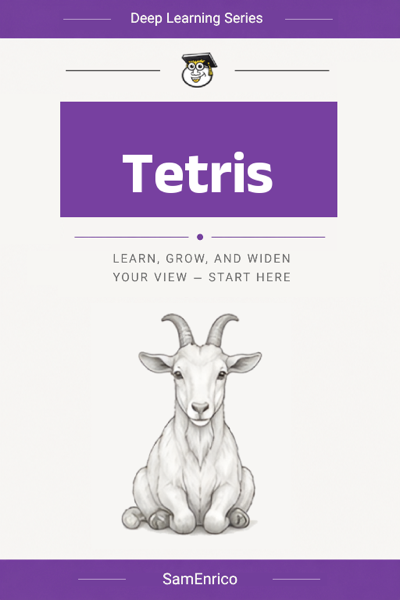
Non-FictionInformativeEducational
Tetris Audiobook
A Coursebook on Tetris
by Newsom Aliza
A Coursebook on Tetris
Formats
Free sample
Chapter 1: The Fourth Square...--In the summer of 1984, the Soviet Union was a country of long lines, gray concrete, and suppressed dreams. Inside the Moscow Academy of Sciences, a thirty-year-old software engineer named Alexey Pajitnov sat before an outdated Electronika 60 computer, ostensibly working on speech recognition. But his mind was elsewhere—trapped in the elegant prison of geometric puzzles. He was bored. He was frustrated.
And he was about to accidentally create the most addictive game the world would ever know.The Electronika 60 was a sad machine by Western standards. It had no graphical display, only a text-based monitor capable of showing eighty columns by twenty-five rows of characters. Its processing power was laughably weak. The Soviet government did not prioritize recreational computing; every line of code had to justify itself through scientific or military application. Pajitnov's official project—teaching computers to understand human speech—was going nowhere.
The bureaucracy was suffocating, the hardware was inadequate, and the climate was one of perpetual gray stagnation.So Pajitnov did what brilliant minds have always done under oppressive systems: he worked on his own projects in secret. His obsession was puzzles. Specifically, he loved Pentominoes—a classic logic puzzle involving twelve distinct shapes, each made of five connected squares. The challenge was to arrange these twelve pieces into a rectangular box. There were thousands of possible arrangements, and finding even one required hours of patient experimentation.
Pajitnov loved the mental geometry of it—the way shapes could be rotated, flipped, and slotted together like a mathematical dance.But he hated the physical labor. Every time he wanted to try a new arrangement, he had to manually pick up the wooden pieces and reposition them. His fingers were clumsy; his eyes tired quickly. He began to fantasize about a computer program that could do the rearranging for him—a digital puzzle that would handle the tedious placement while he focused on the strategy. The idea was simple: falling shapes that the player would rotate and position, with the goal of filling complete rows.The only problem was the hardware.
The Electronika 60 could barely render text. Displaying twelve Pentomino pieces, each occupying five squares, was too computationally expensive. The machine would lag, the pieces would stutter, and the game would be unplayable. Pajitnov needed a simpler set of shapes. He tried three-square pieces, but there were only two (the straight line and the…
This is the end of the free sample. Get the Audiobook to keep going. Buy now
About this book
Details
- Author
- Newsom Aliza
- Publisher
- SamEnrico
- Language
- English
- Genre
- Non-Fiction, Informative, Educational
- Released
- 2026-05-08
- Pages (approx.)
- 124
- Available as
- eBook, Audiobook

Listen in the VoxFlicks app
Audiobooks and audio dramas wherever you go. Sign in with your SamEnrico account and press play.
More by Newsom Aliza
 EQ Culture Building GuideNewsom Aliza$11.99
 Thunberg UN Speech How Dare You CourseNewsom Aliza$11.99
 The Atacama Desert GuideNewsom Aliza$11.99
 Brain Aging Prevention Nutrition GuideNewsom Aliza$11.99
 The Caregiver Meal Planning GuideNewsom Aliza$11.99
 Tangaroa’s Wrath: The Drowning of Maui’s CanoeNewsom Aliza$11.99
 The Great Drain of Mohenjo-Daro: The Ancient World's First Plumbing RevolutionNewsom Aliza$11.99
 Project Success PortfolioNewsom Aliza$12.99
 Kigali Innovation City GuideNewsom Aliza$12.99
 How to Become a Cigarette-making-machine-hopper FeederNewsom Aliza$11.99
 Understanding Floating Limb SyndromeNewsom Aliza$17.99
You may also like
 Hong Kong Handover 1997Dunn Johnnie$11.99
 Zumba For Postnatal Recovery CourseNeal Christian$11.99
 Zumba for BeginnersLadner Nikia$11.99
 YouTube Comment Mining GuideHumes Pandora$12.99
 Worry Box MeditationCarlin Rudy$11.99
 Workplace Stress MeditationNguyen Lynn$11.99
 Workplace Stress and Sleep RepairHawley Ivory$11.99
 Workplace Perfectionism CureDelaney Jeffry$11.99
 Workplace Injustice Anger GuideWallen Isabelle$11.99
 Work Addiction and Burnout LinkGreenwood Ester$11.99
 Women in Yoga and WellnessBeattie Galina$11.99
 Women in Stand Up ComedyChun Evangeline$11.99