
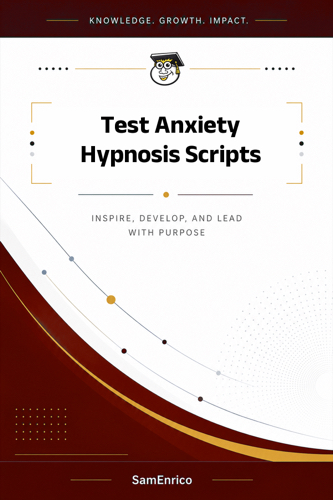
Test Anxiety Hypnosis Scripts eBook
Teaches scripting for recall enhancement and calm
by Lowry Leon
Teaches scripting for recall enhancement and calm during exams.
Formats
Free sample
Chapter 1: The Librarian’s Panic...--–- The first time Sarah walked into my office, she sat on the very edge of the chair, her backpack still on both shoulders, as if she expected to be asked to leave at any moment. She was a second-year medical student who had aced every prerequisite, scored in the 90th percentile on her MCAT, and yet had failed her first two anatomy practical exams. Not barely failed—failed catastrophically. She told me, with the hollow voice of someone repeating a verdict they have already internalized, “I know the material. I study for twelve hours a day.
But when I look at the exam, my mind goes blank. It’s like someone erased a whiteboard I just filled.” She paused, then added the words that every test-anxious student eventually says: “Maybe I’m just not smart enough.”Sarah was not lacking intelligence. She was lacking a language to describe what was happening inside her skull. And without that language, she had defaulted to the only explanation available: personal deficiency. This chapter exists to ensure that no clinician or student ever makes that mistake again.
Before any trance is induced, before any anchor is installed, before any memory palace is built, the student must understand the neurobiology of the blank mind. Psychoeducation is not a warm-up for hypnosis. It is the first intervention itself.The Core Problem: Misattribution and Secondary Anxiety Test anxiety is not a single phenomenon but a cascade. The cascade begins with a trigger—turning the page of an exam booklet, seeing a question that looks unfamiliar, hearing the proctor say “five minutes remaining.” In a non-anxious student, this trigger produces a mild, adaptive stress response: heart rate increases slightly, pupils dilate, attention narrows to the task. In a test-anxious student, the same trigger produces a full-throttle fight-or-flight response.
The amygdala (the brain’s smoke detector) activates the hypothalamus, which signals the pituitary gland, which releases adrenocorticotropic hormone, which tells the adrenal glands to flood the body with cortisol and adrenaline.Here is the cruel irony: cortisol does not impair all memory equally. It enhances memory for emotionally charged, threat-related information—which is why you can remember exactly where you were during a car accident. But cortisol impairs memory for neutral, factual, declarative information—which is exactly what is on the exam. The hippocampus, the brain’s librarian, is densely packed with cortisol receptors. When cortisol levels rise, hippocampal neurons stop firing efficiently.
New information cannot be encoded. Existing information cannot be retrieved. The student does not “forget.” The student’s hippocampus is temporarily offline, like a computer that has frozen but still has all its data.The student does not know this. All the student knows is: I studied this. I knew it last night.
Now it is gone. Because the student lacks a biological explanation, the brain generates a psychological one: I am stupid. I am lazy. I don’t belong here. This is secondary anxiety—anxiety about the anxiety itself.
And secondary anxiety is far more destructive than primary anxiety. Primary anxiety is the amygdala’s false alarm. Secondary anxiety is the student’s belief that the false alarm reveals a fundamental flaw in their character.The therapeutic mechanism of this chapter is therefore twofold. First, psychoeducation normalizes the stress response. When a student learns that their hippocampus has been literally shut down by cortisol, the experience shifts from “I am broken” to “my brain is reacting biologically.” Second, psychoeducation reduces secondary anxiety by providing an accurate, non-shaming explanation for the blank mind.
Students cannot change what they cannot name. This chapter gives them the name.The Script: The Librarian and the Fire Alarm The following script is a non-trance, conversational script. It is delivered before any hypnotic induction, typically in the first 15 minutes of the first session. The therapist speaks in a calm, measured tone, making eye contact, pausing to allow the student to absorb each concept. The script uses analogy and metaphor rather than jargon.
No direct suggestions are given. No trance is induced. The only goal is understanding.Script begins:“I want you to hear something that is not a compliment, not a diagnosis, and not a guess. It is a fact: You have not failed because you are not smart enough. You have failed because your brain has a security system that is too sensitive, and that security system is shutting down your memory at exactly the moment you need it most.Let me explain what happens inside your skull when you sit down for an exam.Deep in the center of your brain, there is a small, almond-shaped cluster of neurons called the amygdala.
Think of it as your brain’s smoke detector. Its only job is to answer one question: Is there a threat? If the answer is yes, the amygdala hits the alarm. If the answer is no, the amygdala stays quiet.Now, for most of human evolution, threats were physical. A saber-toothed tiger.
A rival tribe. A falling rock. The amygdala’s alarm system is designed for those threats. When the alarm goes off, your body does three things: your heart races to pump blood to your muscles, your breathing quickens to take in more oxygen, and your digestion slows down because your stomach is not a priority when you are running from a tiger.But here is the problem. Your amygdala cannot tell the difference between a tiger and a trigonometry final.
It only knows threat. And if you have ever failed an exam before, or if you have been told that your worth depends on your grades, or if you are the kind of person who needs to be perfect, then your amygdala has learned that exams are threats. So when you open that exam booklet, the smoke detector goes off.That is not your fault. That is your brain trying to protect you. It is just using outdated software.Now, what happens when the smoke detector goes off?
The amygdala sends an emergency signal to a control center in your brain called the hypothalamus. The hypothalamus then sends a message to your pituitary gland, which sends a message to your adrenal glands—which sit on top of your kidneys—to release a hormone called cortisol.Cortisol is the brain’s emergency brake. In small amounts, it helps you focus. In large amounts, it shuts down everything that is not essential for immediate survival. And here is the part that matters most for you: the hippocampus—the part of your brain that stores and retrieves memories—is packed with cortisol receptors.Think of your hippocampus as a librarian.
This librarian has spent weeks organizing your anatomy notes, your formulas, your dates and names, into neat, labeled folders. The librarian knows exactly where every fact is stored. But when cortisol floods the library, the librarian does not slowly continue working. The librarian runs out of the room. The fire alarm is blaring.
The librarian assumes the building is on fire. And you are left sitting at your desk, staring at the exam, with a library full of information and no one to retrieve it.That is the blank mind. That is…
This is the end of the free sample. Get the eBook to keep going. Buy now
About this book
Details
- Author
- Lowry Leon
- Publisher
- SamEnrico
- Language
- English
- Genre
- Non-Fiction, Self-Help, Education
- Released
- 2026-06-06
- Pages (approx.)
- 152
- Available as
- eBook, Audiobook

Read better in the ZLOADR app
Your eBooks on your phone or tablet. Sign in with your SamEnrico account and start reading.
More by Lowry Leon
 Anger In Marriage GuideLowry Leon$11.99
 Parental Abandonment TriggersLowry Leon$11.99
 MBSR for CaregiversLowry Leon$11.99
 Dreaming for Pilot TrainingLowry Leon$11.99
 Postpartum Car Seat Safety GuideLowry Leon$11.99
 Alcohol Recovery for College StudentsLowry Leon$11.99
 EdTech Capital StrategiesLowry Leon$11.99
 Sam Sheppard Medical License BattleLowry Leon$11.99
 The Divine Architect: Palestrina and the Salvation of Sacred MusicLowry Leon$11.99
 The Billionaire’s Shadow: How a Tech Mogul Reshaped Global DiplomacyLowry Leon$11.99
 The Last Shot: How a 10-Year-Old’s Free Throw Won the 1949 NBA FinalsLowry Leon$11.99
 Growing TripterygiumLowry Leon$11.99
You may also like
 Hong Kong Handover 1997Dunn Johnnie$11.99
 Zumba For Postnatal Recovery CourseNeal Christian$11.99
 Zumba for BeginnersLadner Nikia$11.99
 YouTube Comment Mining GuideHumes Pandora$12.99
 Worry Box MeditationCarlin Rudy$11.99
 Workplace Stress MeditationNguyen Lynn$11.99
 Workplace Stress and Sleep RepairHawley Ivory$11.99
 Workplace Perfectionism CureDelaney Jeffry$11.99
 Workplace Injustice Anger GuideWallen Isabelle$11.99
 Work Addiction and Burnout LinkGreenwood Ester$11.99
 Women in Yoga and WellnessBeattie Galina$11.99
 Women in Stand Up ComedyChun Evangeline$11.99