
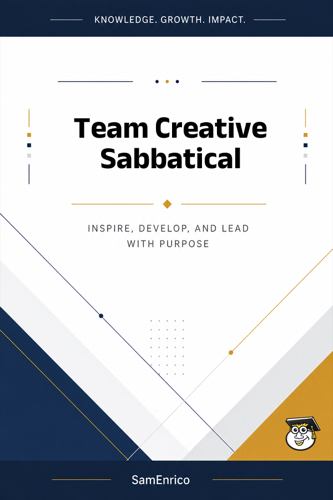
Non-FictionSelf-HelpSabbatical
Team Creative Sabbatical eBook
Take group time away from routine work to focus on
by Lauer Lise
Take group time away from routine work to focus on innovation.
Formats
Free sample
Chapter 1: The Productivity Trap--–- The email arrived at 11:47 PM on a Tuesday. Sarah, a senior product manager at a mid-sized software company, had just finished her third spreadsheet of the evening. The subject line read: "URGENT: Q3 Innovation Offsite – Agenda." She opened it. The agenda was twelve items long. Every single item was about efficiency: "Reduce customer support ticket resolution time by 15%." "Optimize the onboarding funnel." "Cut three days from the release cycle." There was nothing about new markets, forgotten customers, or the question that had been keeping her awake at night: What if we're solving the wrong problems entirely?She closed her laptop, stared at the ceiling, and felt something she couldn't quite name.
It wasn't burnout, exactly. It wasn't boredom. It was a deeper, more structural exhaustion – the feeling of running faster on a treadmill that was bolted to the floor. Her team was good at their jobs. They met every KPI.
They shipped on time. They were, by every traditional measure, a high-performing team. And yet, no one could remember the last time they'd had a genuinely new idea.This is the central paradox of modern work. The very behaviors that make a team successful in day-to-day operations are the ones that systematically destroy their ability to innovate. And until you understand this paradox – until you can see the trap you're already standing in – no creative sabbatical, no offsite, no amount of "blue sky thinking" will save you.
You'll just keep running faster, on that same bolted-down treadmill, wondering why you're not getting anywhere.This chapter is about naming that trap, understanding how it works, and diagnosing exactly where it has taken hold in your own team. Because you cannot escape a prison you don't know you're in.The Efficiency Cult: How We Learned to Worship the Wrong God Let's start with an uncomfortable truth. Most organizations don't actually want innovation. They say they do. They put it in their mission statements.
They hang posters about "thinking outside the box" in their break rooms. But their systems – their budgets, their promotion criteria, their meeting rhythms, their risk protocols – are designed to reward the opposite.Think about the last time someone on your team was promoted. Was it because they proposed a radical new direction that might fail? Or was it because they delivered predictable results, on time and under budget? Now think about the last time someone was criticized in a performance review.
Was it for being "too slow" or "too unpredictable"? Almost certainly yes.We have built an Efficiency Cult – a set of unquestioned beliefs that productivity is the highest good, that variance is error, and that the goal of any team is to do more with less, faster and cheaper, every single quarter. The priests of this cult are called things like "Six Sigma Black Belts" and "Agile Coaches." Their scriptures are KPIs, OKRs, and burn-down charts. Their holy days are quarterly business reviews.None of this is inherently bad. Efficiency matters.
No one is arguing for chaos or waste. But when efficiency becomes the only god you worship, you sacrifice something essential on the altar: the capacity for exploration, curiosity, and breakthrough thinking.Performance vs. Innovation: The Two Modes of Work To understand the trap, you need to distinguish between two fundamentally different modes of work. Most teams never learn this distinction, so they try to do both modes with the same tools, the same mindset, and the same people – and they fail at both.Performance mode is about doing things right. It operates in known territory, with established processes and clear metrics.
The goal is to reduce variance, eliminate errors, and maximize efficiency. In Performance mode, failure is bad. Surprises are bad. Deviation from the plan is bad. This is the mode you use when you're manufacturing a product, processing a transaction, or delivering a service that already exists.
The skills required are discipline, attention to detail, and reliability.Innovation mode is about doing the right things. It operates in unknown territory, with ambiguous problems and uncertain outcomes. The goal is to learn, to discover, and to create new options. In Innovation mode, failure is useful – it's data. Surprises are good – they reveal hidden assumptions.
Deviation from the plan is necessary – the plan was probably wrong to begin with. This is the mode you use when you're inventing a new product, entering a new market, or reimagining a broken process. The skills required are curiosity, tolerance for ambiguity, and the courage to be wrong.Here's the problem. Most teams spend 95% of their time in Performance mode. Their calendars are filled with status meetings, budget reviews, and project updates.
Their incentives reward hitting targets, not asking questions. Their culture punishes mistakes, even small ones. Then, once a quarter, someone announces an "innovation offsite" and expects the team to suddenly switch into Innovation mode – as if flipping a light switch.You cannot flip a switch. The neural pathways, team habits, and organizational systems that make you excellent at Performance are the enemies of Innovation. You cannot optimize your way to creativity.
You cannot standardize your way to surprise. You cannot KPIs your way to a breakthrough.The Productivity Trap: A Working Definition The Productivity Trap is a state where teams become so optimized for efficiency, standardization, and risk avoidance that they lose the capacity for exploration, curiosity, and breakthrough thinking. It is a trap because the very behaviors that seem to be working – hitting targets, closing tickets, shipping features – create a feedback loop that makes it harder and harder to do anything truly new.Here is how the trap works, step by step:Standardization. To improve efficiency, you create standard processes. Everyone follows the same playbook.
Variance decreases. Output becomes predictable.Measurement. You attach metrics to the processes. You track cycle time, defect rate, customer satisfaction. People focus on improving the numbers.Optimization.
You refine the processes based on the metrics. You remove bottlenecks. You automate repetitive tasks. Efficiency improves.Risk avoidance. You learn that deviation from the standard process hurts your metrics.
You discourage experiments. You reject ideas that don't fit the template. You punish failures.Atrophy of exploration. Because no one is exploring, your team loses the skills of exploration. Curiosity becomes unfamiliar.
Ambiguity becomes frightening. The unknown becomes a threat.Trapped. Your team is now excellent at a set of processes that may no longer be relevant. The market changes. The competition innovates.
But your team cannot respond, because their entire identity is built on doing the old thing perfectly.The cruelest part of the Productivity Trap is that it feels like success. Your dashboards are green. Your boss is happy. You get your bonus. And then one day, a startup you've never heard of eats your lunch, and you have no idea what hit you.The Manufacturing Floor Trap: A Cautionary Tale Consider the story of a factory that made automotive parts.
For decades, they perfected their process. They reduced defects to 0.001%. They cut production time by 40%. They were the envy of the industry. And then electric vehicles happened.
Their parts were no longer needed. The factory closed within eighteen months.The managers didn't make any obvious mistakes. They did everything…
This is the end of the free sample. Get the eBook to keep going. Buy now
About this book
Details
- Author
- Lauer Lise
- Publisher
- SamEnrico
- Language
- English
- Genre
- Non-Fiction, Self-Help, Sabbatical
- Released
- 2026-06-08
- Pages (approx.)
- 144
- Available as
- eBook, Audiobook

Read better in the ZLOADR app
Your eBooks on your phone or tablet. Sign in with your SamEnrico account and start reading.
More by Lauer Lise
 Radical Acceptance PracticeLauer Lise$11.99
 Growth Mindset For SeniorsLauer Lise$11.99
 Traffic Jam Coping GuideLauer Lise$11.99
 Mindfulness for Dads BeginnersLauer Lise$11.99
 Delegation for ChefsLauer Lise$11.99
 The Golden Ledger: The Love and Legacy of Abubakar II of MaliLauer Lise$11.99
 The Siege of Fort Mackinac: A Battle for the Heart of the Great LakesLauer Lise$11.99
 The Essential Guide to ChanukahLauer Lise$11.99
 Smooth-stalked Meadowgrass: Kentucky Bluegrass HarvestingLauer Lise$11.99
 How to Produce Quarry Stone and SlabsLauer Lise$11.99
 South Africa Business Credit Start GuideLauer Lise$12.99
 Mailchimp Double Opt In GuideLauer Lise$12.99
You may also like
 Hong Kong Handover 1997Dunn Johnnie$11.99
 Zumba For Postnatal Recovery CourseNeal Christian$11.99
 Zumba for BeginnersLadner Nikia$11.99
 YouTube Comment Mining GuideHumes Pandora$12.99
 Worry Box MeditationCarlin Rudy$11.99
 Workplace Stress MeditationNguyen Lynn$11.99
 Workplace Stress and Sleep RepairHawley Ivory$11.99
 Workplace Perfectionism CureDelaney Jeffry$11.99
 Workplace Injustice Anger GuideWallen Isabelle$11.99
 Work Addiction and Burnout LinkGreenwood Ester$11.99
 Women in Yoga and WellnessBeattie Galina$11.99
 Women in Stand Up ComedyChun Evangeline$11.99