
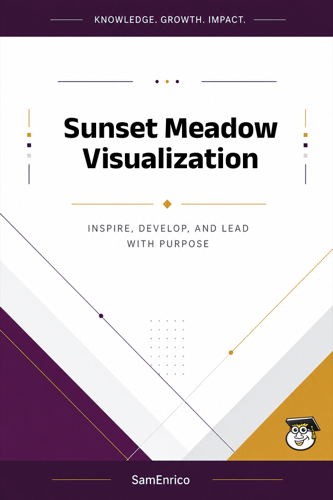
Sunset Meadow Visualization eBook
Lie in tall grass as the sky turns orange and pink
by Duarte Fanny
Lie in tall grass as the sky turns orange and pink around you.
Formats
Free sample
Chapter 1: The Surrender Scan--The first mistake almost everyone makes when they hear about sunset visualization is thinking it’s about the sky. It isn’t. Not really. The sky is the reward, not the foundation. You can watch a thousand perfect sunsets from a standing position, jaw clenched, shoulders raised, phone in hand, and you will feel nothing except the vague disappointment that beauty didn’t fix you.
The foundation of this practice—the thing that determines whether the next sixty minutes will be transformative or merely pleasant—is what happens to your body before you ever look up.You cannot watch the sunset properly if your jaw is clenched. You cannot receive the colors if your shoulders are raised toward your ears. You cannot be changed by the pink afterglow if your hands are gripping the grass, your lower back is hovering off the ground, or your breath is being held hostage by a mind that refuses to stop doing. The sky will perform whether you are ready or not. The question is whether you will be there to receive it.This chapter is called The Surrender Scan because that is exactly what it teaches: not relaxation, which is something you do to yourself, but surrender, which is something you allow to happen.
Relaxation is active. Surrender is passive. Relaxation says, “I will now release my shoulders.” Surrender says, “I notice my shoulders are raised, and I have no need to keep them there anymore.” The difference is subtle but profound. One is effort. The other is permission.
And permission is the only thing that works when you are lying in tall grass as the sky turns orange and pink around you.Before we begin, a clarification that will save you from confusion later: you may practice this visualization either outdoors in a real meadow (weather and location permitting) or indoors with your eyes closed, using imagination. Both are equally valid. If you are outdoors, the ground beneath you is real. The grass you feel is actual grass. The sounds you hear are happening in real time.
If you are indoors, you will imagine all of these sensations in as much detail as you can generate. Neither approach is superior. The only requirement is that you commit to whichever you choose. Half-believing you are in a meadow while half-checking to see if the neighbor is watching will produce nothing except frustration. Choose, and then let the choice disappear.The Default Meadow For the purposes of this book, the visualization assumes a specific setting: a late summer meadow in a temperate climate.
The grass is dry but not brittle. It has been warmed by the sun all day and is now beginning to cool as evening approaches. The ground beneath the grass is uneven in the way that all real ground is uneven—small dips, the occasional stone, the subtle mound of an old mole tunnel. The air is still warm but carries the first hint of coolness that signals sunset is coming. There are grasshoppers.
There are wildflowers, though you may not see them yet. There is the distant possibility of rain, suggested by a particular quality in the air that you can almost smell but not quite name.If you live in a desert, a tropical climate, or somewhere with no late summer as this book describes it, you are invited to adapt. The essential elements are these: you are horizontal, you are hidden, the sky is above you, and the sun is going down. Everything else is negotiable. Appendix C offers seasonal and climate variations.
For now, trust the default. It exists for a reason.Choosing Your Position Before any scanning, any breathing, any watching of the sky, you must find the position your body will hold for the next hour. This is not a casual decision. The position is the container for everything that follows. If the container is uncomfortable, the contents will spill.Lie down on your back.
If you are outdoors, choose a spot where the grass is tall enough to rise above your sightline when you are horizontal. You should not be able to see the horizon clearly without the grass intervening. This is important for reasons that will become clear in Chapter 6. For now, simply know that being hidden changes everything. If you are indoors, lie on a carpeted floor, a yoga mat, or your bed.
The surface matters less than the intention. Arrange your body so that your spine is as straight as possible without forcing it. Your arms can rest at your sides, palms up, or on your belly—whichever allows your shoulders to drop away from your ears. Your legs should be slightly separated, not pressed together. Your feet will naturally fall outward when your hips are relaxed.
Let them.Now check your head. Most people, when lying on their back, tilt their chin slightly toward their chest or crane their neck back. Neither is correct. Your head should rest in neutral—the same position it would be in if you were standing and looking straight ahead. Imagine a line running from the crown of your head down through your spine to your tailbone.
That line should be straight. If you need a small pillow or folded blanket under your head to achieve this, use it. The goal is not ascetic discomfort. The goal is structural surrender.The first inconsistency most beginners encounter is the belief that they need to lie perfectly still. You do not.
You will shift. You will adjust. An itch will appear, and you will scratch it. This is not failure. This is a body reminding you that it is alive.
The only instruction is that when you adjust, you do so slowly, with awareness, and then you return to the position. Sudden, jerky movements wake up the nervous system. Slow, deliberate movements keep it at rest.The Surrender Scan: A Complete Body Map Now you will perform The Surrender Scan. This is not a relaxation exercise. It is a systematic investigation of where you are holding tension that you did not know you were holding.
The difference between a tense body and a surrendered body is not a matter of degree. It is a matter of consciousness. You cannot release what you do not feel. The scan is how you feel it.Begin with your scalp. Most people have never paid attention to their scalp.
They wash it, they brush it, they ignore it. But the scalp is one of the first places tension accumulates—a subtle tightening that runs from the forehead over the crown and down to the base of the skull. Breathe in. As you breathe out, imagine that your scalp is softening. Not relaxing.
Softening. There is a difference. Relaxation implies effort. Softening implies permission. Let the skin on your head become heavy.
If you cannot feel your scalp at all, that is also information. Note it and move on.Move to your jaw. This is where most people store the tension of the day. Clench your jaw now, on purpose, so you know what it feels like. Harder.
Now release. Notice the difference. The jaw has no need to be clenched. There is nothing here to bite, nothing…
This is the end of the free sample. Get the eBook to keep going. Buy now
About this book
Details
- Author
- Duarte Fanny
- Publisher
- SamEnrico
- Language
- English
- Genre
- Non-Fiction, Self-Help, Mindfulness
- Released
- 2026-06-08
- Pages (approx.)
- 125
- Available as
- eBook, Audiobook

Read better in the ZLOADR app
Your eBooks on your phone or tablet. Sign in with your SamEnrico account and start reading.
More by Duarte Fanny
 Loving Kindness for a Partner in RecoveryDuarte Fanny$11.99
 Parent Loss Complicated GriefDuarte Fanny$11.99
 Calcium Bone Health GuideDuarte Fanny$11.99
 Meth Family Intervention GuideDuarte Fanny$11.99
 Immigrant Logistics Disruptor CourseDuarte Fanny$11.99
 Visuospatial SketchpadDuarte Fanny$11.99
 NVC For HealthcareDuarte Fanny$11.99
 Review and Reflect BlockDuarte Fanny$11.99
 The Silver Branch: A Druid’s Last StandDuarte Fanny$11.99
 The Healing Hands of the Nile: Black Surgeons of Ancient EgyptDuarte Fanny$11.99
 The Coral Whisperer: How One Woman Saved an OceanDuarte Fanny$11.99
 Reach Stability SystemsDuarte Fanny$11.99
You may also like
 Metta Self Compassion FirstFellows Petrina$11.99
 The Observation Lead HandbookToliver Vivien$11.99
 The Noticing Comparison ExerciseAugustine Onita$11.99
 The Four Phrases Metta MethodForrester Harriette$11.99
 The Eight Week MBSR WorkbookLudwig Norah$11.99
 Spending Urge Surfing HandbookFredericks Refugia$11.99
 Mindfulness of EmotionsStegall Serita$11.99
 Mindfulness for Urge ControlMessenger Tamela$11.99
 Mindfulness for Students HandbookEgan Ira$11.99
 Mindfulness for Relationship RageBranham Elfriede$11.99
 Mindful Sleep InductionHeck Sherril$11.99
 Mindful Parenting for Stressed MomsDugas Tracee$11.99