
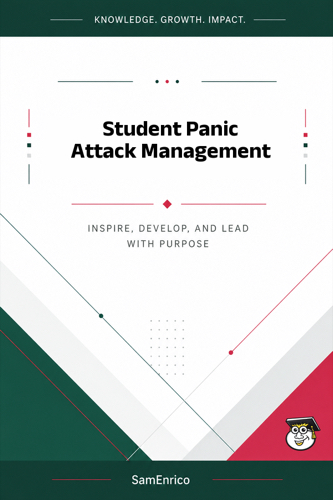
Student Panic Attack Management eBook
Use grounding techniques during exams or presentat
Use grounding techniques during exams or presentations to stop spiraling.
Formats
Free sample
Chapter 1: The 3-Second Warning--–- The spiral doesn’t announce itself with a bang. It whispers. And if you don’t catch that whisper in the first three seconds, the whisper becomes a roar, and the roar becomes a blackout. That’s what happened to Maya during her second-year organic chemistry midterm. She had studied for forty-seven hours.
She knew the difference between SN1 and SN2 reactions cold. She had slept six hours—not great, but not terrible. And yet, when she turned the first page of the exam, the letters didn’t just blur. They became meaningless shapes. Her heart didn’t race so much as it slammed against her ribs like an animal in a cage.
She looked up. Thirty other students were scribbling. One proctor was staring directly at her—or so it felt. Maya grabbed her exam, walked to the front of the room, and whispered, “I can’t do this.” Then she walked out.That was the day Maya learned something most students never put into words: panic doesn’t come from lack of preparation. It comes from a mismatch between a normal biological alarm system and a situation your brain has labeled as life-threatening—even when it’s just a test.
Maya’s story opens this chapter because it contains the single most important fact about student panic attacks: they are never about the material. They are about the first three seconds. Catch the spiral in those three seconds, and you can stop it. Miss that window, and you’re fighting a fire that has already left the building.This chapter will teach you how to become a spiral detector. You will learn to identify the physical and cognitive warning signs that appear in the three seconds before panic fully engages.
You will be introduced to the most powerful grounding technique in existence—the 5-4-3-2-1 sensory reset—and you will learn why daily practice (even when you feel fine) is the secret to making that technique automatic during real crises. By the end of this chapter, you will have your own Spiral Log, a personalized early warning system that turns your unique panic signatures into actionable data. And you will have a roadmap for the rest of the book: a Master Techniques Table that previews all twelve grounding tools you will build over the coming weeks.Let’s start with what actually happens inside your body during those first three seconds—because once you understand the mechanism, you stop blaming yourself for being weak, and you start building a better off switch.The Anatomy of a 3-Second Hijack Your brain is designed to keep you alive, not to make you feel comfortable during exams. This is the single most important fact you will read in this entire book. The human panic response evolved to save you from predators, not from multiple-choice questions.
But your brain cannot tell the difference between a saber-toothed tiger and a final exam when certain conditions are met. Here is what happens in those first three seconds.At second one, your amygdala—a small almond-shaped cluster of neurons deep in your brain—sounds the alarm. The amygdala does not think. It does not reason. It does not ask, “Is this threat real or imagined?” It simply detects something that resembles a past threat (a high-pressure situation, a watching audience, the memory of a previous failure) and sends an emergency signal to your hypothalamus.
This is the amygdala hijack, a term coined by neuroscientist Daniel Goleman, and it happens faster than conscious thought.By second two, your sympathetic nervous system has already flooded your body with adrenaline and cortisol. Your heart rate doubles. Your breathing becomes shallow and fast. Blood rushes away from your prefrontal cortex—the rational thinking part of your brain—and toward your limbs, because your body genuinely believes you might need to run or fight. This is why your mind goes blank during panic.
It’s not a moral failure. It’s a blood flow problem. Your prefrontal cortex has literally been deprioritized.By second three, you experience the subjective feeling of panic. For some students, this feels like tunnel vision (your peripheral vision narrows or darkens). For others, it feels like derealization (the exam paper looks unreal, like it’s made of plastic or sitting behind glass).
For many, it feels like a racing heart combined with the absolute certainty that you are about to die, faint, or humiliate yourself. None of these outcomes is actually likely. But your amygdala doesn’t know that.Here is what you must understand: once this cascade reaches second three, you cannot think your way out of it. Your rational brain is offline. Trying to reason with yourself during a panic attack is like trying to reason with a fire alarm while the building is burning down.
You don’t need logic. You need an emergency brake. That emergency brake is called grounding, and we will teach you the most effective form of it later in this chapter.But first, you need to learn how to catch the spiral before it reaches second three. Because grounding works best when you apply it at second one or two—when the alarm is still just a whisper.Physical Cues: Your Body’s Early Warning System Every student has a unique physical signature of rising panic. For some, the first sign is a tingling sensation in the hands or feet.
For others, it’s a sudden feeling of heat in the chest or face. For many, it’s a slight quiver in the voice or a feeling that the throat is tightening. These signals appear in the first second—before the heart races, before the tunnel vision sets in. Most students miss them because they aren’t paying attention. But you are going to learn to catch them.Let’s go through the most common physical cues, ranked by how frequently students report them in clinical studies of test anxiety.
As you read, note which ones sound familiar to you.Racing or pounding heart. This is the most common physical symptom, reported by nearly eighty percent of students who experience test anxiety. But here’s what most people don’t know: the heart rate increase starts before you consciously feel anxious. Your heart rate can jump from seventy beats per minute to one hundred and twenty beats per minute within two seconds of seeing the exam. By the time you feel your heart pounding, you are already in second two or three.Tunnel vision or blurred vision.
Your pupils dilate under stress to let in more light—that’s a survival mechanism. But excessive dilation can make your vision feel strange, almost like you’re looking through a paper towel roll. Some students report that the exam paper looks too bright or too fuzzy. Others say the words seem to float on the page. This is derealization, a form of visual distortion caused by the same adrenaline flood that deprioritizes your prefrontal cortex.Shortness of breath or the feeling of choking.
Your breathing pattern changes during panic. Instead of a slow, steady rhythm, your breath becomes fast and shallow, originating in…
This is the end of the free sample. Get the eBook to keep going. Buy now
About this book
Details
- Author
- Wiseman Catharine
- Publisher
- SamEnrico
- Language
- English
- Genre
- Non-Fiction, Self-Help, Panic
- Released
- 2026-06-08
- Pages (approx.)
- 149
- Available as
- eBook, Audiobook

Read better in the ZLOADR app
Your eBooks on your phone or tablet. Sign in with your SamEnrico account and start reading.
More by Wiseman Catharine
 Self Hypnosis Progressive Relaxation CourseWiseman Catharine$11.99
 Beginner's Kettlebell SwingWiseman Catharine$11.99Beginner's Kettlebell SwingWiseman Catharine$11.99
 Anger in Long Distance RelationshipsWiseman Catharine$11.99
 Chunking for Bulletin JournalingWiseman Catharine$11.99
 Quantum Dreams in the Desert: The Pioneers of Middle Eastern Quantum ScienceWiseman Catharine$11.99
 The Silk Road’s Last Emperor: A Forgotten Dynasty’s RiseWiseman Catharine$11.99
 Understanding EndometriosisWiseman Catharine$17.99
 Scrum for Google StartupsWiseman Catharine$12.99
 AI Art Niche SelectionWiseman Catharine$12.99
 Fruit Smoothie MakerWiseman Catharine$11.99
 How to Start a Continuous Cast Products Made of Steel Business (Beginners Guide)Wiseman Catharine$11.99
You may also like
 Hong Kong Handover 1997Dunn Johnnie$11.99
 Zumba For Postnatal Recovery CourseNeal Christian$11.99
 Zumba for BeginnersLadner Nikia$11.99
 YouTube Comment Mining GuideHumes Pandora$12.99
 Worry Box MeditationCarlin Rudy$11.99
 Workplace Stress MeditationNguyen Lynn$11.99
 Workplace Stress and Sleep RepairHawley Ivory$11.99
 Workplace Perfectionism CureDelaney Jeffry$11.99
 Workplace Injustice Anger GuideWallen Isabelle$11.99
 Work Addiction and Burnout LinkGreenwood Ester$11.99
 Women in Yoga and WellnessBeattie Galina$11.99
 Women in Stand Up ComedyChun Evangeline$11.99