
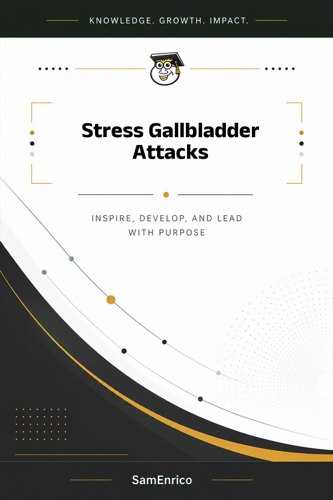
Non-FictionSelf-HelpGallbladder
Stress Gallbladder Attacks eBook
How tension triggers painful gallstone episodes.
by Hunt Clayton
How tension triggers painful gallstone episodes.
Formats
Free sample
Chapter 1: The Great Masquerade--–- The first time Eleanor’s gallbladder attacked her, she was standing in the frozen food aisle of a grocery store, trying to decide between two brands of organic vegetable lasagna. She was forty-two years old, a senior accountant at a regional firm, mother of two teenagers, and the primary caregiver for her aging mother who lived fifteen minutes away. Her life was a carefully orchestrated sequence of obligations, and she had not had an uninterrupted night of sleep in nearly six years. The pain arrived not as a dramatic thunderclap but as a quiet, malevolent pressure just beneath her right rib cage—like someone had slipped a smooth stone between her liver and her diaphragm and was slowly inflating it. She finished her shopping, drove home, unloaded the groceries, and only then allowed herself to sit down and acknowledge that something was very, very wrong.
By midnight, she was in the emergency department of her local hospital, where a tired resident pressed on her abdomen, ordered an ultrasound, and delivered the news: gallstones. Multiple. The largest was 1.8 centimeters. The recommendation was straightforward: schedule a laparoscopic cholecystectomy and be done with it. Eleanor nodded, took the surgical referral, and went home.
But something about the diagnosis never sat right with her. Not because she doubted the ultrasound—the stones were clearly there on the images—but because the pattern of her attacks did not match the pattern her doctor described. He had told her to avoid fatty foods: cheeseburgers, pizza, fried chicken, creamy sauces. And yet, Eleanor could eat a cheeseburger with fries and feel absolutely nothing. She could eat a bowl of steamed vegetables and brown rice and find herself curled on the bathroom floor three hours later.
Her attacks did not follow meals. They followed phone calls with her mother. They followed quarterly reporting deadlines. They followed nights when she lay awake replaying every mistake she had made in the past decade. The stones were real.
But the trigger was something else entirely.This is the great masquerade of stress-induced gallbladder disease. Millions of people walk around with imaging-confirmed gallstones, dutifully avoiding dietary fat, while their attacks continue unabated—because the true trigger was never the food on their plate. It was the cortisol in their blood, the tension in their diaphragm, the clenched fist of their sympathetic nervous system squeezing their bile duct shut like a garden hose under a bootheel. And because conventional medicine is trained to see stones on a screen but cannot visualize a spasm, these patients are systematically misdiagnosed, dismissed, and—most tragically—subjected to surgery that often fails to address the root cause of their pain.The Epidemiology of Silence Gallstones are astonishingly common. In Western nations, the prevalence ranges from 10 to 15 percent of the adult population, rising to nearly 30 percent in women over sixty and in certain ethnic groups, including Indigenous peoples of North and South America and Hispanic populations.
In absolute numbers, this means approximately 20 to 25 million Americans are walking around with gallstones at any given moment. For the vast majority of these people—as many as 80 percent—the stones remain entirely asymptomatic. They are discovered incidentally during an ultrasound for an unrelated complaint, like a "silent passenger" that never causes trouble. These individuals are appropriately managed with watchful waiting, and most will never need intervention.But for the remaining 20 percent—roughly four to five million Americans—the stones eventually announce themselves. The classic presentation is biliary colic: a steady, gnawing, or cramping pain in the right upper quadrant or epigastrium, often radiating to the right shoulder blade or the tip of the scapula.
The pain typically begins thirty to ninety minutes after a fatty meal, as the gallbladder contracts against an obstructing stone, and it resolves gradually over one to six hours as the stone either passes back into the gallbladder or the spasm relaxes. This is the textbook picture, and it is what every medical student learns to expect.Here is the problem: the textbook picture describes only a subset of patients. A substantial proportion—some studies suggest 30 to 40 percent—do not fit this pattern. Their attacks occur after stress, not after meals. Their pain is not predictably postprandial.
Their ultrasounds show stones, yes, but the stones are small, or they are multiple, or they are accompanied by sludge that would not explain the severity of the symptoms. And when these patients undergo the standard surgical treatment—cholecystectomy—their outcomes are significantly worse than those of their "classic presentation" counterparts. Up to 40 percent of patients with atypical, stress-triggered symptoms continue to experience pain after surgery, a condition known as Post-Cholecystectomy Syndrome. They have removed the organ, but they have not removed the spasm.The medical literature has a name for this population, though you will rarely hear it discussed in a surgeon's office. They are the "functional" patients.
Their pain is real. Their suffering is real. Their imaging is abnormal enough to justify surgery. But their underlying pathophysiology is not primarily mechanical—it is neuroendocrine. And because the system is designed to treat mechanical problems (stones) with mechanical solutions (surgery), they fall through the cracks.The Diagnostic Blind Spot To understand why stress-triggered gallbladder attacks are so consistently misdiagnosed, you must understand what a standard abdominal ultrasound actually shows—and what it completely misses.An ultrasound uses sound waves to create images of solid structures.
It is excellent at detecting gallstones, which appear as bright, echogenic foci that cast acoustic shadows. It is excellent at measuring gallbladder wall thickness, which can indicate inflammation. It is excellent at visualizing the diameter of the common bile duct, which can dilate if a stone is lodged downstream. These are all static, anatomical features. The ultrasound is a snapshot of the gallbladder at rest.What the ultrasound cannot see is movement.
It cannot see the Sphincter of Oddi—the tiny, donut-shaped ring of smooth muscle at the junction of the common bile duct and the duodenum—snapping shut in response to a surge of norepinephrine. It cannot see the cystic duct kinking as the gallbladder spasms. It cannot see the pressure gradient building inside the biliary tree as the sympathetic nervous system diverts blood flow away from the gut and toward the muscles of the arms and legs. These are dynamic, functional phenomena. They happen in time, not in space.
And conventional imaging is blind to time.This diagnostic blind spot has profound consequences. A patient arrives at the emergency department with severe right upper quadrant pain. The physician orders an ultrasound. The ultrasound shows gallstones. The physician concludes that the stones are the cause of the pain.
This is a reasonable inference—most of the time. But in the stress-sensitive patient, the stones may be incidental. The pain may be caused by a stress-induced spasm that would have occurred with or without the stones. The stones are a red herring. And because the physician has no way to distinguish between a "stone-caused" attack and a "spasm-caused" attack in the moment, the patient is labeled as having symptomatic cholelithiasis and referred for surgery.There is a test that can help distinguish these populations, but it is vastly underutilized.
The HIDA scan (hepatobiliary iminodiacetic acid scan) with CCK (cholecystokinin) infusion measures the gallbladder's ejection fraction—the percentage of bile it…
This is the end of the free sample. Get the eBook to keep going. Buy now
About this book
Details
- Author
- Hunt Clayton
- Publisher
- SamEnrico
- Language
- English
- Genre
- Non-Fiction, Self-Help, Gallbladder
- Released
- 2026-06-09
- Pages (approx.)
- 144
- Available as
- eBook, Audiobook

Read better in the ZLOADR app
Your eBooks on your phone or tablet. Sign in with your SamEnrico account and start reading.
More by Hunt Clayton
 Rugby Player's Hypnosis GuideHunt Clayton$11.99
 Perimenopause Nutrition PlanHunt Clayton$11.99
 Caregiver Stress PartnershipHunt Clayton$11.99
 Self Talk for CouplesHunt Clayton$11.99
 The Deep Work Hope GuideHunt Clayton$11.99
 Eisenhower Matrix for Event PlannersHunt Clayton$11.99
 Mars Desert Calm GuideHunt Clayton$11.99
 The Hidden Brushstrokes: Trailblazing Women Artists of the Golden AgeHunt Clayton$11.99
 The Great Fire That Never Was: The 1992 Windsor Arson ConspiracyHunt Clayton$11.99
 Zebus: Humped CattleHunt Clayton$11.99
 How to Start a Hobby in Computer programmingHunt Clayton$11.99
 How to Produce Disc Golf EquipmentHunt Clayton$11.99
You may also like
 Hong Kong Handover 1997Dunn Johnnie$11.99
 Zumba For Postnatal Recovery CourseNeal Christian$11.99
 Zumba for BeginnersLadner Nikia$11.99
 YouTube Comment Mining GuideHumes Pandora$12.99
 Worry Box MeditationCarlin Rudy$11.99
 Workplace Stress MeditationNguyen Lynn$11.99
 Workplace Stress and Sleep RepairHawley Ivory$11.99
 Workplace Perfectionism CureDelaney Jeffry$11.99
 Workplace Injustice Anger GuideWallen Isabelle$11.99
 Work Addiction and Burnout LinkGreenwood Ester$11.99
 Women in Yoga and WellnessBeattie Galina$11.99
 Women in Stand Up ComedyChun Evangeline$11.99