
Non-FictionSelf-HelpNarrative Memory
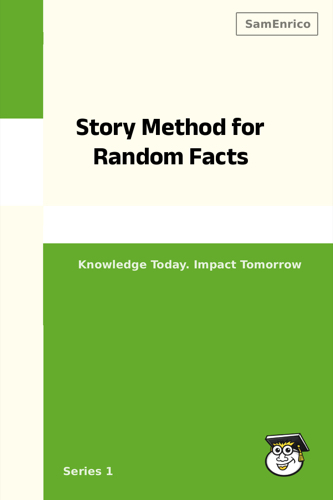
Story Method for Random Facts eBook
Teaches linking unrelated items into a vivid narra
by Baer Jacinto
Teaches linking unrelated items into a vivid narrative for easier recall.
Formats
Free sample
Chapter 1: The Forgetting Funeral--–- The day I forgot my own mother’s phone number, I was standing in an airport terminal, sweating through my shirt, staring at a screen of ten digits that might as well have been ancient Sanskrit. I had dialed that number once a week for fifteen years. Fifteen years. And yet, under the mild pressure of a canceled flight and a dead phone battery, my brain simply… deleted it. Not misplaced it.
Not blurred it. Deleted it, the way you’d empty a trash folder without a second thought.That moment was not unusual. It was not a medical emergency or a sign of early dementia. It was the forgetting curve doing exactly what it evolved to do: purge information that lacks context, emotion, and narrative structure. My mother’s number wasn’t a story.
It was a string of digits. And the human brain, for all its staggering complexity, is terrible at storing strings.But here is what I remembered perfectly from that same trip: the plot of a mediocre action movie I had watched on the plane. I could describe the hero’s jacket, the villain’s scar, the car chase through Budapest, even the throwaway line about a stolen hard drive. I had seen that movie once, half-watching, while eating a stale pretzel. And yet it stuck.
Not because it was important. Because it was a story.This is the great paradox of human memory. We spend years in school trying to memorize facts through repetition, flashcards, and sheer willpower — methods that fight against our brain’s natural architecture. Meanwhile, we effortlessly absorb hundreds of narratives from books, movies, gossip, and dreams, retaining them for decades without any conscious effort. The problem is not that you have a bad memory.
The problem is that you have been using the wrong tool for the job.This chapter will bury the myth that memory is about repetition. You will learn why your brain treats lists like poison and stories like oxygen. You will meet the forgetting curve — an enemy you cannot defeat with brute force but can outsmart with narrative. And you will run your first experiment, proving to yourself that a thirty-second story can outperform an hour of flashcards.By the end of this chapter, you will never look at a random fact the same way again. You will see it not as a burden to be crammed, but as the seed of a story waiting to be told.The Funeral of Repetition Let us begin with a eulogy.
We are here to bury the myth of rote memorization.Rote repetition — saying a fact over and over, writing it again and again, staring at a flashcard until your eyes water — has been the dominant model of learning for centuries. It feels productive. It feels like effort. And it works just well enough to fool you into thinking it works at all.The truth is brutal. Research in cognitive psychology has consistently shown that rote repetition produces what scientists call “shallow encoding.” You are not building a memory; you are wearing a groove in sand.
Within hours, sometimes minutes, the information washes away.Consider a landmark study by Hermann Ebbinghaus, the German psychologist who discovered the forgetting curve in 1885. He memorized lists of nonsense syllables (like “ZOF” and “KAP”) and tested himself at intervals. His results, replicated hundreds of times since, showed a devastating pattern: within one hour, he forgot nearly 50 percent of what he had learned. Within 24 hours, he had lost 70 percent. Within a week, only 10 percent remained.And that was with nonsense syllables — items with no prior associations.
Real-world facts are slightly better, but not much. The curve is relentless.But here is what Ebbinghaus also discovered, though it took generations of researchers to fully appreciate: when information is embedded in a meaningful structure — a story, a narrative, a cause-and-effect chain — the forgetting curve flattens dramatically. Instead of losing 70 percent in a day, you might lose 20 percent. Instead of forgetting everything in a week, you retain the core for months or years.The difference is not in the facts themselves. The difference is in the packaging.Your brain is not a hard drive.
It does not store data in neat folders. It stores experiences. And a story, even a stupid one, is an experience. A list is not.Three Funerals, One Wedding To understand why stories defeat the forgetting curve, we have to look under the hood. Memory, as neuroscientists now understand it, is not a single process but three distinct stages: encoding, storage, and retrieval.Encoding is the moment your brain first encounters new information.
This is where most memory failures begin. When you read a random fact in isolation — “Octopuses have three hearts” — your brain encodes it weakly. Why? Because there is nothing to attach it to. No character.
No conflict. No emotional residue. The fact enters your mind like a stranger at a party, speaks once, and then disappears into the crowd.Storage is how your brain keeps information over time. Contrary to popular belief, memories are not stored in one place. They are distributed across networks of neurons.
A single fact might involve your visual cortex (if you saw it written), your auditory cortex (if you heard it spoken), and your prefrontal cortex (if you thought about it). The more brain regions involved during encoding, the stronger the storage.Retrieval is the act of pulling a memory back into conscious awareness. This is where stories really shine. A well-encoded story offers multiple paths to the same fact. You can retrieve it through the character, the setting, the emotional twist, the sensory detail, or the narrative sequence.
A list offers one path: brute force.Now here is the wedding. When you turn a fact into a story, you are not just making it more interesting. You are fundamentally changing how it is encoded, stored, and retrieved. You are transforming a lone stranger into a guest with friends, a backstory, and a reason to stay.The Von Restorff effect, named after the German psychiatrist Hedwig von Restorff, adds the final piece. Her research, published in 1933, showed that when multiple items are presented together, the one that stands out — the bizarre, the emotional, the unexpected — is far more likely to be remembered.
In a list of ten vegetables, a singing carrot is unforgettable. In a sequence of historical dates, the one where a king choked on a fish bone is the one you will recall a decade later.Stories are not just containers for facts. They are factories for Von Restorff moments. Every twist, every absurd image, every emotional beat is a neon sign pointing at the fact you want to remember.But — and this is crucial — there is a limit. Too much weirdness, and the sign becomes noise.
That calibration, the sweet spot between boring and chaotic, is so important that we will devote an entire chapter to it later (Chapter 9). For now, the rule is simple: add one surprising element per two realistic ones. A talking stapler in an otherwise normal office. An astronaut slipping on a banana peel on the moon. A rebellious mitochondria demanding a vacation.
That is the goldilocks zone of memorable absurdity.The Airport Experiment Before we go any further, you are going to prove…
This is the end of the free sample. Get the eBook to keep going. Buy now
About this book
Details
- Author
- Baer Jacinto
- Publisher
- SamEnrico
- Language
- English
- Genre
- Non-Fiction, Self-Help, Narrative Memory
- Released
- 2026-06-07
- Pages (approx.)
- 131
- Available as
- eBook, Audiobook

Read better in the ZLOADR app
Your eBooks on your phone or tablet. Sign in with your SamEnrico account and start reading.
More by Baer Jacinto
 Pet Loss MeditationBaer Jacinto$11.99
 Dream Premonition LogBaer Jacinto$11.99
 Walking Meditation in RehabBaer Jacinto$11.99
 The Rhyme and Song MethodBaer Jacinto$11.99
 Yoga Nidra Nap GuideBaer Jacinto$11.99
 Honor Your HungerBaer Jacinto$11.99
 Financial Goal Action PlanBaer Jacinto$11.99
 The Starlight Philanthropists: How Black Industrialists Funded the FutureBaer Jacinto$11.99
 The Ballarat Goldfields Conspiracy: Australia's Forgotten Mob TrialBaer Jacinto$11.99
 A Collector's Handbook to the Lancia 2000hfBaer Jacinto$11.99
 Cooperative Succession PlanningBaer Jacinto$12.99
 API Payment IntegrationBaer Jacinto$12.99
You may also like
 Hong Kong Handover 1997Dunn Johnnie$11.99
 Zumba For Postnatal Recovery CourseNeal Christian$11.99
 Zumba for BeginnersLadner Nikia$11.99
 YouTube Comment Mining GuideHumes Pandora$12.99
 Worry Box MeditationCarlin Rudy$11.99
 Workplace Stress MeditationNguyen Lynn$11.99
 Workplace Stress and Sleep RepairHawley Ivory$11.99
 Workplace Perfectionism CureDelaney Jeffry$11.99
 Workplace Injustice Anger GuideWallen Isabelle$11.99
 Work Addiction and Burnout LinkGreenwood Ester$11.99
 Women in Yoga and WellnessBeattie Galina$11.99
 Women in Stand Up ComedyChun Evangeline$11.99