
Non-FictionAnnual CheckupState Privacy
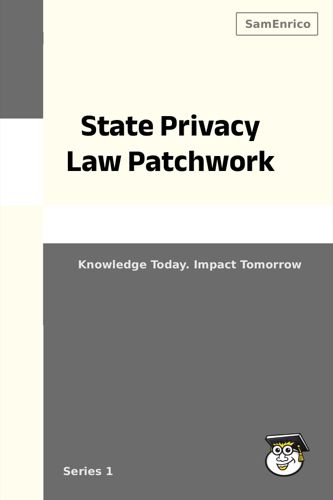
State Privacy Law Patchwork eBook
Document Virginia, Colorado, Connecticut, and Utah
Document Virginia, Colorado, Connecticut, and Utah privacy law impacts.
Formats
Free sample
Chapter 1: The California Mirage...--For nearly a decade, privacy professionals have operated under a comforting illusion. That illusion—call it the California Mirage—held that if you built a compliance program to satisfy the California Consumer Privacy Act and its successor, the California Privacy Rights Act, you had effectively built a national program. The logic was seductive in its simplicity: California is the largest economy in the United States, its laws are the most stringent, and no company of any size would bother maintaining fifty different compliance architectures. Better to build one robust program and apply it everywhere. Better to treat California as the ceiling and call the job done.That era ends in 2026.
Not gradually. Not with a gentle transition period. It ends with the force of a regulatory tsunami that has been building for three years, unnoticed by all but the most obsessive compliance watchers. The California Mirage shatters not because California has weakened—far from it—but because four other states have evolved in radically different directions, creating a patchwork that cannot be papered over by a single privacy policy. Virginia, Colorado, Connecticut, and Utah have each constructed privacy regimes that diverge from California and from one another on foundational questions: What constitutes a sale of data?
At what age does a consumer become an adult for privacy purposes? How long does a business have to fix a violation before facing a fine? Who has the right to sue? These are not minor technical disagreements. They are irreconcilable philosophical differences that demand entirely different compliance architectures.This book is not another dry recitation of statutory requirements.
It is a strategic field guide for navigating the 2026 privacy landscape, organized around the Four Pillars that now define American data protection: Virginia, Colorado, Connecticut, and Utah. We will not spend significant time on California—not because it is unimportant, but because the compliance industry has already internalized its requirements. The real challenge of 2026 is that California is no longer the ceiling. It is merely one pole in a multipolar system. And the companies that survive this transition will be those that abandon the one-size-fits-all mentality and build modular, state-specific compliance architectures.The End of the California Monopoly To understand why 2026 represents a rupture, not an evolution, we must first understand how California achieved its dominance.
The CCPA, enacted in 2018 and effective in 2020, was the first comprehensive state privacy law in the United States. It arrived at a moment of peak frustration with the notice-and-choice regime that had governed internet privacy since the 1990s—that familiar, useless ritual of clicking "I agree" to a terms-of-service document that no human being reads. The CCPA gave California residents the right to know what data businesses collected about them, to delete that data, and to opt out of its sale. It was imperfect, loophole-ridden, and initially hampered by vague definitions. But it was real.
And because California represents roughly 15 percent of the US economy, companies quickly realized that maintaining a separate compliance regime for California was more expensive than simply adopting its standards nationwide. This phenomenon, known as the "California effect," had precedent in auto emissions standards and consumer warranty laws. A large state with a stringent regulation effectively sets the national standard because manufacturers cannot justify producing two versions of the same product.For several years, the California effect held. When Virginia passed the Virginia Consumer Data Protection Act in 2021, effective 2023, many observers assumed it would be a minor variation on the California theme. When Colorado and Connecticut followed in 2022, the assumption persisted.
Utah, passing its privacy law in 2022 as well, was dismissed as the lightweight—a law so business-friendly that it barely constrained data collection at all. The prevailing wisdom was that these laws would converge over time, either through amendments or through federal preemption, leaving the California model intact as the de facto national standard.That wisdom was wrong. It was wrong because it underestimated the political forces driving state-level privacy legislation. It was wrong because it assumed that all privacy laws share a common philosophical foundation. And it was wrong because it failed to anticipate the 2025 amendment cycles, which would entrench divergence rather than convergence.The 2025 Amendments: Divergence Codified Between the summer and fall of 2025, Virginia, Colorado, and Connecticut each enacted significant amendments to their privacy laws.
These were not technical corrections or minor clarifications. They were substantive changes that locked in each state's unique philosophical orientation. Utah, notably, did not amend its law in 2025, leaving its lighter-touch regime intact.Virginia's amendments focused squarely on minors and social media. The VCDPA was already considered business-friendly—it offered a permanent cure period, no private right of action, and narrow definitions of sensitive data. The 2025 amendments added a new layer: a one-hour daily time restriction for minors on social media platforms, coupled with mandatory parental consent for account creation.
These provisions, effective in 2026, transformed Virginia from a safe harbor for businesses into a testing ground for state-level content moderation. For the first time, a privacy law directly regulated how long a user could interact with a platform. This was no longer about notice, consent, and deletion. This was about design, time, and behavior.Colorado's amendments expanded the Colorado Privacy Act in the opposite direction—toward greater consumer protection. The CPA already featured a "duty of care" for controllers, a concept borrowed from tort law that imposes affirmative obligations to protect consumer data.
The 2025 amendments extended COPPA-style protections to all minors up to age eighteen, not just under thirteen. They banned dark patterns—those manipulative design elements like infinite scroll, autoplay, and reward streaks—specifically for teen users. They required companies to assess their algorithms for bias against minors. And they mandated that data protection assessments be retained for three years and produced to the Attorney General upon request. Colorado was no longer just a privacy law.
It was a design regulation.Connecticut's amendments were the most aggressive of all. The CTDPA already had a broad definition of "sale" that included any transfer of data for "valuable consideration," not just monetary exchange. The 2025 amendments added a data broker registry, requiring any entity that sells data not collected directly from consumers to register annually, pay fees, and provide a centralized deletion mechanism. They restricted algorithmic pricing—sometimes called surveillance pricing—that uses behavioral data to personalize prices. They required disclosure if neural data or biometric information is used to train large language models.
And they mandated specific, opt-in consent for each instance of facial recognition scanning or precise geolocation tracking. Connecticut was no longer regulating data. It was regulating the secondary markets, the AI training pipelines, and the surveillance infrastructure that most consumers never see.Utah, by contrast, stood still. Its law remained the lightest-touch regime: a $25 million revenue threshold that exempted most startups, no right to correct inaccurate data, no universal opt-out mechanism, and no private right of action. The only significant 2026 provision was the Social Media Portability Rule, which required platforms to allow users to export their data to competitors.
But even that rule applied equally to all users, without age-based distinctions. Utah had chosen its path: privacy as an economic transaction, not a fundamental right.The Cure Period Shuffle One of the…
This is the end of the free sample. Get the eBook to keep going. Buy now
About this book
Details
- Author
- Higgins Tiffany
- Publisher
- SamEnrico
- Language
- English
- Genre
- Non-Fiction, Annual Checkup, State Privacy
- Released
- 2026-06-09
- Pages (approx.)
- 143
- Available as
- eBook, Audiobook

Read better in the ZLOADR app
Your eBooks on your phone or tablet. Sign in with your SamEnrico account and start reading.
More by Higgins Tiffany
 Pharmacist Imposter SyndromeHiggins Tiffany$11.99Pharmacist Imposter SyndromeHiggins Tiffany$11.99
 The Teen Self Esteem Podcast GuideHiggins Tiffany$11.99
 Instagram Carousel MasteryHiggins Tiffany$11.99
 The Narcissistic Abuse Self EsteemHiggins Tiffany$11.99
 The Shield of the Sun: The Military Genius of the Aksumite EmpireHiggins Tiffany$11.99
 Understanding Prinzmetal's Variant AnginaHiggins Tiffany$17.99
 Courier Success SpecialistHiggins Tiffany$11.99
 Executive Summary for Strategic PlansHiggins Tiffany$12.99
 Adobe Creative Cloud GuideHiggins Tiffany$12.99
 How to Start a Ballet Dancers - Independent BusinessHiggins Tiffany$11.99
You may also like
 Hong Kong Handover 1997Dunn Johnnie$11.99
 Zumba For Postnatal Recovery CourseNeal Christian$11.99
 Zumba for BeginnersLadner Nikia$11.99
 YouTube Comment Mining GuideHumes Pandora$12.99
 Worry Box MeditationCarlin Rudy$11.99
 Workplace Stress MeditationNguyen Lynn$11.99
 Workplace Stress and Sleep RepairHawley Ivory$11.99
 Workplace Perfectionism CureDelaney Jeffry$11.99
 Workplace Injustice Anger GuideWallen Isabelle$11.99
 Work Addiction and Burnout LinkGreenwood Ester$11.99
 Women in Yoga and WellnessBeattie Galina$11.99
 Women in Stand Up ComedyChun Evangeline$11.99