
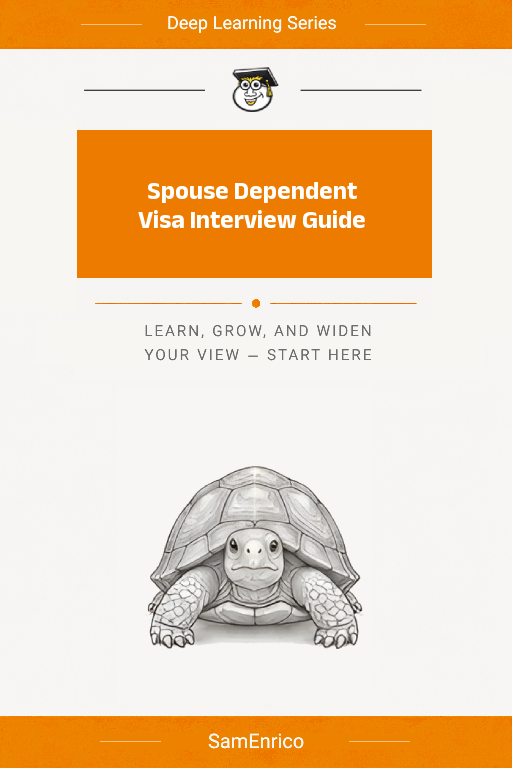
Spouse Dependent Visa Interview Guide eBook
Prepare F2 or PBS Dependent answers about financia
by Chapa Logan
Prepare F2 or PBS Dependent answers about financial support and intention to leave with main applicant.
Formats
Free sample
Chapter 1: The Shadow Applicant--–- The first time I understood how easily a family could be torn apart by a visa officer's pen was not in a courtroom or a solicitor's office. It was in a small, windowless room at the UK Visa and Citizenship Application Services centre in New Delhi, where I watched a woman named Priya walk out of her interview, her face blank, her hands trembling around a single sheet of paper. Her husband had been approved fifteen minutes earlier. His student visa for a Ph D in biomedical engineering at Imperial College London was stamped, sealed, and celebrated. Priya's refusal letter cited a single sentence: "The Entry Clearance Officer is not satisfied that the dependant has demonstrated independent financial knowledge or genuine intention to leave the United Kingdom at the end of the sponsor's leave."She had done everything right.
Or so she thought. The bank statements showed £8,200 – well above the £7,605 required for nine months in London. The marriage certificate was original, attested, and accompanied by wedding photographs. She had even memorised her husband's course schedule. But when the officer asked, "How much money is in your joint account as of today?" Priya hesitated for two seconds.
She looked at her husband. He whispered, "Eight thousand two hundred." The officer wrote: "Dependant sought confirmation from sponsor regarding basic financial information. This raises concerns as to whether the dependant has genuine knowledge of the family's financial position or whether the funds have been provided solely for the purpose of the application."Priya's visa was refused. Her husband flew to London alone. They spent eleven months apart.This book exists because of Priya.
And because of the thousands of spouses every year who receive that same paper, that same sick feeling in their stomach, for reasons that could have been prevented with the right preparation.The Unspoken Truth About Dependent Visas If you are reading this book, you already know the basics: your spouse has been offered a place at a UK university, or a job with a skilled worker sponsor, or perhaps you are accompanying them as a visitor or joining a British citizen partner. You know you need to prove your relationship is genuine. You know you need bank statements. You know there is an interview.What no one tells you is that the Entry Clearance Officer – the person who decides your fate – is trained to see you as a problem to be solved, not a family to be protected. Every year, the UK Home Office publishes refusal data.
For dependant visas, the refusal rate hovers between 18 and 24 percent for PBS dependants and climbs as high as 35 percent for visitor dependants and Appendix FM partners. That means nearly one in four spouses who apply are separated from their families.The reasons are rarely fraud. They are not conspiracy. They are almost always small, preventable mistakes: a bank statement dated 32 days before the application instead of 31, a salary slip that doesn't perfectly match a deposit, a moment of hesitation in an interview, a well-meaning answer like "We love London" that triggers the "settled status" trap.This book exists to ensure you are not one of those statistics.What This Chapter Will Teach You Before we dive into the mechanics of bank statements, the 28-day rule, or the exact phrasing to use when an officer asks about your spouse's future plans, we must first understand how the officer thinks. This chapter covers:The "Anchoring" concept – why officers view dependants as potential burdens The three visa categories and why mixing them up is a common refusal reason The two scores the officer assigns to every application – Financial Risk and Immigration Risk Why small negatives trigger automatic rejections (the $5 overdraft case)The mindset shift from "passenger" to "co-pilot" that changes everything By the end of this chapter, you will no longer see yourself as a tag-along.
You will see yourself as the Shadow Applicant – the person who must appear less risky than the main applicant, even though your visa is tied to theirs.The Anchoring Concept: Why You Are a Burden Until Proven Otherwise Immigration officers do not wake up wanting to separate families. They wake up wanting to protect the UK's borders, its public funds, and the integrity of its immigration system. Your family is not their priority. Their priority is risk assessment.Every officer is trained to ask a single question about every dependant applicant: "If the main applicant fails – if they lose their job, drop out of school, run out of money, or decide to stay illegally – does this dependant have a separate reason to remain in the UK or a separate pot of money to support themselves?"This is called the Anchoring concept. The main applicant is the anchor.
You are the ship tied to that anchor. If the anchor drags, the officer assumes you will drag too – unless you prove otherwise.Consider two scenarios:Scenario A: The main applicant is a Ph D student with full funding and a clear academic record. The dependant has no job, no savings of their own, and no ties to their home country beyond a elderly parent they rarely visit. The officer thinks: "If this student drops out, the dependant has nothing to return to. They will fight to stay.
High risk."Scenario B: The main applicant is the same Ph D student. But the dependant has £5,000 in a personal savings account, a job offer letter from an employer back home with a start date six weeks after the visa expires, and a lease on an apartment in their name. The officer thinks: "This dependant has reasons to leave and money to leave with. Low risk."The difference between Scenario A and Scenario B is not love. It is not the strength of the marriage.
It is documentation and preparation.The Three Visa Categories – And Why Confusing Them Gets You Refused One of the most common reasons for refusal is applying under the wrong rules. The UK has three distinct dependant visa categories, and they are not interchangeable. Using a rule from one category to support an application in another signals to the officer that you have not done your research – which signals that you might be desperate, which signals higher risk.Here are the three categories. You will need to identify yours before you read further.Category 1: PBS Dependant (Points-Based System)This applies if your spouse is:A Student on a Tier 4 or Student visa A Skilled Worker on a Tier 2 or Skilled Worker visa A Graduate visa holder (post-study work)Your rules:Maintenance funds: £845/month for London, £680/month outside London, held for 28 days Work rights: Full rights except for doctors/dentists in training or professional sportspeople No minimum income requirement for the sponsor University sponsorship letters can waive bank statements Category 2: Visitor Dependant (Non-PBS, Temporary)This applies if your spouse is:A Standard Visitor (tourism, short courses, business meetings)A Temporary Worker (Tier 5, Youth Mobility Scheme)A Permitted Paid Engagements visitor Your rules:No minimum income requirement No third-party support – money must belong to you or your spouse No work rights at all (including remote work for a home employer)Must prove strong ties to home country (job, property, family)Maximum stay is…
This is the end of the free sample. Get the eBook to keep going. Buy now
About this book
Details
- Author
- Chapa Logan
- Publisher
- SamEnrico
- Language
- English
- Genre
- Non-Fiction, Student's Shortcut
- Released
- 2026-05-30
- Pages (approx.)
- 148
- Available as
- eBook, Audiobook

Read better in the ZLOADR app
Your eBooks on your phone or tablet. Sign in with your SamEnrico account and start reading.
More by Chapa Logan
 EV Charging Wait RageChapa Logan$11.99
 Geo Arbitrage for Course CreatorsChapa Logan$11.99
 Battle Of Leipzig NationsChapa Logan$11.99
 Persuasion For TeachersChapa Logan$11.99
 The Urgent vs Important Filter GuideChapa Logan$11.99
 Disc Herniation Recovery ExercisesChapa Logan$11.99
 The Household Chore BlockChapa Logan$11.99
 The Freelance Performance ReviewChapa Logan$11.99
 Scripting AffirmationsChapa Logan$11.99
 The Crimson Code: How a Single Dye Changed the WorldChapa Logan$11.99
 The Billionaire Who Bought a Country: The Untold Story of Michael Bloomberg’s Island ExperimentChapa Logan$11.99
 Blackheart & Compass: The Pirate-Explorer Who Charted the UnknownChapa Logan$11.99
You may also like
 Hong Kong Handover 1997Dunn Johnnie$11.99
 Zumba For Postnatal Recovery CourseNeal Christian$11.99
 Zumba for BeginnersLadner Nikia$11.99
 YouTube Comment Mining GuideHumes Pandora$12.99
 Worry Box MeditationCarlin Rudy$11.99
 Workplace Stress MeditationNguyen Lynn$11.99
 Workplace Stress and Sleep RepairHawley Ivory$11.99
 Workplace Perfectionism CureDelaney Jeffry$11.99
 Workplace Injustice Anger GuideWallen Isabelle$11.99
 Work Addiction and Burnout LinkGreenwood Ester$11.99
 Women in Yoga and WellnessBeattie Galina$11.99
 Women in Stand Up ComedyChun Evangeline$11.99