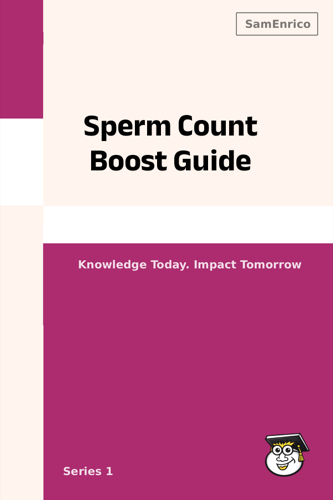
Sperm Count Boost Guide eBook
Teaches lifestyle and dietary changes to increase
by Titus Omega
Teaches lifestyle and dietary changes to increase sperm concentration and total count.
Formats
Free sample
Chapter 1: The 50% Collapse...--–- The first time Mike held his semen analysis report, he thought the lab had made a mistake. He was thirty-four years old, six feet tall, a former college athlete who still ran three times a week. He ate reasonably well. He didn't smoke. He had a demanding job in software engineering, sure, but nothing that should explain the number printed on that page: sperm concentration 12 million per milliliter.
The World Health Organization's "normal" threshold was 15 million. He was below normal. The fertility specialist didn't sugarcoat it. "At this level," she said, "natural conception is possible but unlikely within a twelve-month window. I recommend we discuss intrauterine insemination or IVF."Mike and his wife had been trying for eighteen months.
Two miscarriages. Countless ovulation prediction kits. A calendar covered in color-coded stickers that now felt like evidence of failure. They had already spent thousands of dollars on consultations, testing, and a first round of IVF that had failed to implant. The second round was scheduled to cost another twenty thousand dollars.
Mike was exhausted, ashamed, and convinced that something was fundamentally wrong with him—not just with his sperm, but with his body, his masculinity, his future as a father.Here is what Mike did not know that day, and what this book will teach you: his sperm count was not a life sentence. It was a report card.Six months later, after changing exactly three habits—removing his phone from his front pocket, avoiding hot tubs and car seat warmers, and eating two Brazil nuts daily—Mike's sperm concentration had risen to 48 million per milliliter. His total sperm count had more than tripled. His wife conceived naturally three weeks after his second semen analysis. Today, they have a healthy two-year-old daughter.Mike is not a miracle.
He is not an outlier. He is the rule—once you understand the rules of spermatogenesis.The Silent Epidemic You Haven't Heard About Let us start with the number that should terrify you, not because fear is productive but because denial is dangerous. Between 1973 and 2026, the average sperm concentration among men in Western countries declined by 52 percent. That is not a typo. Half.
In five decades. The most comprehensive meta-analysis to date, published in 2025 and spanning fifty-three countries and over 70,000 men, found that the average man today has half the sperm his grandfather had at the same age. The rate of decline is not slowing; it is accelerating. In the 1980s and 1990s, the decline was approximately 1.2 percent per year. Since 2015, it has been closer to 2.5 percent per year.Let those numbers land.
If the trend continues, the median sperm concentration in young men will fall below the WHO "fertile" threshold by 2045. That is not a prediction of human extinction—assisted reproductive technology will still work for many—but it is a prediction of a world where natural conception becomes the exception rather than the rule. A world where most couples require medical intervention to have biological children. A world where the baseline of male health has shifted so dramatically that "normal" is redefined downward every decade.This chapter is not written to scare you into paralysis. It is written to wake you up.
Because here is the counterintuitive truth that the fertility industry does not want you to hear: most male factor infertility is reversible. Not all. Some men have anatomical or genetic conditions that require medical intervention, and we will address those in Chapter 11. But the majority of men who receive a diagnosis of "low sperm count" or "low concentration" have acquired that condition through lifestyle, environment, and behavior. What has been acquired can be reversed.Infertility Versus Sub-Fertility: The Critical Distinction Before we go any further, we need to establish a distinction that most doctors do not take the time to explain.
Clinical infertility is defined as the inability to conceive after twelve months of regular, unprotected intercourse. It affects approximately one in six couples worldwide, and male factor contributes to roughly half of those cases. Clinical infertility can be permanent or temporary, depending on the underlying cause. It is a diagnosis.Sub-fertility is different. Sub-fertility means reduced fertility potential that falls below the threshold for "normal" but does not necessarily meet the clinical definition of infertility.
A man with a sperm concentration of 12 million per milliliter (like Mike) may not be clinically infertile—he could conceive naturally given enough time—but he is sub-fertile. His odds of natural conception in any given cycle are significantly lower than a man with 50 million per milliliter. Sub-fertility is almost always reversible because it is almost always caused by modifiable factors: diet, heat exposure, endocrine disruptors, sleep deprivation, stress, and recreational substances.Here is the analogy I want you to keep in your mind throughout this book. Imagine your sperm count is your credit score. A credit score of 500 is bad.
It suggests past mistakes, but it also suggests that with changed behavior—paying bills on time, reducing credit utilization, disputing errors—the score can rise into the 700s within months. Your sperm count works the same way. It is a dynamic, responsive measure of your recent history. It is not a fixed trait like eye color or height.The World Health Organization has revised its reference values for "normal" semen parameters multiple times over the past forty years. In 1980, the normal threshold for sperm concentration was 60 million per milliliter.
In 1990, it was lowered to 40 million. In 2010, it was lowered again to 15 million. This does not mean that men in 1980 had better sperm because the testing was different. It means that the distribution of sperm counts in the general population has shifted so dramatically that the definition of "normal" had to be lowered to avoid classifying most men as abnormal. A man with 20 million per milliliter today would have been considered sub-fertile in 1980.
Now he is considered "normal" by WHO standards—even though his odds of natural conception are significantly lower than a man's in the 1980s.This book rejects that quiet redefinition of normal. We are not aiming for "normal" by 2026 standards. We are aiming for optimal: sperm concentration above 50 million per milliliter, total count above 150 million per ejaculate, progressive motility above 50 percent, and morphology above 10 percent normal forms. These numbers are achievable for the vast majority of men. The men in the studies who achieved these numbers did not have special genetics.
They had clean lifestyles.Why This Chapter Starts with Bad News I am going to tell you something that might feel uncomfortable. Most books about male fertility start with hope. They start with success stories and gentle encouragement. They avoid the dark statistics because they do not want to frighten you away from making changes. I am taking the opposite approach.
I am starting with the bad news because the bad news is the only thing that will motivate real, lasting change.You have been lied to—not maliciously, but systemically. The supplement industry has sold you under-dosed, misformulated products for decades. The food industry has filled your meals with endocrine-disrupting pesticides and phthalate-leaching plastics. Your workplace has normalized chronic sleep deprivation, sedentary sitting, and thermal stress on your testicles. Your doctors have been trained to treat…
This is the end of the free sample. Get the eBook to keep going. Buy now
About this book
Details
- Author
- Titus Omega
- Publisher
- SamEnrico
- Language
- English
- Genre
- Non-Fiction, Health & Wellness, Andrology
- Released
- 2026-06-06
- Pages (approx.)
- 160
- Available as
- eBook, Audiobook

Read better in the ZLOADR app
Your eBooks on your phone or tablet. Sign in with your SamEnrico account and start reading.
More by Titus Omega
 Tooth Gap Self EsteemTitus Omega$11.99
 The Reciprocity Question GuideTitus Omega$11.99
 Franchising Your Local Brand Across Borders Trade AgreementsTitus Omega$11.99
 Missing Elderly HikersTitus Omega$11.99
 Assertiveness and Social AnxietyTitus Omega$11.99
 Stimulant and PregnancyTitus Omega$11.99
 Exam Stress Memory GuideTitus Omega$11.99
 The Last Emperor’s Broken Vow: Love, Betrayal, and the Fall of a DynastyTitus Omega$11.99
 Excalibur’s Shadow: The Knight Who Refused the SwordTitus Omega$11.99
 How to Produce a SprayerTitus Omega$11.99
 A Collector's Handbook to the Darracq P75Titus Omega$11.99
 Mastering The Art of Bare-knuckle BoxingTitus Omega$11.99