
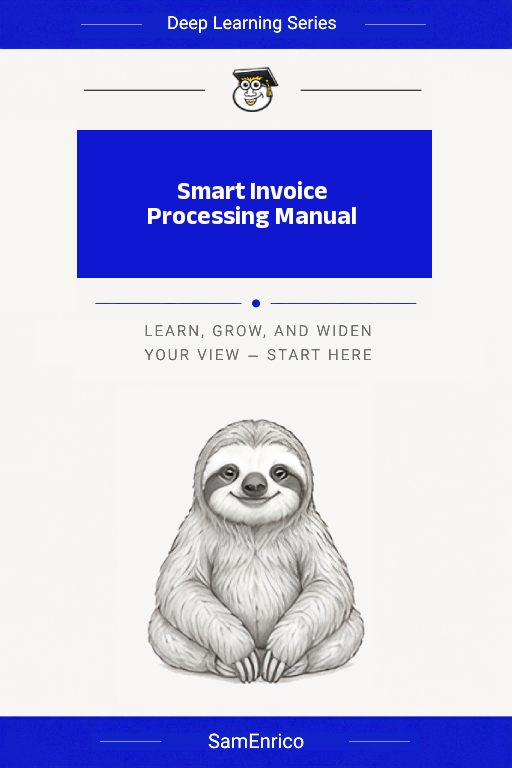
Smart Invoice Processing Manual eBook
Learn how AI extracts data from invoices and recei
Learn how AI extracts data from invoices and receipts automatically, reducing manual entry errors and accelerating accounts payable workflows for your small business.
Formats
Free sample
Chapter 1: The Shoebox Funeral--–- The first time I saw a grown woman cry over a stack of paper, I was sitting in a cramped home office in Akron, Ohio. The woman was a bakery owner named Linda. She had built a successful business from scratch—six employees, a loyal customer base, and a line out the door every Saturday morning. But on that Tuesday afternoon, Linda was not baking. She was holding a crumpled invoice from her flour supplier, dated eleven months earlier.
The invoice was for 847.32.Shehadpaidit.Butshehadalsopaiditagainsixmonthslater.Andthenathirdtime,threemonthsafterthat.Atotalof847.32. She had paid it. But she had also paid it again six months later. And then a third time, three months after that. A total of 847.32.Shehadpaidit.Butshehadalsopaiditagainsixmonthslater.Andthenathirdtime,threemonthsafterthat.Atotalof2,541.96 had left her bank account for a single delivery of flour.
Linda was not stupid. She was not careless. She was simply drowning in paper.This chapter is not about artificial intelligence. Not yet. Before we talk about automation, before we discuss confidence scores or cognitive extraction or three-way matching, we must first perform an autopsy.
We must open the shoebox—that metaphorical (and sometimes literal) cardboard container where millions of small businesses store their financial lives—and examine exactly how it kills your profits, your time, and your sanity. Because you cannot solve a problem until you know its true cost. And the true cost of manual invoice processing is almost certainly higher than you think.The Three Hidden Costs of Manual APMost small business owners believe their accounts payable process is "fine." They pay their bills. They rarely miss a payment. Their accountant hasn't yelled at them.
But "fine" is a dangerous word in business. It disguises slow leaks as normal operations. Let me show you what is actually happening inside your AP process, broken down into three distinct categories of hidden cost.Hidden Cost #1: The Late Fee Tax Late fees are the most obvious hidden cost, but their cumulative impact is rarely calculated. The average late fee for a small business invoice ranges from 50to50 to 50to200 per missed term. If you process 100 invoices per month—a modest volume for a retail store or a small construction company—and you pay just 5% of them late due to misplaced paperwork or delayed approvals, you are burning 250to250 to 250to1,000 per month.
That is 3,000to3,000 to 3,000to12,000 per year. For what? For the privilege of shuffling paper.But late fees are only the beginning. The real damage is the relationship cost. Vendors who are paid late—even once—may quietly adjust your credit terms.
A net-30 vendor might become net-15. A net-15 vendor might demand cash on delivery. Some vendors will simply stop accepting your orders without a prepayment. I have seen a plumbing supply company lose a 50,000annualdiscountbecauseasinglelatepaymenttriggeredatermsreview.Theownersaved50,000 annual discount because a single late payment triggered a terms review. The owner saved 50,000annualdiscountbecauseasinglelatepaymenttriggeredatermsreview.Theownersaved75 in late fees.
He lost $3,800 in discounts the following year. He never connected the two events because no software was tracking the pattern.Hidden Cost #2: The Labor Black Hole Here is where manual processing truly bleeds you dry. Let us do the math together. A bookkeeper or office manager earning 20perhourspends,onaverage,10hoursperweekonaccountspayabletasks.Thatisreceivinginvoices,openingemails,printing PDFs,typingdatainto Quick Books,filingpaperwork,chasingapprovals,andreconcilingpayments.Tenhoursperweekequals520hoursperyear.At20 per hour spends, on average, 10 hours per week on accounts payable tasks. That is receiving invoices, opening emails, printing PDFs, typing data into Quick Books, filing paperwork, chasing approvals, and reconciling payments.
Ten hours per week equals 520 hours per year. At 20perhourspends,onaverage,10hoursperweekonaccountspayabletasks.Thatisreceivinginvoices,openingemails,printing PDFs,typingdatainto Quick Books,filingpaperwork,chasingapprovals,andreconcilingpayments.Tenhoursperweekequals520hoursperyear.At20 per hour, that is 10,400indirectwages.Butthatisnotthefullcost.Benefitsaddapproximately2010,400 in direct wages. But that is not the full cost. Benefits add approximately 20%—another 10,400indirectwages.Butthatisnotthefullcost.Benefitsaddapproximately202,080. The true labor cost is closer to $12,500 per year for a single employee processing a modest volume of invoices.Now consider what that employee is not doing.
Those 520 hours could have been spent on customer follow-up, inventory optimization, vendor negotiation, or any number of revenue-generating activities. Opportunity cost is harder to calculate, but conservative estimates add another 30% to the labor figure. You are not paying 12,500fordataentry.Youarelosing12,500 for data entry. You are losing 12,500fordataentry.Youarelosing16,250 in productive capacity. And if you are the owner doing your own bookkeeping at 10 PM on a Sunday night, the cost is even higher because your time is worth more than $20 per hour.I interviewed a landscaping company owner in Portland who tracked his AP time obsessively for two weeks.
He discovered that he spent 14 hours per month just searching for missing invoices. Fourteen hours. That is almost two full work days every month. His solution was not a new hire or a faster scanner. His solution was to finally look at automation—but only after he calculated his actual cost.Hidden Cost #3: The Error Economy The third hidden cost is the most insidious because it rarely appears on a profit and loss statement.
It is the cost of errors: duplicate payments, missed discounts, mis-coded expenses, and fraudulent invoices that slip through a manual review.Duplicate payments are shockingly common. A 2018 study by the Institute of Finance and Management found that the average mid-sized business makes one duplicate payment for every 1,000 invoices processed. That is 0.1%. It sounds small. But if you process 10,000 invoices per year, that is 10 duplicate payments.
The average duplicate value is 500to500 to 500to2,000. You are losing 5,000to5,000 to 5,000to20,000 annually to a problem you probably do not even know you have.Missed discounts are even larger. The standard early-payment term in many industries is "2% 10, net 30"—a 2% discount if you pay within 10 days, otherwise the full amount is due in 30 days. Paying on day 20 instead of day 10 loses that 2% discount. Over a year of payables, 2% is a massive number.
If your business pays 500,000annuallytovendors,missingtheearly−paymentdiscountonjusthalfofthoseinvoicescostsyou500,000 annually to vendors, missing the early-payment discount on just half of those invoices costs you 500,000annuallytovendors,missingtheearly−paymentdiscountonjusthalfofthoseinvoicescostsyou5,000. Miss it on all of them—as many small businesses do—and you have left $10,000 on the table. For what? For the convenience of paying on your own schedule instead of the vendor's.Then there are coding errors. When a manual data entry person types an invoice into your accounting system, they must assign a general ledger code.
A 500purchaseofprinterpapercodedto"Office Supplies"iscorrect.Thesame500 purchase of printer paper coded to "Office Supplies" is correct. The same 500purchaseofprinterpapercodedto"Office Supplies"iscorrect.Thesame500 coded to "Cost of Goods Sold" will inflate your gross margin and hide the true cost of running your office. These errors compound over time. By the end of the year, your financial statements are not a reliable map of your business. They are a rough sketch drawn from memory.The Psychology of Manual Data Entry Why do humans make so many errors when processing invoices?
It is not because they are lazy or incompetent. It is because invoice processing is a task perfectly designed to exploit the weaknesses of the human brain.Consider what happens when you process an invoice manually. You must read a document that is rarely standardized. Vendors use different layouts, different fonts, different paper sizes. You must locate the total, the date, the invoice number…
This is the end of the free sample. Get the eBook to keep going. Buy now
About this book
Details
- Author
- Sommer Shanell
- Publisher
- SamEnrico
- Language
- English
- Genre
- Non-Fiction, Business Brief, Automation Guide
- Released
- 2026-05-29
- Pages (approx.)
- 128
- Available as
- eBook, Audiobook

Read better in the ZLOADR app
Your eBooks on your phone or tablet. Sign in with your SamEnrico account and start reading.
More by Sommer Shanell
 Defensive Driving for Rage ReductionSommer Shanell$11.99
 Elderly Microbiome SupportSommer Shanell$11.99
 Catherine the Great Art Collection CurationSommer Shanell$11.99
 Smoke Free Home Environment GuideSommer Shanell$11.99
 Weekly Review for Investors CourseSommer Shanell$11.99
 The Mold That Conquered the World: How a Hidden Fungus Changed Medicine ForeverSommer Shanell$11.99
 Island of the Lost: The Mysterious Disappearance of the SS BaychimoSommer Shanell$11.99
 How to Start a Cutting Blades for Machines or Mechanical Appliances Business (Beginners Guide)Sommer Shanell$11.99
 Trade Credit Insurance GuideSommer Shanell$12.99
 Understanding Bd SyndromeSommer Shanell$17.99
 IT Field Services TechnicianSommer Shanell$11.99
You may also like
 Bank Reconciliation AI ToolsMonahan Josephina$12.99
 Xero AI Automation GuideMercado Gilma$12.99
 Voice Activated AccountingMccormack Karyl$12.99
 Tax Preparation AI GuideBranson Marybeth$12.99
 Receipt Scanner Automation GuideMortensen Mariko$12.99
 QuickBooks AI Features GuideKroll Solange$12.99
 Payroll AI Automation GuideCoe Goldie$12.99
 Payment Notifications and Alerts for ExportersShephard Dina$12.99
 Inventory Accounting AIStern Lawana$12.99
 Free AI Accounting ToolsFlecha Luanne$12.99
 Financial Forecasting AIRowland Darlena$12.99
 Expense Reporting AI ToolsBeatty Temeka$12.99