
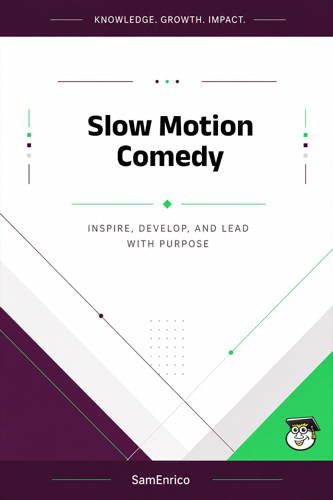
Non-FictionSelf-HelpPhysical Comedy
Slow Motion Comedy eBook
Exaggerate actions in slow speed for humor and foc
Exaggerate actions in slow speed for humor and focus.
Formats
Free sample
Chapter 1: The Amplified Consequence...–- The first rule of slow comedy is this: nothing funny happens at full speed. Not really. Not the kind of funny that makes people rewind a video three times or quote a moment for years. The kind of funny that lives in the space between a cup tipping and the coffee hitting the floor. The kind of funny that happens when a face takes fifteen seconds to transition from confusion to horror.
The kind of funny that only reveals itself when you give every millisecond a reason to exist.This book is called Slow Motion Comedy, but let us be precise from the very first page. The phrase “slow motion” in these chapters means two distinct things, and understanding the difference is the difference between getting a laugh and losing an audience.Two Meanings, One Goal The first meaning is literal slow motion. You record an action at normal speed—thirty frames per second, for example—and then you play it back at fifteen frames per second, or eight, or four. The result is a video where a two-second action takes eight seconds. The audience sees every flutter of fabric, every jiggle of flesh, every micro-expression they would have missed in real time.
This is the slow motion of cinema, of You Tube tutorials, of every fail compilation that has ever made you snort coffee through your nose.The second meaning is performed slow motion. An actor moves as if the air has turned to honey. A comedian on stage takes fifteen seconds to turn their head. A street performer mimes fighting against invisible gravity. There is no camera trickery here, no post-production manipulation.
The slowness is real, happening in real time, and the audience experiences it live. This is the slow motion of silent film comedians, of physical theater, of the improviser who understands that a thirty-second pause can be funnier than any punchline.This book teaches both. Not because they are the same skill—they are not—but because the principles that make slow motion funny are identical across both domains. The tools differ. The physics differ.
But the psychology of the audience does not.When you slow down an action, whether by camera or by muscle control, you are doing one thing above all else: you are amplifying consequence. A dropped pen is not funny. A dropped pen that takes four seconds to fall, with the owner watching in helpless slow motion, the pen rotating in the air, the hand reaching too late, the pen bouncing once, twice, then rolling under a desk—that is funny. The consequence has been amplified by time. The audience has been forced to imagine, in those stretched seconds, every possible outcome.
The pen could break. It could make a sound. It could be lost forever. And when the actual consequence turns out to be mundane—the pen is fine—the gap between imagined disaster and real outcome produces laughter.That gap is the engine of slow comedy. The longer you stretch time, the wider the gap becomes.
The wider the gap, the bigger the potential laugh. But there is a catch, and it is the most important catch in this entire book.The Stretch-and-Release Principle Comedy is tension and release. A joke sets up a pattern, then breaks it. A pratfall establishes normal movement, then disrupts it. A slow-motion action does something more subtle: it establishes normal time, then stretches it, building tension with every passing second, then finally releases that tension with the completion of the action or the recognition of failure.Call this the stretch-and-release principle.In normal comedy timing, the arc looks like this: Setup → Quick Punch → Release.
The setup might be two seconds. The punch is instantaneous. The release is the laugh. The total time from setup to laugh might be three seconds.In slow-motion exaggeration, the arc looks like this: Setup → Extended Struggle → Delayed Recognition → Release. The setup is still short.
But the struggle—the action itself stretched in time—can last ten seconds, thirty seconds, even ninety seconds. The recognition, the moment when the character realizes what is happening, is also stretched. And only then, after all that accumulated tension, does the release come.Here is the counterintuitive truth: slow comedy takes longer to produce a laugh, but the laugh is often bigger. The audience has been waiting. They have been anticipating.
They have imagined the worst. When the release finally comes, it comes with the force of accumulated expectation.Think of it as a roller coaster. A quick dip produces a small scream. A long, slow climb up a high hill, with the cars clicking and the ground falling away, produces a much larger scream on the way down. The climb is not the fun part—the drop is.
But you cannot have the drop without the climb. Slow comedy is the climb.Why Speed Decreases Perceived Stakes Here is a strange fact about human perception: the slower something happens, the more important it seems. This is not a comedy principle. This is a neurological fact. The brain interprets unexpected slowness as a sign of significance.
When a person moves slowly, the brain assumes one of two things: either the person is injured, or the situation is dangerous. Either way, the stakes are high.You can use this against your audience. Deliberately.When a comedian drops a pen at normal speed, the brain registers the event as mundane. A pen was dropped. So what?
The stakes are zero. The audience does not lean forward. They do not hold their breath. They might not even notice.When the same comedian drops the same pen in slow motion—performed or filmed—the brain suddenly pays attention. Why is this slow?
Is the pen important? Is the comedian hurt? Is something about to explode? The stakes have been artificially elevated by the mere fact of slowness. The audience leans in.
They watch the pen rotate. They watch the hand reach. They anticipate disaster.And when the pen simply hits the floor with a quiet click, the release comes. The gap between anticipated disaster and actual mundane outcome produces laughter.This is the comedy of amplified consequence. You take an action with tiny real-world stakes, and you blow it up by slowing it down.
The audience projects enormous stakes onto the action because their brains are wired to treat slowness as significance. Then you reveal that the stakes were never real. Laughter.The Silent Film Blueprint If you want to understand slow comedy, you must start with silent film. Not because silent film is old or quaint, but because silent film comedians invented every technique this book will teach you—and they did it without slow-motion cameras.Charlie Chaplin, Buster Keaton, Harold Lloyd, and their peers performed in an era when film cameras ran at a steady speed and could not be slowed down in post-production. If they wanted a slow-motion effect, they had to create it with their bodies.
They had to move slowly, deliberately, with exaggerated tension and release. They had to make the audience feel time stretching without any technical assistance.Watch Chaplin’s Modern Times. There is a scene where the…
This is the end of the free sample. Get the eBook to keep going. Buy now
About this book
Details
- Author
- Pepper Adaline
- Publisher
- SamEnrico
- Language
- English
- Genre
- Non-Fiction, Self-Help, Physical Comedy
- Released
- 2026-06-09
- Pages (approx.)
- 138
- Available as
- eBook, Audiobook

Read better in the ZLOADR app
Your eBooks on your phone or tablet. Sign in with your SamEnrico account and start reading.
More by Pepper Adaline
 Building Friendship After 30Pepper Adaline$11.99
 Maurice LaMarche Brain VoicePepper Adaline$11.99
 Spitfire Battle of BritainPepper Adaline$11.99
 The Retirement Housing Virtual Tour GuidePepper Adaline$11.99
 Difficult Conversation TrainingPepper Adaline$11.99
 Supplements For Menopause ReliefPepper Adaline$11.99
 Morning Routine for Project ManagersPepper Adaline$11.99
 The Flying Flynns: How a Family of Daredevils Redefined the CircusPepper Adaline$11.99
 Lens of the East: How Li Zhensheng Captured China's Fashion RevolutionPepper Adaline$11.99
 Service Providers Guide to Building & Home InspectionPepper Adaline$11.99
 How to Produce Laboratory ChemicalsPepper Adaline$11.99
 Transfer Between DLI SchoolsPepper Adaline$12.99
You may also like
 Hong Kong Handover 1997Dunn Johnnie$11.99
 Zumba For Postnatal Recovery CourseNeal Christian$11.99
 Zumba for BeginnersLadner Nikia$11.99
 YouTube Comment Mining GuideHumes Pandora$12.99
 Worry Box MeditationCarlin Rudy$11.99
 Workplace Stress MeditationNguyen Lynn$11.99
 Workplace Stress and Sleep RepairHawley Ivory$11.99
 Workplace Perfectionism CureDelaney Jeffry$11.99
 Workplace Injustice Anger GuideWallen Isabelle$11.99
 Work Addiction and Burnout LinkGreenwood Ester$11.99
 Women in Yoga and WellnessBeattie Galina$11.99
 Women in Stand Up ComedyChun Evangeline$11.99