
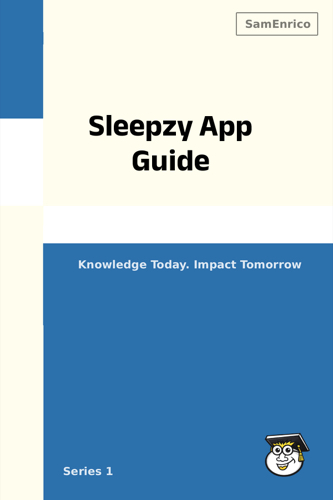
Non-FictionHealth & WellnessSchedule Fix
Sleepzy App Guide eBook
Use sleep cycle alarm and bedtime reminders to fix
by Ramey Mac
Use sleep cycle alarm and bedtime reminders to fix irregular schedules.
Formats
Free sample
Chapter 1: The Debt Trap--–- The morning alarm shrieks. You silence it, eyes still closed, already calculating: If I skip breakfast and the shower, I can steal fifteen more minutes. Those fifteen minutes become thirty. You bolt upright, heart racing, scramble through the morning, and stumble into the day already behind. By noon you are running on caffeine and resentment.
By 3 PM you are staring at a spreadsheet without remembering what the numbers mean. By 9 PM you are wired but exhausted, scrolling mindlessly because the day never gave you a single moment that was yours. Then you do it again. And again. And you tell yourself the problem is laziness, or weakness, or some fundamental flaw in your character.It is none of those things.You are caught in the debt trap—a silent, compounding cycle that modern life has normalized and you have internalized as personal failure.
This chapter will show you exactly how that trap works, why willpower cannot spring it, and how the Sleepzy app’s most underrated metric—the Sleep Debt score—can become your escape route. By the time you finish reading, you will understand sleep debt not as a vague feeling of tiredness but as a precise, measurable, and reversible biological accounting system. More importantly, you will never look at your Sunday morning lie-in the same way again.The Saturday Morning Illusion Let us begin with a scene so familiar it barely registers. Friday night: you stay up later than intended, maybe two hours, maybe three. Saturday morning: you wake naturally around 10 or 11 AM, feeling smugly virtuous.
I caught up, you think. I deserved that. Saturday night: you are not tired at the usual hour, so you stay up late again. Sunday morning: another lie-in, perhaps until 10 AM. Sunday night: you lie in bed at 11 PM, wide awake, mind racing, dreading Monday.
Monday morning: the alarm feels like an assault. You drag through the day convinced you need more sleep.Here is the truth that sleep science has established beyond any reasonable doubt: you did not catch up. You borrowed from Tuesday.The phrase “social jet lag” was coined by chronobiologist Till Roenneberg to describe exactly this phenomenon. Every time you shift your sleep by two or three hours on weekends, you effectively fly across two time zones without leaving your bed. Your brain’s master clock—a tiny cluster of neurons called the suprachiasmatic nucleus, or SCN, located deep in the hypothalamus—does not care about your social calendar.
It cares about consistency. When you wake at 7 AM on weekdays and 10 AM on weekends, you are asking your SCN to reset its anchor every five days. That is like asking a pendulum to swing in two different rhythms simultaneously. It cannot. So it defaults to confusion.The result is a phenomenon researchers call the “sleep debt cycle.” You accumulate debt during the week (sleeping less than your biological requirement).
You attempt to repay it on weekends (sleeping more than your biological requirement). But because the weekend sleep happens at the wrong circadian time—your body expecting 7 AM but getting 10 AM—the repayment is inefficient. You wake up feeling like you slept eight hours but performed like you slept five. Then Monday resets the spiral.The problem is not that you are lazy. The problem is that you have been taught a false accounting system.
You have been told that sleep is like a bank account: deposit hours on the weekend, withdraw them during the week. In reality, sleep is more like a heartbeat. You cannot store up beats for tomorrow. You can only experience the rhythm of each moment.The Biology of Biological Debt To understand why weekend catch-up sleep fails, you need to understand what sleep actually does. This is not abstract neuroscience; this is the engine of your daily existence.During sleep, your brain performs a kind of janitorial service that has no equivalent during waking hours.
The glymphatic system—a waste clearance pathway recently discovered by researchers at the University of Rochester—flushes out metabolic byproducts that accumulate during the day. Among these byproducts is beta-amyloid, a protein whose chronic buildup is associated with Alzheimer’s disease. This cleaning happens almost exclusively during deep slow-wave sleep, which occurs primarily in the first half of the night. If you cut that deep sleep short, the waste remains. One night of reduced deep sleep is trivial.
Hundreds of nights, accumulated over years, are not.But the debt is not just long-term. It is immediate and measurable.Sleep debt impairs memory formation through a specific mechanism. During sleep, particularly during REM sleep, the hippocampus replays the day’s neural firing patterns, strengthening some connections and pruning others. This is how short-term memories become long-term knowledge. Without sufficient sleep, that replay process is truncated.
You can study for six hours, but if you sleep poorly, you will remember less than someone who studied for two hours and slept well. The debt directly attacks your ability to learn.Sleep debt also dysregulates emotional processing. The amygdala, your brain’s threat-detection center, becomes hyperactive after sleep loss. The medial prefrontal cortex, which normally calms the amygdala, becomes less connected to it. The result is that small frustrations—a curt email, a slow internet connection, a child’s whining—feel like genuine threats.
You are not becoming more irritable as a person. Your brain is literally misreading the world.And sleep debt compromises immune function with startling speed. One study published in the journal Sleep found that individuals sleeping less than seven hours were nearly three times more likely to develop a common cold after exposure than those sleeping eight hours or more. The mechanism is clear: sleep loss reduces the production of cytokines, signaling proteins that coordinate immune responses. You are not imagining that you get sick more often when you are tired.
You are observing a causal relationship.The Cruelest Trick of Sleep Debt Here is where the debt trap becomes truly insidious. Sleep debt impairs your ability to perceive sleep debt.This is not a metaphor. It is a documented neurological phenomenon.Researchers have repeatedly found that chronically sleep-deprived individuals rate their own impairment as significantly lower than objective tests of reaction time, working memory, and decision-making demonstrate. In one classic study, participants who were restricted to five hours of sleep per night for two weeks reported feeling only mildly tired by the end, despite performing as poorly on cognitive tests as someone who had been awake for 48 hours straight. They did not know how impaired they were because the part of the brain that monitors self-awareness—the prefrontal cortex—was itself impaired.This is why “listening to your body” fails when you are already in debt.
Your body’s signals are scrambled. You feel tired but not desperate. You feel foggy but not incapacitated. You feel like you could drive, work, parent, decide—and statistically, you would be wrong. The debt has stolen your internal auditor.The result is a trap that works like this:You accumulate debt slowly, over days or weeks, losing 30 to 60 minutes per night.Your perception of impairment adapts downward.
What felt terrible at day three feels normal at day fourteen.You begin to believe that your current level of functioning…
This is the end of the free sample. Get the eBook to keep going. Buy now
About this book
Details
- Author
- Ramey Mac
- Publisher
- SamEnrico
- Language
- English
- Genre
- Non-Fiction, Health & Wellness, Schedule Fix
- Released
- 2026-06-07
- Pages (approx.)
- 137
- Available as
- eBook, Audiobook

Read better in the ZLOADR app
Your eBooks on your phone or tablet. Sign in with your SamEnrico account and start reading.
More by Ramey Mac
 Assertive Phone Call Skills CourseRamey Mac$11.99
 Endometriosis FAQ GuideRamey Mac$11.99
 Swiss Green Tax IncentivesRamey Mac$11.99
 The Hungarian Low Cost Master GuideRamey Mac$11.99
 The Last Emperor of the Sky: How Howard Hughes Built a Media Empire and Lost It AllRamey Mac$11.99
 Turkish Language Preparation YearRamey Mac$12.99
 Recruitment Platforms ComparisonRamey Mac$12.99
 How to Start a Banana Ripening and Conditioning Business (Beginners Guide)Ramey Mac$11.99
 Understanding RetinoblastomaRamey Mac$17.99
 Lead Systems EngineerRamey Mac$11.99
You may also like
 Hong Kong Handover 1997Dunn Johnnie$11.99
 Zumba For Postnatal Recovery CourseNeal Christian$11.99
 Zumba for BeginnersLadner Nikia$11.99
 YouTube Comment Mining GuideHumes Pandora$12.99
 Worry Box MeditationCarlin Rudy$11.99
 Workplace Stress MeditationNguyen Lynn$11.99
 Workplace Stress and Sleep RepairHawley Ivory$11.99
 Workplace Perfectionism CureDelaney Jeffry$11.99
 Workplace Injustice Anger GuideWallen Isabelle$11.99
 Work Addiction and Burnout LinkGreenwood Ester$11.99
 Women in Yoga and WellnessBeattie Galina$11.99
 Women in Stand Up ComedyChun Evangeline$11.99