
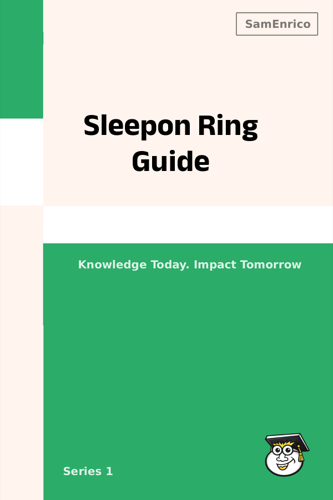
Sleepon Ring Guide eBook
Monitor overnight oxygen with FDA cleared pulse ox
by Queen Stacee
Monitor overnight oxygen with FDA cleared pulse oximetry ring.
Formats
Free sample
Chapter 1: The Midnight Suffocation--–- You can sleep eight hours and still be slowly suffocating. That sentence sounds like a contradiction, doesn't it? Sleep is supposed to be restful. Sleep is when your body repairs itself, when your brain consolidates memories, when your heart rate slows and your breathing deepens. But for nearly one billion people worldwide, sleep is something far more sinister: a nightly battle for air that they are losing, night after night, without ever knowing it.Imagine holding your breath for thirty seconds.
Your chest tightens. Your brain sends an urgent signal. You gasp. Now imagine doing that every sixty seconds, all night long, for years. That is not a metaphor.
That is the literal physiology of obstructive sleep apnea (OSA), a condition so common and so underdiagnosed that it has been called the silent epidemic. The word "silent" is almost cruel, because the condition is not silent at all. The snoring, the gasping, the choking sounds—these are audible. But the medical establishment has been slow to listen, and the public has been slower still.This chapter draws a hard line between two things that most people, including many doctors, confuse: poor sleep hygiene and physiological sleep disorders. They are not the same.
They do not feel the same. They do not have the same consequences. And confusing one for the other can cost you years of your life.The Great Confusion: Tiredness vs. Oxygen Deprivation Let us begin with a simple distinction. Poor sleep hygiene is what happens when you drink coffee at 8 PM, scroll through your phone in bed, keep your bedroom too warm, or maintain an irregular sleep schedule.
The result is subjective tiredness. You feel groggy. You yawn during meetings. You crave caffeine. But your body is getting enough oxygen.
Your blood oxygen saturation (Sp O2) stays comfortably above 94% all night. Your organs are not starving.Oxygen deprivation during sleep is something else entirely. You can follow every rule of perfect sleep hygiene—cool room, no screens, consistent bedtime, no alcohol—and still wake up exhausted. Why? Because your airway collapsed two hundred times while you slept.
Your brain was not resting; it was fighting for survival. The fatigue you feel in the morning is not from lack of sleep duration. It is from sleep fragmentation and repetitive hypoxia, a one-two punch that damages every organ system in your body.This distinction matters because the solutions are different. Sleep hygiene responds to behavioral changes: put down the phone, go to bed earlier, stop the late-night espresso. Oxygen deprivation during sleep responds to medical interventions: CPAP, oral appliances, positional therapy, surgery.
You cannot willpower your way out of a collapsed airway. You cannot meditate away hypoxia. And yet, millions of people are told—by themselves, by their partners, by their primary care doctors—to "just sleep better." That is like telling someone with a broken leg to "just walk better."The Anatomy of a Collapse: Understanding OSALet us look inside the throat. During wakefulness, the muscles of the pharynx—the passage behind the nose and mouth that leads to the larynx—maintain tonic activity. They hold the airway open against the negative pressure generated by breathing.
When you fall asleep, these muscles relax. In most people, this relaxation is harmless. The airway remains patent. Air flows freely.But in a person with a narrow or collapsible airway, relaxation is catastrophic. The tongue, which is attached to the mandible, falls backward.
The soft palate, that fleshy curtain at the back of the roof of the mouth, sags downward. The epiglottis, a leaf-shaped cartilage that protects the windpipe during swallowing, can also collapse. The result is a physical obstruction that blocks the flow of air.This obstruction takes two forms. A hypopnea (from Greek: hypo meaning "under" and pnoia meaning "breath") is a partial obstruction. Airflow is reduced by at least 30% for ten seconds or longer, and oxygen saturation drops by at least 3-4%.
An apnea (from Greek: *a* meaning "without" and pnoia meaning "breath") is a complete obstruction. Airflow stops entirely for at least ten seconds. In severe cases, apneas can last sixty, ninety, even one hundred twenty seconds.What happens during those seconds without air? Oxygen levels in the blood begin to fall. Carbon dioxide levels rise.
The brain, specifically the chemoreceptors in the medulla oblongata, detects the threat. It sends an emergency signal: wake up. The body releases a surge of catecholamines—adrenaline and noradrenaline—that jolts the sleeper into a lighter stage of sleep or a brief arousal. The airway muscles contract. The obstruction clears.
The sleeper takes a few deep, gasping breaths. Oxygen levels recover. Carbon dioxide drops. And then the sleeper falls back into deeper sleep, the muscles relax again, and the cycle repeats.The patient rarely remembers these arousals. They are too brief—usually three to fifteen seconds—to enter conscious awareness.
But the body remembers. The heart remembers. The brain remembers. The cumulative effect is devastating.By the Numbers: What Mild, Moderate, and Severe Look Like The severity of sleep apnea is measured by the Apnea-Hypopnea Index (AHI): the number of apneas and hypopneas per hour of sleep. The standard clinical classification, established by the American Academy of Sleep Medicine, is straightforward:Normal: Fewer than 5 events per hour Mild OSA: 5 to 15 events per hour Moderate OSA: 15 to 30 events per hour Severe OSA: More than 30 events per hour Let us translate these numbers into lived experience.
A person with mild OSA (say, 10 events per hour) stops breathing or breathes insufficiently every six minutes, on average, all night long. That is eighty times in an eight-hour sleep period. Eighty awakenings. Eighty adrenaline surges. Eighty times their heart rate spikes and their oxygen drops.A person with severe OSA (50 events per hour) experiences an apnea or hypopnea every seventy-two seconds.
They never achieve stable sleep. Their body is in a constant state of physiological emergency. Some patients with very severe OSA have AHI scores exceeding 100 events per hour—an apnea or hypopnea every thirty-six seconds or less. At that frequency, there is almost no difference between "sleep" and "a series of suffocation events punctuated by gasping."Here is what those numbers do not capture: the oxygen desaturation. Not every apnea or hypopnea causes the same drop in oxygen.
The clinical threshold for a "significant" desaturation is a drop of at least 4% from baseline. A patient with an AHI of 30 might have an Oxygen Desaturation Index (ODI4) of 25 or 35, depending on individual physiology. Some patients desaturate dramatically with each event, dropping from 96% to 75% in thirty seconds. Others desaturate more modestly, from 94% to 88%. Both are harmful, but the former is an emergency happening on repeat.The Cardiovascular Toll: How Hypoxia Destroys the Heart The connection between sleep apnea and cardiovascular disease is one of the most well-established relationships in all of medicine.
It is also one of the most underappreciated by the general public. Let us trace the pathophysiology.When oxygen levels drop, the body responds as if it is being suffocated—because it is. The sympathetic nervous system activates. Blood vessels constrict to shunt blood to vital organs. Heart rate increases to maintain cardiac output.
Blood pressure rises. All of this happens dozens or hundreds of times per night, every night, for years.Over time, this…
This is the end of the free sample. Get the eBook to keep going. Buy now
About this book
Details
- Author
- Queen Stacee
- Publisher
- SamEnrico
- Language
- English
- Genre
- Non-Fiction, Health & Wellness, FDA Cleared
- Released
- 2026-06-07
- Pages (approx.)
- 136
- Available as
- eBook, Audiobook

Read better in the ZLOADR app
Your eBooks on your phone or tablet. Sign in with your SamEnrico account and start reading.
More by Queen Stacee
 Mindful Walking For CreativityQueen Stacee$11.99
 International Franchise Currency HedgingQueen Stacee$11.99
 ABCDE Goal Setting IntegrationQueen Stacee$11.99
 The Black Dahlia Medical Examiner ReportsQueen Stacee$11.99
 Quetzalcoatl’s Feathered Serpent: The Fifth Sun’s AwakeningQueen Stacee$11.99
 Understanding Rheumatoid VasculitisQueen Stacee$17.99
 Marketing and Sales CoordinatorQueen Stacee$11.99
 Study in Rwanda Excellence GuideQueen Stacee$12.99
 OSS EU VAT System GuideQueen Stacee$12.99
 How to Become a DumperQueen Stacee$11.99