
Non-FictionSelf-HelpDigital Communication
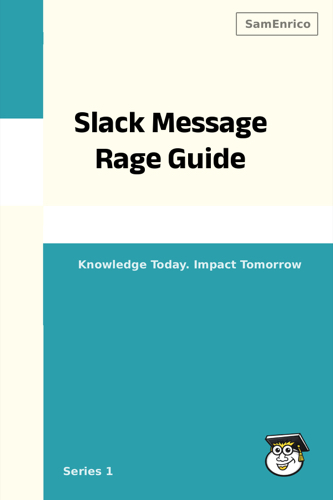
Slack Message Rage Guide eBook
Handle passive aggressive DMs and late night pings
by Cline Tracey
Handle passive aggressive DMs and late night pings using this practical guide.
Formats
Free sample
Chapter 1: The Ping That Broke You--–- The Slack notification arrived at 11:47 PM on a Tuesday. It was a single character: a question mark. Nothing else. No greeting, no context, no "sorry for the late ping." Just "?" from a colleague who had not spoken to you in three weeks. You were already in bed, phone on the nightstand, finally untangled from a ten-hour day of back-to-back meetings and fire drills.
Your partner was asleep beside you. The dog was curled at the foot of the bed. The room was dark and quiet. And then your phone buzzed with the distinctive double-vibration of a Slack direct message—a sound designed by engineers to be noticeable but not alarming, yet which has somehow become the auditory equivalent of someone tapping a fork against a wine glass at a dinner party to demand attention.You picked up the phone. You saw the question mark.
Your chest tightened. Your jaw clenched. Your heart rate, which had finally settled into a resting rhythm, spiked. And then came the familiar inner monologue: What did I miss? Did I forget to do something?
Why are they messaging me now? Is this urgent? Do they think I'm ignoring them? Am I supposed to reply right now? If I reply now, do I look like a pushover who answers Slack at midnight?
If I don't reply now, will they send another question mark at 7 AM?You put the phone down. You picked it up again. You typed "Sorry, just saw this" (even though you saw it immediately). You deleted it. You typed "What's up?" You deleted that too.
You put the phone face-down on the nightstand, which you know does nothing to stop notifications but feels like a small act of rebellion. You stared at the ceiling. You did not fall back asleep for forty-five minutes.If this story feels familiar, this book is for you.Welcome to the anatomy of Slack rage.The Silent Epidemic You Didn't Know Had a Name Slack rage is not a clinical diagnosis. You will not find it in the DSM-5. No therapist will bill your insurance for "Slack rage disorder." But if you work in a knowledge economy job—technology, marketing, finance, education, healthcare administration, government, nonprofit, or any field that has adopted chat-based workplace communication—you have almost certainly felt it.
And you have almost certainly felt ashamed of feeling it.Here is what Slack rage feels like: a sudden, hot rush of irritation that rises from your sternum to your face when a notification appears. It is not the slow burn of general workplace frustration. It is not the exhaustion of burnout. It is a discrete, event-driven spike of anger that is disproportionate to the actual content of the message and yet feels completely justified in the moment. You are not angry about the question mark.
You are angry about everything the question mark represents: the expectation of availability, the assumption that your time is less valuable than the sender's, the weaponized vagueness, the implied criticism, the intrusion into a space you had declared (to yourself, if not to anyone else) as off-limits.Therapists have a term for this kind of disproportionate emotional response to a minor trigger: reaction formation. But that implies the problem is internal. This book will argue the opposite. Your rage is not a sign that you are weak, irritable, or bad at your job. Your rage is a normal human response to a communication medium that was designed without empathy as a design requirement.The Intention Gap: Why Digital Text Makes You See Red Face-to-face conversation is a rich, multi-channel experience.
When you speak to someone in person, you receive information through at least six channels: words (the literal content), tone of voice (the melody and emphasis), facial expression (the micro-movements of eyebrows, lips, and eyes), body language (posture, gesture, proximity), timing (pauses, interruptions, overlaps), and context (the physical environment, recent history, shared knowledge). These channels work together to create meaning. When they align, communication feels easy. When they misalign—someone says "I'm fine" while crossing their arms and looking away—you know to dig deeper.Slack strips away five of those six channels. All that remains is words on a screen, arranged in a monospaced font, stripped of tone, expression, gesture, timing, and environment.
The result is what communication psychologists call the intention gap: the distance between what the sender meant to convey and what the receiver actually perceives.Here is a simple experiment. Read the following sentence aloud to yourself, then try to imagine it said in two different tones:"Okay. Thanks."In the first tone, imagine a colleague who has just received exactly what they needed from you. They are appreciative and slightly rushed. The "Okay" is a confirmation.
The "Thanks" is genuine. The message feels fine.In the second tone, imagine a colleague who asked you for something three days ago, you forgot, and now they are finally responding to your apology. The "Okay" is clipped. There is a period after it, which in text feels definitive. The "Thanks" is flat.
The message feels terrible.Here is the problem: the words are identical. The punctuation is identical. The only difference is the tone you imagined. And because Slack provides no tone, your brain automatically fills in the gap—usually with the most negative possible interpretation. This is not a personality flaw.
It is a cognitive bias called negativity bias, the tendency for humans to weigh negative information more heavily than positive information. Your brain is wired to assume the worst because, evolutionarily, assuming a rustle in the bushes is a predator kept you alive. Assuming a rustle in the bushes is the wind got you eaten. The same wiring now makes you assume that "Okay. Thanks." is passive-aggressive when it might be perfectly neutral.The intention gap is the single biggest driver of Slack rage.
It is not that your colleagues are trying to make you angry. It is that the medium makes it extraordinarily easy for you to interpret their messages as angry, dismissive, or hostile—even when they are not.The Road Rage Analogy: Why Anonymity Breeds Hostility In the 1990s, traffic psychologists noticed a strange phenomenon. Drivers who were perfectly polite, patient, and reasonable in face-to-face interactions would become screaming, tailgating, horn-blaring monsters behind the wheel. The same person who would never cut in line at a coffee shop would cut off three lanes of traffic without signaling. The same person who would apologize for bumping into a stranger on the sidewalk would flip the bird at a driver who merged too slowly.The explanation was a combination of three factors: anonymity (the other driver cannot see your face, and you cannot see theirs), lack of consequences (you will likely never see this person again), and physical separation (the car's windshield and metal frame create a psychological barrier).
These factors lower inhibition. When you feel invisible, unaccountable, and protected, you behave worse.Slack creates the exact same conditions. Your colleague cannot see your face. The physical distance between your keyboard and theirs is often hundreds or thousands of miles. There is no immediate social consequence for a curt message…
This is the end of the free sample. Get the eBook to keep going. Buy now
About this book
Details
- Author
- Cline Tracey
- Publisher
- SamEnrico
- Language
- English
- Genre
- Non-Fiction, Self-Help, Digital Communication
- Released
- 2026-06-06
- Pages (approx.)
- 132
- Available as
- eBook, Audiobook

Read better in the ZLOADR app
Your eBooks on your phone or tablet. Sign in with your SamEnrico account and start reading.
More by Cline Tracey
 Metta For Disabled PersonsCline Tracey$11.99
 Road Rage In Carpool LanesCline Tracey$11.99
 The Spanish Inquisition ManualCline Tracey$11.99
 The Assertiveness for Actors GuideCline Tracey$11.99
 The Pillars of Heaven: The Gothic Cathedral BuildersCline Tracey$11.99
 Understanding PhthiriophobiaCline Tracey$17.99
 AI-Driven Marketing AutomationCline Tracey$11.99
 Quantum Computing MapCline Tracey$12.99
 VA Training Manual TemplatesCline Tracey$12.99
 How to Start a Buttons Made of Glass Business (Beginners Guide)Cline Tracey$11.99
You may also like
 Hong Kong Handover 1997Dunn Johnnie$11.99
 Zumba For Postnatal Recovery CourseNeal Christian$11.99
 Zumba for BeginnersLadner Nikia$11.99
 YouTube Comment Mining GuideHumes Pandora$12.99
 Worry Box MeditationCarlin Rudy$11.99
 Workplace Stress MeditationNguyen Lynn$11.99
 Workplace Stress and Sleep RepairHawley Ivory$11.99
 Workplace Perfectionism CureDelaney Jeffry$11.99
 Workplace Injustice Anger GuideWallen Isabelle$11.99
 Work Addiction and Burnout LinkGreenwood Ester$11.99
 Women in Yoga and WellnessBeattie Galina$11.99
 Women in Stand Up ComedyChun Evangeline$11.99