
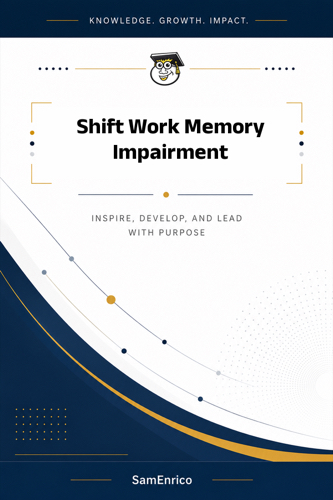
Shift Work Memory Impairment eBook
Teaches how circadian disruption harms recall and
Teaches how circadian disruption harms recall and cognitive performance.
Formats
Free sample
Chapter 1: The Silent Heist--–- Maria’s hands were shaking. Not from caffeine or cold, but from the quiet terror of realizing she had almost killed a man. It was 3:17 AM on her fifth straight night shift in the intensive care unit. The patient in Bed 4, a 68-year-old with diabetes and kidney failure, needed his scheduled insulin. Maria had walked to the medication dispenser, scanned her badge, pulled the vial, and drawn the dose into a syringe.
She was standing at the patient’s bedside, alcohol swab in hand, when something made her stop. A whisper of doubt. She checked the chart again—not the medication administration record, but the actual doctor’s order. Bed 4’s insulin had been discontinued that morning. The patient in Bed 6, two rooms down, had the active order.
Maria had read the right room number but encoded the wrong patient. Her brain had merged two similar pieces of information into a single, confident, and entirely false memory.She returned the syringe to the dispenser, walked to the bathroom, locked the door, and cried for three minutes. Then she washed her face, returned to the floor, and told no one.Maria is not stupid. Maria is not careless. Maria is not suffering from early dementia or burnout or a moral failing.
Maria is a victim of the silent heist that shift work perpetrates on the human brain every single night—the systematic, biological, and entirely predictable theft of memory. And unless you are reading this book because you are curious about neuroscience rather than desperate for a solution, you have had your own Maria moment. Perhaps you are a truck driver who missed a highway exit you have taken a thousand times. A police officer who could not remember whether you had already read a suspect their rights. A nurse like Maria.
A pilot. A factory supervisor. A parent working nights who looked at your child the next morning and could not recall putting them to bed.This book is not a collection of sleep hygiene tips. It is not a lecture about getting more rest. It is a field manual for a war you did not sign up for—the war between your job and your memory.
And before we can fight that war, you need to understand exactly what is being stolen from you, how the thief operates, and why no amount of coffee or willpower will stop it.The Anatomy of a Heist Every memory you have ever formed—every face, every fact, every skill, every warning—follows a specific biological pathway. That pathway begins with attention (you must notice something), moves to encoding (your brain must translate that something into a neural code), and ends with consolidation (that neural code must be stabilized and stored). Each step requires precise neurochemical conditions. Each step can be disrupted. And shift work disrupts every single one.The first step, attention, is governed largely by the prefrontal cortex—the thin layer of neural tissue just behind your forehead that serves as your brain’s executive assistant.
The prefrontal cortex is responsible for deciding what matters and what does not. It filters the flood of sensory information (the hum of the ventilator, the weight of the stethoscope, the sound of your own breathing) and directs your conscious focus to the task at hand. Under normal conditions, this system works reasonably well. You notice what you need to notice. You ignore what you can ignore.But the prefrontal cortex is metabolically expensive.
It requires a steady supply of glucose and oxygen, delivered at a rate that matches demand. And here is the first betrayal of shift work: during your biological night, your brain reduces glucose delivery to the prefrontal cortex by as much as 30%. This is not a design flaw; it is an evolutionary adaptation. Your ancient ancestors did not need sharp executive function at 3:00 AM because they were asleep in a cave. Your brain is still operating under that ancient assumption.
It is funneling resources away from the prefrontal cortex and toward more primitive survival systems—because as far as your brain knows, you should be unconscious.This is why night shift workers describe the “haze” that descends between 2:00 AM and 5:00 AM. This is why the same person who can calculate drug dosages at 2:00 PM struggles to add simple numbers at 2:00 AM. The resources have been diverted. Your prefrontal cortex is running on fumes. And attention—the gateway to all memory—collapses.But attention is only the beginning.
Even if you manage to notice something, your brain must still encode it. Encoding is the process of transforming a sensory experience (the sight of a medication vial, the sound of an alarm, the feel of a steering wheel) into a pattern of neural activity that can be stored. Encoding happens in the hippocampus, a seahorse-shaped structure buried deep in your temporal lobe. The hippocampus is the brain’s librarian. It receives information from the senses, decides whether it is worth keeping, and begins the process of filing it away.Encoding requires a specific neurochemical environment.
In particular, it requires low levels of stress hormones and the absence of sleep-pressure signals. Shift work inverts both conditions. Your cortisol (the primary stress hormone) is elevated because your body perceives working at night as a threat. Your adenosine (the chemical that builds up during wakefulness and signals the need for sleep) is at its peak because you have been awake for hours. The hippocampus, like the prefrontal cortex, is sensitive to this chemical chaos.
It begins to misfire. It encodes fragments instead of wholes. It confuses similar events. It sometimes encodes nothing at all.This is why you can read a page of text at 3:00 AM and remember nothing. This is why you can complete a task, walk away, and genuinely not know whether you did it correctly.
The encoding step was skipped. The information entered your eyes and ears, but it never became a memory.The final step, consolidation, is the most vulnerable of all. Consolidation is the process by which short-term neural patterns are transformed into long-term storage. It happens primarily during sleep, specifically during slow-wave sleep (the deepest stage) and REM sleep (when most dreaming occurs). During slow-wave sleep, the hippocampus replays the day’s events at high speed, strengthening the connections between neurons that were active during encoding.
During REM sleep, those replayed memories are integrated into existing networks, connected to prior knowledge, and stabilized.Consolidation is not optional. Without sufficient slow-wave and REM sleep, memories simply evaporate. You can pay perfect attention. You can encode with crystal clarity. But if you do not sleep well—and shift workers almost never sleep well—those memories will be gone by morning.This is the silent heist in three acts.
Your attention is starved. Your encoding is corrupted. Your consolidation is aborted. And you are left with the ghost of a memory—a sense that you should remember something, a feeling of familiarity without substance, a confidence that is entirely unmoored from fact.The Three Lies Your Memory Will Tell You Over the next several chapters, we will examine the specific ways that shift work distorts memory. But it is useful…
This is the end of the free sample. Get the eBook to keep going. Buy now
About this book
Details
- Author
- Nickel Kirstie
- Publisher
- SamEnrico
- Language
- English
- Genre
- Non-Fiction, Self-Help, Shift Work
- Released
- 2026-06-07
- Pages (approx.)
- 123
- Available as
- eBook, Audiobook

Read better in the ZLOADR app
Your eBooks on your phone or tablet. Sign in with your SamEnrico account and start reading.
More by Nickel Kirstie
 The Gacy Burial GardenNickel Kirstie$11.99
 LTC Insurance For LGBTQ SinglesNickel Kirstie$11.99
 Pattern Recognition HandbookNickel Kirstie$11.99
 Benzo Taper Calculator WorkbookNickel Kirstie$11.99
 Breath Awareness for JealousyNickel Kirstie$11.99
 Sexual Addiction ScreeningNickel Kirstie$11.99
 TM For ExecutivesNickel Kirstie$11.99
 Robespierre MaximilienNickel Kirstie$11.99
 The Last Ronin's Shadow: A Forgotten War of the SengokuNickel Kirstie$11.99
 The Lost Fleet of the Atlantic: Spain’s Sunken Secrets of the New WorldNickel Kirstie$11.99
 The Comeback Kid: How a Disgraced CEO Reinvented HimselfNickel Kirstie$11.99
 Native Discovery Platform BuyingNickel Kirstie$11.99
You may also like
 Self Esteem for Night Shift WorkersStaley Norberto$11.99
 Scheduling for Shift WorkersAshmore Fae$11.99
 Binge Eating For Shift Workers GuideStinnett Jordan$11.99
 Mindfulness for Beginner Shift WorkersStevenson Shari$11.99
 Meditation for Shift Work SleepMinton Vinnie$11.99
 Mindfulness for Night Shift WorkersPinkerton Digna$11.99
 The Shift Work Memory Recovery GuideNewman Hattie$11.99
 Shift Worker Sleep RescueJordan Douglas$11.99
 Shift Worker Sleep MeditationBroussard Maynard$11.99
 Shift Worker Sleep GuideMeyer Marco$11.99
 Shift Worker Memory GuideGriffiths Mariam$11.99
 Shift Work Memory GuideVines Coleen$11.99