
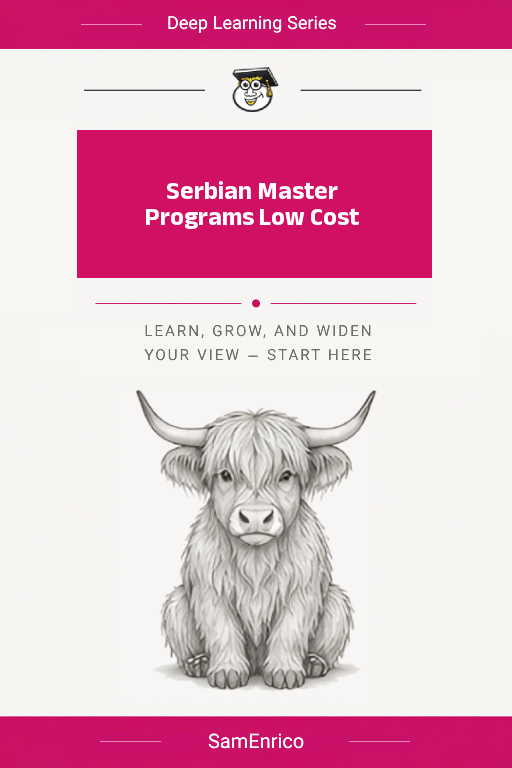
Serbian Master Programs Low Cost eBook
Study in Belgrade for 2000 to 4000 euros annually
by Buss Winford
Study in Belgrade for 2000 to 4000 euros annually with affordable living under 600 euros monthly.
Formats
Free sample
Chapter 1: The Soviet-Bologna Fusion--–- Most prospective students assume that a low-cost European degree means sacrificing academic quality. They picture crumbling Soviet-era buildings, outdated textbooks, and professors who refuse to speak English. This assumption is not only wrong—it is backwards. The very feature that scares most students away—Serbia’s hybrid academic heritage—is actually the secret weapon that produces graduates who consistently outperform their Western peers in technical fields, medicine, and mathematics.To understand why Serbian Master’s programs are the best-kept secret in European higher education, you first need to understand two apparently contradictory educational philosophies: the Soviet system and the Bologna system. Serbia inherited both, and the fusion is remarkable.The Soviet Legacy: Rigor Over Comfort Between 1945 and 1991, Serbian higher education operated under the Soviet model.
This system had flaws—it was rigid, hierarchical, and resistant to interdisciplinary work. But it had one overwhelming strength: it produced graduates with extraordinary depth in their chosen fields.In the Soviet model, a Master’s degree was not a commodity. It was a certification of genuine expertise. Students spent hundreds of hours in laboratories, completed multiple long-form research projects, and defended their theses before panels of senior academics who had no hesitation failing students who did not meet the standard. There was no “grade inflation.” There were no “easy A” courses.
If you graduated, you had earned it.This legacy survives in Serbia today, particularly in STEM fields, medicine, and mathematics. Professors who trained under the old system still teach. They still expect students to memorize foundational formulas, to derive proofs from first principles, and to spend weekends in the lab. Western students often experience this as “too hard” or “unnecessarily demanding.” But employers recognize it as rigor.Consider the Faculty of Electrical Engineering at the University of Belgrade. It is not well-known in London or New York, but within the global engineering community, it has a cult reputation.
Graduates are recruited by Siemens, Bosch, Microsoft, and Nvidia—not because of the university’s brand name, but because these companies have learned that Belgrade-trained engineers know their craft at a deeper level than graduates of many more expensive programs.The same is true for mathematics. Serbia consistently produces top-performing teams at the International Mathematical Olympiad. This tradition filters into university-level instruction. A Master’s in Mathematics from the University of Belgrade is not a degree you coast through. It is a degree that transforms how you think.The Bologna Revolution: Flexibility and Portability In 2003, Serbia signed the Bologna Declaration, committing to harmonize its degree structure with the rest of Europe.
This was not a small administrative change. It fundamentally restructured every degree program in the country.Before Bologna, Serbian degrees were confusing to outsiders. After Bologna, they became fully compatible with the European Credit Transfer System. This means that a Master’s degree from a Serbian university carries exactly the same 60 ECTS credits per year as a degree from Germany, France, or the Netherlands.Why does this matter for you? Because when you apply for a job in Berlin or Stockholm, your transcript will be immediately understood.
The hiring manager does not need to research “what is a Serbian diploma worth.” They see 120 ECTS credits, a Bologna-compliant structure, and they recognize it as equivalent to any EU degree.The Bologna system also enabled the proliferation of English-taught programs. Before 2003, virtually all instruction was in Serbian. Today, as we will detail in this chapter, there are dozens of English-taught Master’s programs across Serbia, from engineering to economics to political science.The Rankings Reality Check Every student considering a non-traditional destination asks the same question: “What are the rankings?” The honest answer is nuanced.The University of Belgrade consistently ranks in the 301-400 range globally in the ARWU (Shanghai) rankings, and between 401-500 in the QS World University Rankings. To put this in perspective, this places it above many mid-tier US state schools and on par with respectable European universities like the University of Lisbon, the University of Athens, and the University of Zagreb.But rankings are a poor measure of the value proposition this book offers. A university’s research output (which drives rankings) has almost nothing to do with the quality of its Master’s teaching.
What matters is whether you will learn from competent professors, whether your degree will be recognized, and whether the cost is justified.By all three measures, Serbian universities deliver exceptional value. The professors are knowledgeable (often trained in the Soviet system’s rigorous Ph D programs). The degree is recognized across Europe under Bologna. And the cost, as the title of this book suggests, is a fraction of Western alternatives.The Language Myth: Debunked“I don’t speak Serbian.” This is the single most common objection students raise when considering Serbia. It is also the easiest objection to overcome.The reality is that you can complete an entire Master’s degree in Serbia without speaking a word of Serbian.
Your coursework, exams, assignments, and thesis can all be conducted in English. Your professors will speak English. Your textbooks will be in English. Your fellow students will come from Turkey, China, India, Russia, and across the Balkans—and they will communicate with you in English.The author does not recommend this approach. Learning even basic Serbian will enrich your experience, lower your costs (as we will discuss in Chapter 6 on the pijaca markets), and open social doors.
But it is not required.Below is a comprehensive, faculty-by-faculty list of English-taught Master’s programs offered at Serbian public universities. This list is not exhaustive—programs change and new ones appear—but it represents the core offerings as of the time of writing.University of Belgrade: English-Taught Master’s Programs Faculty of Electrical Engineering Master in Electrical Engineering and Computing (multiple specializations: Power Systems, Electronics, Telecommunications, Computer Science)Tuition: €3,500–4,500/year Faculty of Economics and Business Master in Business Economics Master in Quantitative Finance Master in Marketing Tuition: €3,000–4,000/year Faculty of Political Sciences Master in European Integration Master in International Security Master in Political Analysis Tuition: €2,500–3,500/year Faculty of Philology Master in English Language and Literature Master in Translation Studies (English-Serbian)Master in Digital Humanities Tuition: €2,000–3,000/year Faculty of Organizational Sciences Master in Information Systems Master in Project Management Master in Quality Management Tuition: €3,000–4,000/year Faculty of Law Master in European Law Master in International Commercial Law Note: Some courses require Serbian; verify with faculty Tuition: €2,500–3,500/year Faculty of Mathematics Master in Applied Mathematics Master in Financial Mathematics Master in Data Science Tuition: €3,000–4,000/year Faculty of Technology and Metallurgy Master in Chemical Engineering Master in Materials Science Tuition: €3,000–4,000/year University of Novi Sad: English-Taught Master’s Programs Master in Environmental Engineering (€3,000–4,000/year)Master in Agricultural Economics (€2,500–3,500/year)Master in Food Safety (€3,000–4,000/year)Master in Digital Media (€2,500–3,500/year)University of Niš: English-Taught Master’s Programs Master in Civil Engineering (€2,500–3,500/year)Master in Electronic Engineering (€3,000–4,000/year)Master in Management (€2,500–3,500/year)University of Kragujevac: English-Taught Master’s Programs Master in Mechanical Engineering (€2,500–3,500/year)Master in Computer Science (€3,000–4,000/year)Master in Economics (€2,500–3,500/year)Private Universities (Higher Cost, Smaller Class Sizes)Singidunum University: Business, IT, Psychology (€4,000–6,000/year)Union University: Law, Business, Environmental Studies (€3,500–5,000/year)Metropolitan University: Design, IT, Management (€4,000–5,500/year)A Note on Medical Programs Medical education in Serbia is structured differently. Students do not complete a separate “pre-med” Bachelor’s degree followed by a Master’s. Instead…
This is the end of the free sample. Get the eBook to keep going. Buy now
About this book
Details
- Author
- Buss Winford
- Publisher
- SamEnrico
- Language
- English
- Genre
- Non-Fiction, Student's Shortcut
- Released
- 2026-06-01
- Pages (approx.)
- 145
- Available as
- eBook, Audiobook

Read better in the ZLOADR app
Your eBooks on your phone or tablet. Sign in with your SamEnrico account and start reading.
More by Buss Winford
 Sandwich Evidence Diamond HeistBuss Winford$11.99
 HGH Legal Supplements GuideBuss Winford$11.99
 Retirement Assets Community PropertyBuss Winford$11.99
 Senior Memory TrainingBuss Winford$11.99
 Change Management Stress GuideBuss Winford$11.99
 Natural HGH BoostersBuss Winford$11.99
 Menstrual Equity AdvocacyBuss Winford$11.99
 Bipolar Mindfulness Practice ManualBuss Winford$11.99
 The Vanishing of the Golden Girl: The Unsolved Disappearance of Suzanne JovinBuss Winford$11.99
 The Mutiny That Shook an Empire: The Ingenious Defiance of Mangal PandeyBuss Winford$11.99
 The Rothschild Dynasty: Banking the Modern WorldBuss Winford$11.99
 Resume Fraud Detection PrimerBuss Winford$12.99
You may also like
 LSE Online Program LengthAgee Letisha$11.99
 Harvard Extension School for Working AdultsRoush Yer$11.99
 LSE Online Reading ListAshford Ludivina$11.99
 LSE Online Language RequirementsWhitten Daphine$11.99
 LSE Online Class SizeHughey Garret$11.99
 LSE Online Alumni MentorshipWild Lyla$11.99
 London School of Economics Alumni NetworkDutton Chantal$11.99
 Harvard Extension School Student SupportCantrell Christene$11.99
 Harvard Extension School Library AccessSantana Adah$11.99
 Harvard Extension School Degree CompletionBray Wyatt$11.99
 Harvard Extension School Course AuditingAbbott Craig$11.99
 Harvard Extension School Extension DiplomaNew Joane$11.99