
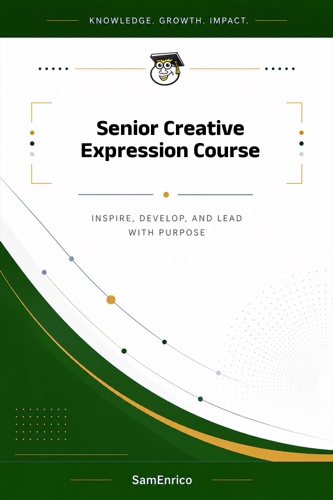
Non-FictionSelf-HelpCreative AgingArt Therapy
Senior Creative Expression Course eBook
Discover art, writing, or music as a source of sel
by Bonilla Meri
Discover art, writing, or music as a source of self worth in later years.
Formats
Free sample
Chapter 1: The Permission Revolution...--–- You have not lost your usefulness. You have been lied to by a culture that confuses productivity with worth. The single greatest barrier between you and a creative life is not arthritis, not failing eyesight, not a shaky hand, and certainly not age. It is a story you have been telling yourself for so long that you mistake it for the truth. The story says: "I am too old to start something new.
My best years are behind me. Creativity is for the young, the talented, the trained. Who am I kidding?"This chapter exists to dismantle that story. Not gently, not slowly, but with the same decisive clarity you would use to throw away a pair of shoes that have been hurting your feet for twenty years. You have been carrying this weight long enough.
It is time to set it down.The Washed-Up Myth and the Late Bloomers They Never Told You About Let us begin with a question that sounds impertinent but is actually the most liberating question you will ever ask yourself: What if you are not too old? What if you are finally free?Think about the word "retirement" for a moment. The word itself comes from an old French term meaning "to withdraw" or "to go back." But language is a trap. When you hear "retirement," you likely hear decline. Slowing down.
Becoming irrelevant. That is not the meaning of the word. That is the meaning we have assigned to the word. And you can un-assign it just as easily.Consider the stories that popular culture never puts on a billboard. Grandma Moses did not pick up a paintbrush until she was seventy-eight years old.
Seventy-eight. At an age when most of her peers were being told to "take it easy," she was covering canvases with bright, joyful scenes of rural American life. She went on to become one of the most celebrated artists of the twentieth century. Frank Mc Court was sixty-six years old when he published Angela's Ashes, a memoir that won the Pulitzer Prize. Sixty-six.
He had spent decades as a high school English teacher, never publishing a word. And then he wrote one true sentence, and that sentence became a book, and that book became a legacy. Harriette Thompson finished her last marathon at the age of ninety-four. Ninety-four. She did not run her first marathon until she was seventy-six.
She was not a lifelong athlete. She was a woman who decided, late in life, that her body was still capable of surprise.These are not exceptional people. They are not anomalies. They are examples of what happens when an ordinary person refuses to believe the lie that their time is up. The only difference between them and you is that they gave themselves permission before anyone else did.
They did not wait for a doctor to say "you are healthy enough." They did not wait for a family member to say "that is a good idea." They did not wait for society to applaud. They simply decided that the story of "too old" was a story they would no longer tell.Age Shame: The Social Construct That Lives in Your Chest There is a word for the feeling that rises in your throat when you consider trying something new. That tightness, that heat, that voice that says "don't embarrass yourself." That feeling has a name. It is called age shame, and it is not a biological reality. It is a social construct.Social constructs are not imaginary.
They are real in the same way that money is real. A dollar bill is just a piece of paper until everyone agrees that it has value. Age shame is the same. You feel it because you have been taught to feel it. Every advertisement you have ever seen, every movie that shows young people as vibrant and old people as comic relief or tragic figures, every birthday card that jokes about "over the hill," every well-meaning relative who says "aren't you going to take it easy at your age?"—all of these messages have built a structure in your mind.
That structure says: trying new things is embarrassing for someone your age.But here is the liberating truth: social constructs can be deconstructed. You do not have to believe in them forever. The shame you feel is not a sign that you are wrong to want to paint or write or sing. The shame is a sign that you have internalized a lie. And the antidote to internalized shame is not to "be more confident." The antidote is to name the lie and then refuse to participate in it.This is called cognitive reframing.
It is a psychological technique with decades of research behind it. Here is how it works: every time you catch yourself thinking "I am too old to start," you deliberately replace that thought with a different one. You do not argue with the thought. You do not try to suppress it. You simply offer an alternative.
The alternative is: "I am finally free to try."Notice the difference. "I am too old to start" is a statement of limitation. It closes doors. "I am finally free to try" is a statement of liberation. It opens doors.
Retirement—or whatever you call this stage of life—is the first time in your adult existence when you are not required to be productive. You are not raising children full-time (or not in the same way). You are not climbing a career ladder. You are not performing for a boss or a client or a committee. You are, for perhaps the first time since childhood, unscripted.
That is not a loss. That is a gift.Think about the structure of a human life. From age five to eighteen, you are in school. From age eighteen to twenty-two (or longer), you are in higher education or entry-level work. From age twenty-two to sixty-five, you are in the workforce, often with the additional roles of spouse, parent, homeowner, community member.
These roles come with scripts. You know what is expected of you. You know when to wake up, what to wear, what to say in meetings, how to fill out forms. Even the role of "retiree" has a script: travel, golf, grandchildren, hobbies. But the script for "retiree" is thin and unsatisfying for most people.
It does not ask you to grow. It asks you to settle.What if you threw away the script entirely? What if you woke up tomorrow with no obligations and no expectations, and you simply asked yourself: what would I like to try today? Not "what would be useful?" Not "what would impress anyone?" Not "what would be age-appropriate?" Just: what would I like to try?That is the permission revolution. And it begins right here, in this chapter, with a single act of refusal.
You refuse to believe that your useful years are over. You refuse to accept that creativity belongs to the young. You refuse to be embarrassed by your own desires.The Two Voices That Live in Your Head Every person who has ever tried to create anything—at any…
This is the end of the free sample. Get the eBook to keep going. Buy now
About this book
Details
- Author
- Bonilla Meri
- Publisher
- SamEnrico
- Language
- English
- Genre
- Non-Fiction, Self-Help, Creative Aging, Art Therapy
- Released
- 2026-06-10
- Pages (approx.)
- 114
- Available as
- eBook, Audiobook

Read better in the ZLOADR app
Your eBooks on your phone or tablet. Sign in with your SamEnrico account and start reading.
More by Bonilla Meri
 Voice Anchoring ProtocolBonilla Meri$11.99
 Breath Awareness at WorkBonilla Meri$11.99
 Gig Economy Tax GuideBonilla Meri$11.99
 Portugal D7 Passive Income Visa GuideBonilla Meri$11.99
 The Blood Moon Murders of Veracruz: Ritual, Revenge, and the LawBonilla Meri$11.99
 Home Office Spending GuideBonilla Meri$12.99
 Non Resident LLC DIY Formation GuideBonilla Meri$12.99
 Gis AnalysisBonilla Meri$11.99
 Understanding L-transposition and CctgaBonilla Meri$17.99
 How to Become a Drawer-in - HandBonilla Meri$11.99
You may also like
 Hong Kong Handover 1997Dunn Johnnie$11.99
 Zumba For Postnatal Recovery CourseNeal Christian$11.99
 Zumba for BeginnersLadner Nikia$11.99
 YouTube Comment Mining GuideHumes Pandora$12.99
 Worry Box MeditationCarlin Rudy$11.99
 Workplace Stress MeditationNguyen Lynn$11.99
 Workplace Stress and Sleep RepairHawley Ivory$11.99
 Workplace Perfectionism CureDelaney Jeffry$11.99
 Workplace Injustice Anger GuideWallen Isabelle$11.99
 Work Addiction and Burnout LinkGreenwood Ester$11.99
 Women in Yoga and WellnessBeattie Galina$11.99
 Women in Stand Up ComedyChun Evangeline$11.99