
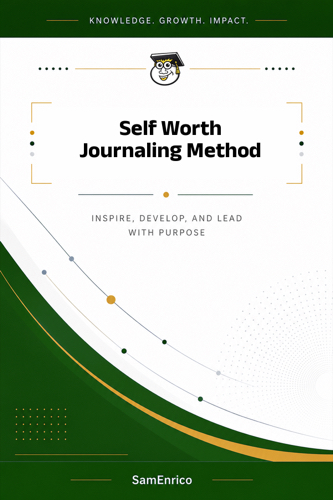
Non-FictionSelf-HelpJournal Therapy
Self Worth Journaling Method eBook
Uses structured journaling to rewire childhood low
Uses structured journaling to rewire childhood low self-worth beliefs.
Formats
Free sample
Chapter 1: The Origin Detective...--The first time you felt small, you didn't know you were taking notes.You thought you were just living. Just being a kid. Just trying to figure out a world that felt confusing, loud, or quiet in all the wrong ways. But somewhere beneath your awareness, your brain was doing something extraordinary and terrible at the same time: it was learning a rule about you.Not about the world. About you.That rule went something like this: There is something wrong with me.
I am not enough. I am too much. I am a problem.You didn't choose this rule. You didn't vote on it or debate its logic. It arrived like weather—uninvited, unexplained, and utterly convincing.
And then it did what rules do: it started predicting your future. Every awkward silence confirmed it. Every criticism proved it. Every time someone you loved looked away, the rule whispered, "See? I told you."This chapter is about finding that rule.
Not to shame it, not to fight it, but to see it for what it is: a story you learned, not a fact you were born with.We are going to become detectives of your own past. And we are going to do it without reliving the pain.The Problem with Most "Childhood Work"Before we begin, I need to name something uncomfortable.Many self-help books tell you to "go back to your childhood" and "feel the feelings you couldn't feel then." This sounds noble. It sounds like healing. But for many people, it is actually retraumatizing.Here is the distinction that changes everything:Cool recall is observing a memory like a scientist looks at a specimen. You see it.
You name its parts. You note its effects. But you do not climb inside it and live there again. Your feet stay in the present. Your adult self stays in charge.Hot processing is re-living the memory.
Your body tenses. Your breath shortens. You feel the shame, the fear, the abandonment as if it is happening right now. This is not healing—this is rehearsing trauma. And it strengthens the very neural pathways you are trying to rewire.In this book, we do cool recall.
Always. Except for one single chapter (Chapter 7, which has its own safety gate), we never ask you to emotionally re-enter a painful memory. We ask you to examine it from a distance. Like a detective examining evidence. Like a cartographer mapping territory you have already crossed.If at any point in this chapter you feel your body tightening, your breath shortening, or your mind fogging over, you are allowed to stop.
Close the book. Place a hand on your chest. Breathe out longer than you breathe in. And come back when you are ready.The memory will wait. It has been waiting this long.Why Your Childhood Became a Data Set Neuroscience has a name for what happened to you: implicit memory.Implicit memories are not stories you can tell.
They are sensations, impulses, and beliefs that live below the level of conscious recall. You don't remember learning that the stove is hot—you just know to flinch. In the same way, you don't remember the exact moment you decided you weren't enough. You just know that when someone criticizes you, your stomach drops and your mind says, "See? I knew it."These implicit beliefs form most rapidly between ages 3 and 10.
This is not because children are weak. It is because children are pattern-detection machines. Your young brain was designed to notice what leads to safety and what leads to danger. If being loud led to punishment, your brain learned: loud = danger, quiet = safety. If asking for help led to irritation, your brain learned: needs = burden, silence = love.None of this was a choice.
It was survival.And here is the part that breaks my heart and also frees you: the beliefs your child-brain formed were not based on truth. They were based on the only information available at the time—from caregivers who were themselves wounded, overwhelmed, or absent.A child whose parent is depressed does not think, "My parent is struggling with a chemical imbalance." The child thinks, "I am not interesting enough to make them smile."A child whose parent is anxious does not think, "My parent's nervous system is dysregulated." The child thinks, "The world is dangerous, and I need to be perfect to keep us safe."A child whose parent is dismissive does not think, "My parent did not learn how to attune to emotions." The child thinks, "My feelings are a problem."You did not choose these beliefs. They were encoded automatically, in a brain that was doing its best to keep you alive. And now, those beliefs are running in the background of your adult life like a piece of software that was installed without your permission.This chapter is about finding that software. Reading its code.
And deciding, for the first time, whether you want to keep running it.The Detective's Toolkit: Separating Fact from Interpretation Here is the single most important skill you will learn in this entire book. Master this, and everything else becomes possible.Facts are what actually happened. A camera could have recorded them. A court of law would accept them. Examples:"My mother sighed and left the room.""My father did not respond when I spoke.""My teacher called on every student except me."Interpretations are the meaning your child-brain assigned to those facts.
Examples:"My mother sighed because I am exhausting.""My father didn't respond because I am invisible.""My teacher didn't call on me because I am stupid."Here is the liberating truth: you cannot change the facts. The sigh happened. The silence happened. The being skipped over happened. But you can absolutely change the interpretation.
Because the interpretation was never fact—it was a guess made by a child with incomplete information.Let me show you how this works with a real example from a former client I'll call Maria.Fact: At age 6, Maria was coloring at the kitchen table. Her mother walked in, saw the crayons scattered, and said sharply, "Why do you always make such a mess?" Then she cleaned up the crayons without speaking to Maria again for the rest of the evening.Childhood Interpretation: "I am a burden. My presence makes things worse. People tolerate me but don't actually want me around."Adult Re-Interpretation (with cool recall): "My mother had just returned from a 10-hour shift as a nurse. She was exhausted, underpaid, and parenting alone.
Her sharpness had nothing to do with my worth and everything to do with her capacity. She was not rejecting me—she was depleted."Notice what happened there. Maria did not pretend her mother wasn't sharp. She did not invent a fantasy where her mother was perfect. She simply added context that a 6-year-old could not see.
And with that context, the interpretation changed from "I am a burden" to "My mother was depleted."The fact remained. The interpretation shifted. And with that shift, the shame began to loosen.The Three-Column Prompt Now it is your turn. You will need your journal (any notebook is fine) and…
This is the end of the free sample. Get the eBook to keep going. Buy now
About this book
Details
- Author
- Groce Doretha
- Publisher
- SamEnrico
- Language
- English
- Genre
- Non-Fiction, Self-Help, Journal Therapy
- Released
- 2026-06-06
- Pages (approx.)
- 125
- Available as
- eBook, Audiobook

Read better in the ZLOADR app
Your eBooks on your phone or tablet. Sign in with your SamEnrico account and start reading.
More by Groce Doretha
 Global Market Talent Retention StrategiesGroce Doretha$11.99
 Survivor Guilt WorkbookGroce Doretha$11.99
 Natural Light Exposure GuideGroce Doretha$11.99
 The Sollecito and Knox Trial DynamicsGroce Doretha$11.99
 The Battle of Ipsus: The Day Four Kings FellGroce Doretha$11.99
 Customer Account ManagerGroce Doretha$11.99
 Real Estate Zoning Reform GuideGroce Doretha$12.99
 Automation One Page Marketing WorkbookGroce Doretha$12.99
 How to Become a Coke BurnerGroce Doretha$11.99
 Understanding Leukocyte Adhesion Deficiency Type 2Groce Doretha$17.99
You may also like
 Hong Kong Handover 1997Dunn Johnnie$11.99
 Zumba For Postnatal Recovery CourseNeal Christian$11.99
 Zumba for BeginnersLadner Nikia$11.99
 YouTube Comment Mining GuideHumes Pandora$12.99
 Worry Box MeditationCarlin Rudy$11.99
 Workplace Stress MeditationNguyen Lynn$11.99
 Workplace Stress and Sleep RepairHawley Ivory$11.99
 Workplace Perfectionism CureDelaney Jeffry$11.99
 Workplace Injustice Anger GuideWallen Isabelle$11.99
 Work Addiction and Burnout LinkGreenwood Ester$11.99
 Women in Yoga and WellnessBeattie Galina$11.99
 Women in Stand Up ComedyChun Evangeline$11.99