
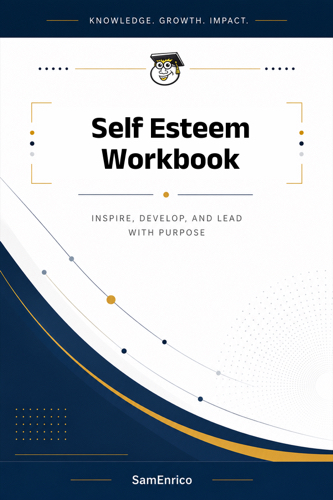
Self Esteem Workbook eBook
Complete daily exercises to build lasting confiden
by Finley Erich
Complete daily exercises to build lasting confidence independent of appearance.
Formats
Free sample
Chapter 1: The Great Disconnect...--The first time you believed you weren't enough, you were probably too young to remember. Someone looked at you—a parent, a teacher, a stranger in a checkout line—and their eyes said something that their mouth did not. Maybe they glanced at your body instead of your face. Maybe they praised your sister's hair and said nothing about yours. Maybe they sighed when you reached for a second cookie.
You learned a lesson that day, even though no one taught it to you explicitly: What you look like matters. Maybe it matters more than anything else.That lesson has been reinforced tens of thousands of times since. Every magazine cover at the grocery store checkout. Every movie where the "ugly" character puts on glasses and suddenly becomes beautiful. Every Instagram post where a photo of a "flawed" body gets half the likes of a filtered one.
Every time an adult pinched your cheek and said "You're so pretty" as if that were your primary value. Every time a dating app swipe reduced you to a thumbnail. Every time you felt your stomach drop because a photo of you was tagged without your permission.This chapter has one job: to prove that your low self-esteem is not a personal failure. It is a conditioned response to a culture that has spent billions of dollars training you to hate what you see in the mirror.The Invention of Insecurity Here is a truth that sounds like a lie: one hundred years ago, the average person did not have a self-esteem problem tied to their appearance. Not because they were wiser or stronger than you, but because they barely saw themselves.In 1924, a typical person encountered their own reflection a handful of times per day.
A still pond if they lived rurally. A small mirror in the bedroom, maybe eight inches across. A shop window if they walked through town. That was it. They had no idea what the back of their head looked like.
They had never seen their own face in high definition. They had never compared their nose to a stranger's nose at 2 AM while lying in bed.Fast forward to today. By some estimates, the average person now sees their own image between sixty and two hundred times daily. Selfies. Zoom calls.
Instagram stories. Tik Tok videos. Facebook photos tagged without warning. Surveillance cameras in every store. Front-facing cameras that open automatically.
Your face appears on screens more often than you see actual human faces. You have become an object of study to yourself, and you have become a harsh critic.The philosopher and psychologist William James wrote in 1890 that self-esteem is a fraction: our successes divided by our pretensions. In other words, we feel good about ourselves when we meet our own expectations. But what happens when our expectations are not based on reality? What happens when our expectations are based on filtered, airbrushed, surgically enhanced, professionally lit, carefully curated images of people who have teams of stylists and years of editing experience?The fraction breaks.
The denominator becomes infinite. And we spend our lives trying to close a gap that was never fair to begin with.The Observer and the Observed Let me introduce a framework that will appear throughout this book. It is simple, but it will change the way you see yourself.There are two versions of you.The first is the Observed. This is your physical vessel. Your height.
Your weight. Your skin tone, texture, and blemishes. Your hair color, thickness, and distribution. The symmetry of your face. The shape of your fingernails.
The size of your thighs. The lines around your eyes. The way you sound when you speak. All of it—every measurable, photographable, evaluable aspect of your physical form. This is the version of you that lives in mirrors, photos, and other people's eyeballs.The second is the Observer.
This is the consciousness behind your eyes. The part of you that reads these words right now. Your sense of humor. Your moral compass. Your capacity for kindness, outrage, curiosity, boredom, love, and grief.
Your memories. Your hopes. The voice that narrates your inner life. The part of you that knows the difference between right and wrong, even when you choose wrong. This is the version of you that looks out at the world, not the version that is looked at.Low self-esteem occurs when the Observer abandons its post and merges entirely with the Observed.
You stop thinking I have a body and start thinking I am a body. You confuse having a flaw with being a flaw. You mistake the vessel for the captain.Here is the liberating truth: the Observer is permanent. The Observed changes constantly. Your body today is not your body at ten years old, and it will not be your body at seventy.
But the Observer—the "you" that has been here the whole time—is continuous. When you identify with the Observer, criticism of the Observed becomes less threatening. Someone says "Your nose is big," and instead of hearing "I am ugly," you hear "Someone has an opinion about my nose." Your nose is something you have. It is not something you are.This distinction is not abstract philosophy. It is a practical tool you will use daily in this workbook.The Economics of Insecurity Here is something the self-help industry does not want you to know: your low self-esteem is profitable.The global beauty industry is worth approximately five hundred billion dollars per year.
The weight loss industry is worth another two hundred fifty billion. The cosmetic surgery industry, the skincare industry, the hair replacement industry, the teeth whitening industry, the fashion industry—they all run on the same fuel: your belief that you are not enough as you are.Imagine a world where every person woke up completely satisfied with their appearance. No one would buy anti-aging cream. No one would get lip fillers. No one would spend hours editing their photos before posting.
No one would scroll through Instagram feeling inadequate. That world is a nightmare for advertisers. They do not want you healed. They want you slightly sick—sick enough to keep buying, but not so sick that you give up entirely.The French philosopher Michel Foucault wrote about "biopower"—the way societies regulate bodies to maintain control. But you do not need French philosophy to understand what is happening.
Open any women's magazine (many of which are owned by the same companies that sell cosmetics). Notice the pattern: first an article titled "Why You're Not Sexy Enough," followed by an ad for a product that promises to fix exactly that problem. The media creates the wound and then sells you the bandage.Social media algorithms are even more insidious. They have learned that negative emotions drive engagement. A photo that makes you feel jealous or inadequate will keep you scrolling longer than a photo that makes you feel content.
The algorithm does not hate you; it simply does not care about your mental health. It cares about watch time. And watch time increases when you feel bad about yourself.You have been caught in a machine…
This is the end of the free sample. Get the eBook to keep going. Buy now
About this book
Details
- Author
- Finley Erich
- Publisher
- SamEnrico
- Language
- English
- Genre
- Non-Fiction, Self-Help, Workbook
- Released
- 2026-06-06
- Pages (approx.)
- 134
- Available as
- eBook, Audiobook

Read better in the ZLOADR app
Your eBooks on your phone or tablet. Sign in with your SamEnrico account and start reading.
More by Finley Erich
 Elderly Complicated Grief GuideFinley Erich$11.99
 Navigating Conflict At Work GuideFinley Erich$11.99
 The Interruption Reset ButtonFinley Erich$11.99
 CRE Lease Enforcement GuideFinley Erich$11.99
 Pattern Recognition for ParentsFinley Erich$11.99
 Koi Pond GazingFinley Erich$11.99
 Resume UAE Specific GuideFinley Erich$11.99
 Addiction at Home Healing RoadmapFinley Erich$11.99
 Fire and Steel: Hannibal's Love and War Across the AlpsFinley Erich$11.99
 The Leviathan’s Last Stand: The Battle of the Grand BanksFinley Erich$11.99
 The Phantom of Flight 447: The AI That Couldn’t Save UsFinley Erich$11.99
 Understanding Alveolar Soft Part SarcomaFinley Erich$17.99
You may also like
 Hong Kong Handover 1997Dunn Johnnie$11.99
 Zumba For Postnatal Recovery CourseNeal Christian$11.99
 Zumba for BeginnersLadner Nikia$11.99
 YouTube Comment Mining GuideHumes Pandora$12.99
 Worry Box MeditationCarlin Rudy$11.99
 Workplace Stress MeditationNguyen Lynn$11.99
 Workplace Stress and Sleep RepairHawley Ivory$11.99
 Workplace Perfectionism CureDelaney Jeffry$11.99
 Workplace Injustice Anger GuideWallen Isabelle$11.99
 Work Addiction and Burnout LinkGreenwood Ester$11.99
 Women in Yoga and WellnessBeattie Galina$11.99
 Women in Stand Up ComedyChun Evangeline$11.99