
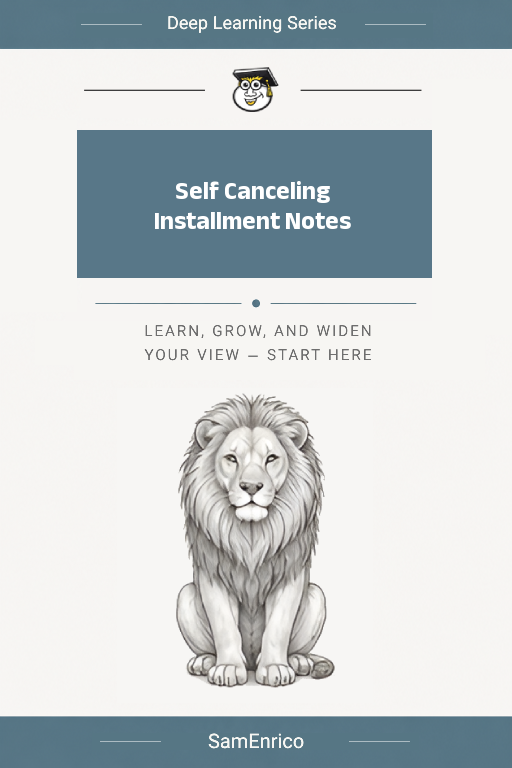
Self Canceling Installment Notes eBook
Explains SCINs for business succession including t
by Arce Jordon
Explains SCINs for business succession including tax treatment, interest rates, and death benefit provisions.
Formats
Free sample
Chapter 1: The Estate Eraser--The first time Harold Finch heard the words "self-canceling installment note," he was sitting in his estate planner's office, staring at a number that made his heart skip. Not in a good way. The number was $4.7 million—the estimated federal estate tax his children would owe if he died that afternoon. Harold was 71 years old, the sole owner of a regional chain of auto parts stores, and his only plan for passing the business to his daughter was a handshake and a hope that the IRS would look the other way. It would not.The estate planner leaned across the mahogany desk and said something Harold would never forget: "What if I told you that you could sell the entire business to your daughter tomorrow, collect a paycheck for the rest of your life, and have the remaining debt vanish from the face of the earth the moment you take your last breath?
And what if I told you the IRS would thank you for it?"Harold thought the man had finally lost his mind. But he hadn't. He was describing a Self-Canceling Installment Note, or SCIN—one of the most powerful, most misunderstood, and most aggressively effective estate planning tools available to business owners in America. And Harold Finch, who had never taken a dime of outside investment and had built his company from a single storefront, was about to become a true believer.The Problem That SCINs Solve Before we dive into the mechanics of the Self-Canceling Installment Note, we need to understand the problem it solves. Every business owner faces a brutal arithmetic problem when they die.
The federal government—and in many states, the state government as well—imposes an estate tax on the value of everything you own at death. For 2025, the federal exemption stands at approximately 13millionperindividual,13 million per individual, 13millionperindividual,26 million for married couples. Above that, the tax rate is 40 percent. Forty cents on every dollar over the exemption.Here is the trap that destroys more family businesses than bankruptcy, divorce, and bad competition combined: your business is an asset. A valuable one, presumably.
And when you die, the IRS says, "Congratulations, your family now owes us 40 percent of the value of that business above the exemption. Cash, please. Due within nine months."Most family businesses are not sitting on millions of dollars of cash. The value is tied up in inventory, equipment, real estate, and goodwill. So the family faces a choice: sell the business to raise the cash, borrow against it at punishing rates, or negotiate a payment plan with the IRS under Section 6166 (which comes with its own nightmare of interest and compliance).
Too often, they sell. The business that took forty years to build goes to a competitor or a private equity fund. The legacy ends. The employees lose their jobs. And the family gets a fraction of the after-tax value.The SCIN offers an escape hatch from this nightmare.
It is a legal, IRS-approved strategy that allows a business owner to transfer their company to the next generation during their lifetime, remove its value from their taxable estate, and continue to receive income until death—all while avoiding the gift tax that would otherwise apply to such a transfer.What Exactly Is a Self-Canceling Installment Note?Let us begin with the simplest possible definition. A Self-Canceling Installment Note is a promissory note used to sell an asset—most commonly a business interest—with one extraordinary feature built into its DNA: if the seller dies before the note is fully paid, the remaining balance is automatically canceled. The buyer owes nothing more. The seller's estate does not collect the balance. The debt simply disappears.That cancellation feature is the magic trick.
It is also the reason the entire structure works for estate tax purposes.Think about what happens in a normal sale. You sell your business to your daughter for 5million.Shesignsapromissorynoteagreeingtopayyou5 million. She signs a promissory note agreeing to pay you 5million.Shesignsapromissorynoteagreeingtopayyou500,000 per year for ten years plus interest. On the day the sale closes, you have exchanged your business for a piece of paper—the promissory note. That note is an asset.
It has value. And when you die, that note becomes part of your taxable estate. Your daughter still owes the remaining payments, but now those payments go to your estate, and eventually to your heirs. The IRS taxes the full value of the remaining payments. Your family pays tax on money they have not yet received.Now contrast that with a SCIN.
You sell your business to your daughter for 5million.Shesignsa Self−Canceling Installment Noteagreeingtopayyou5 million. She signs a Self-Canceling Installment Note agreeing to pay you 5million.Shesignsa Self−Canceling Installment Noteagreeingtopayyou500,000 per year for ten years plus a risk premium (more on that in Chapter 3). The note contains a single additional clause: "Upon the death of the Seller, any outstanding balance on this Note shall be automatically canceled and forgiven, and the Buyer shall have no further obligation to make payments."You die in year six. The remaining four years of payments—approximately 2million—arecanceled.Thedebtvanishes.Yourdaughterownsthebusinessfreeandclear.Andhereisthekicker:that2 million—are canceled. The debt vanishes.
Your daughter owns the business free and clear. And here is the kicker: that 2million—arecanceled.Thedebtvanishes.Yourdaughterownsthebusinessfreeandclear.Andhereisthekicker:that2 million of canceled debt is not pulled back into your estate. It is gone. The IRS cannot tax it. Your family pays zero estate tax on that $2 million.This is the Estate Eraser in action.
It does not rely on loopholes or aggressive interpretations of the law. It relies on a straightforward legal principle: if you do not own an asset at death, the IRS cannot tax it. The SCIN ensures that whatever you have not yet collected is no longer yours. It belongs to the buyer now, free of any further obligation.The Critical Distinction: SCIN Versus Private Annuity No discussion of SCINs is complete without addressing the Private Annuity, because the two are often confused and the consequences of that confusion can be catastrophic.A Private Annuity is an ancient estate planning tool. You transfer an asset to a buyer in exchange for the buyer's promise to pay you a fixed annual amount for the rest of your life.
When you die, the payments stop. No debt ever existed. The buyer simply stops writing checks.On the surface, this sounds similar to a SCIN. Both provide lifetime income. Both terminate payments at death.
Both remove the asset from your estate. So why does the SCIN exist? Why not just use a Private Annuity?The answer lies in the income tax treatment. In a Private Annuity, each payment is treated partially as a return of principal (tax-free) and partially as capital gain (taxable). But the IRS has complex rules under Section 72 that can create phantom income and unfavorable tax consequences if the seller dies earlier or later than expected.
More importantly, the Private Annuity offers no flexibility in payment terms—you are locked into a fixed stream for life.The SCIN, by contrast, is a true debt instrument. It is governed by the installment sale rules of Section 453. The seller pays capital gains tax…
This is the end of the free sample. Get the eBook to keep going. Buy now
About this book
Details
- Author
- Arce Jordon
- Publisher
- SamEnrico
- Language
- English
- Genre
- Non-Fiction, Annual Checkup, SCIN
- Released
- 2026-06-01
- Pages (approx.)
- 154
- Available as
- eBook, Audiobook

Read better in the ZLOADR app
Your eBooks on your phone or tablet. Sign in with your SamEnrico account and start reading.
More by Arce Jordon
 Sonar Technology EvolutionArce Jordon$11.99
 Celebrating Wrinkles And Gray HairArce Jordon$11.99
 Daily Purpose Rituals GuideArce Jordon$11.99
 The Gambling Disorder Diagnosis GuideArce Jordon$11.99
 The Reddit Achievement Envy GuideArce Jordon$11.99
 The Unbreakable Marathon: Eliud Kipchoge and the Quest for Human LimitsArce Jordon$11.99
 Veterinary AcupunctureArce Jordon$11.99
 Understanding Spinal Atrophy Ophthalmoplegia Pyramidal SyndromeArce Jordon$17.99
 Equipment Breakdown ClimateArce Jordon$12.99
 How to Start a Civil Engineering Research and Experimental Development Business (Beginners Guide)Arce Jordon$11.99