
Non-FictionHealth & WellnessReligious
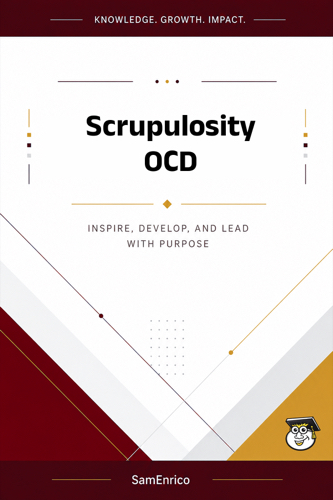
Scrupulosity OCD eBook
Teaches religious or moral obsessions with excessi
Teaches religious or moral obsessions with excessive confession.
Formats
Free sample
Chapter 1: The Prison of Good Intentions...--–- Sarah believed her faith was supposed to bring peace. Instead, it brought a courtroom that never adjourned. Every prayer was a performance. Every thought was evidence. Every moment of silence was an opportunity to have accidentally offended a God she desperately wanted to please.
She had become a prisoner of her own good intentions, and the bars were made of repetition, confession, and a guilt that no amount of apology could satisfy.The alarm clock read 3:47 AM. Sarah had been lying awake for two hours, her mind cycling through the same seven-word phrase she had prayed imperfectly before bed. Had she said "thy will be done" or "your will be done"? Did the pronoun matter? What if the original language of scripture used a specific form of address, and she had used the wrong one?
What if God noticed? What if He was waiting for her to correct it before she could be forgiven for the other, larger sins she had confessed last week? She whispered the phrase again. Then again. Then a third time, just to be sure.
Then she began to cry, because she knew she would be here again tomorrow night.This is not a story about a lack of faith. It is a story about a hijacking. Sarah’s conscience—the very faculty that was supposed to guide her toward goodness—had been taken over by a disorder that used her deepest values as weapons against her. She loved God, so OCD attacked her love with doubts about blasphemy. She valued honesty, so OCD attacked her honesty with fears that every casual statement was a lie.
She wanted to be a good person, so OCD insisted that being good meant being perfect, and that any imperfection was catastrophic.Sarah has Scrupulosity OCD, and this chapter is the key that unlocks her prison door.The Doubting Disease: A Definition Scrupulosity is a specific subtype of Obsessive-Compulsive Disorder (OCD), often historically referred to as "the doubting disease." The term comes from the Latin word scrupulus, meaning a small, sharp stone—the kind that gets lodged in one’s shoe and makes every step painful. For centuries, spiritual directors and confessors recognized that some of the most devout parishioners suffered from a pathological inability to feel forgiven, no matter how many times they confessed. They called it "scruples." Today, we understand it as a neurobiological condition, not a spiritual failure.At its core, Scrupulosity is characterized by persistent, unwanted, intrusive thoughts (obsessions) related to religious or moral themes, followed by repetitive behaviors or mental acts (compulsions) performed to neutralize the resulting anxiety. The person with Scrupulosity is not imagining their doubts. The doubts are real, visceral, and agonizing.
But they are not accurate reflections of reality. They are misfires in the brain’s alarm system—false alarms that the brain has learned to treat as genuine emergencies.Consider the difference between normal doubt and Scrupulosity. A person without OCD might occasionally wonder, "Did I pray sincerely?" They might feel a flicker of concern, resolve to be more attentive next time, and move on with their day. A person with Scrupulosity, by contrast, cannot move on. The question becomes a trap.
"Did I pray sincerely?" leads to "What if I didn't?" leads to "If I didn't, did I commit a sin?" leads to "If I committed a sin, am I still forgiven?" leads to "If I'm not forgiven, am I going to hell?" leads to "I need to pray again, perfectly this time." And then the cycle repeats.This is not a matter of willpower. It is not a lack of trust in God or a failure of moral character. It is a neurological disorder in which the brain’s error-detection circuitry—the part that normally helps us notice mistakes and correct them—becomes hyperactive and cannot be turned off. The person with Scrupulosity is trapped in a loop of detection, anxiety, ritual, temporary relief, and renewed detection. And the only way out is to stop playing the game by different rules.The Two Faces of Scrupulosity: Religious and Moral Obsessions Scrupulosity wears two primary faces, though many people experience both.
Understanding which face you are looking at is the first step toward removing its power.Religious Obsessions: The Fear of Offending the Divine For those with religious Scrupulosity, the obsessions center on the sacred. Common themes include:Blasphemy fears: Intrusive thoughts that insult God, the prophets, sacred texts, or religious figures. A Catholic might have a sudden image of the Virgin Mary in a profane context. A Muslim might have an unbidden thought that questions the Prophet's character. A Hindu might visualize a deity in a disrespectful posture.
The person with Scrupulosis is horrified by these thoughts—not because they agree with them, but because they are so deeply opposed to them. The OCD knows exactly where to strike.Imperfect prayer: The belief that prayers must be recited with perfect attention, perfect pronunciation, perfect intention, or perfect feeling. Any distraction, wandering thought, or perceived lack of sincerity invalidates the entire prayer and requires repetition. Some people repeat the same prayer dozens or even hundreds of times, trying to achieve an elusive "feeling" of rightness that never comes.Confession compulsions: The overwhelming urge to confess sins repeatedly, even after they have been absolved by a priest or forgiven through personal prayer. The person fears that they left out a detail, or that their contrition was insufficient, or that the sin was actually mortal when they thought it was venial.
They return to confession again and again, exhausting themselves and their confessors.Salvation anxiety: The persistent fear that one has committed the unforgivable sin, lost their salvation, or been rejected by God. This fear often attaches to ordinary experiences—a moment of anger, a skeptical thought, a failure to pray—and magnifies them into cosmic catastrophes.Ritual purity: In traditions with purity laws (such as Orthodox Judaism or Islam), obsessions may focus on ritual cleanliness. A person might wash their hands dozens of times before prayer, afraid that a single missed spot invalidates their worship. They might avoid touching certain objects, or spend hours checking whether they have become impure.Moral Obsessions: The Fear of Being a Bad Person For those with moral Scrupulosity—including many secular individuals—the obsessions center on ethics and character. Common themes include:Lying and honesty: The fear that one has lied, even when they have told the truth.
A person might replay a casual conversation for hours, searching for any statement that could be construed as misleading. They might confess to minor exaggerations or omissions, convinced that they have deceived others.Cheating and fairness: The fear that one has taken unfair advantage, cut corners, or received something they did not earn. A person might worry that they cheated on a test years ago, or that they underpaid for an item, or that they received a compliment they did not deserve.Harm and negligence: The fear that one has accidentally harmed another person, physically or emotionally, and failed to notice or apologize. A person might worry that they bumped into someone in a crowd and caused an injury, or that…
This is the end of the free sample. Get the eBook to keep going. Buy now
About this book
Details
- Author
- Menendez Darleen
- Publisher
- SamEnrico
- Language
- English
- Genre
- Non-Fiction, Health & Wellness, Religious
- Released
- 2026-06-07
- Pages (approx.)
- 143
- Available as
- eBook, Audiobook

Read better in the ZLOADR app
Your eBooks on your phone or tablet. Sign in with your SamEnrico account and start reading.
More by Menendez Darleen
 Sobriety for ProfessionalsMenendez Darleen$11.99
 Physical Therapy Multiples ManualMenendez Darleen$11.99
 The Fishing Boat Captain VictimMenendez Darleen$11.99
 Innovation for Human Resources ProsMenendez Darleen$11.99
 Social Security TotalizationMenendez Darleen$11.99
 Customer Deposit StrategyMenendez Darleen$12.99
 Mickey Wright Power LifeMenendez Darleen$11.99
 Mugshot Exposure ContaminationMenendez Darleen$11.99
 The Silk Road Heist: The Rise and Fall of a Digital UnderworldMenendez Darleen$11.99
 The Bloodied Crown: Boudicca's Last StandMenendez Darleen$11.99
 Service Providers Guide to Lead Testing & RemovalMenendez Darleen$11.99
 Factoring in Sub Saharan Africa GuideMenendez Darleen$12.99
You may also like
 Hong Kong Handover 1997Dunn Johnnie$11.99
 Zumba For Postnatal Recovery CourseNeal Christian$11.99
 Zumba for BeginnersLadner Nikia$11.99
 YouTube Comment Mining GuideHumes Pandora$12.99
 Worry Box MeditationCarlin Rudy$11.99
 Workplace Stress MeditationNguyen Lynn$11.99
 Workplace Stress and Sleep RepairHawley Ivory$11.99
 Workplace Perfectionism CureDelaney Jeffry$11.99
 Workplace Injustice Anger GuideWallen Isabelle$11.99
 Work Addiction and Burnout LinkGreenwood Ester$11.99
 Women in Yoga and WellnessBeattie Galina$11.99
 Women in Stand Up ComedyChun Evangeline$11.99