
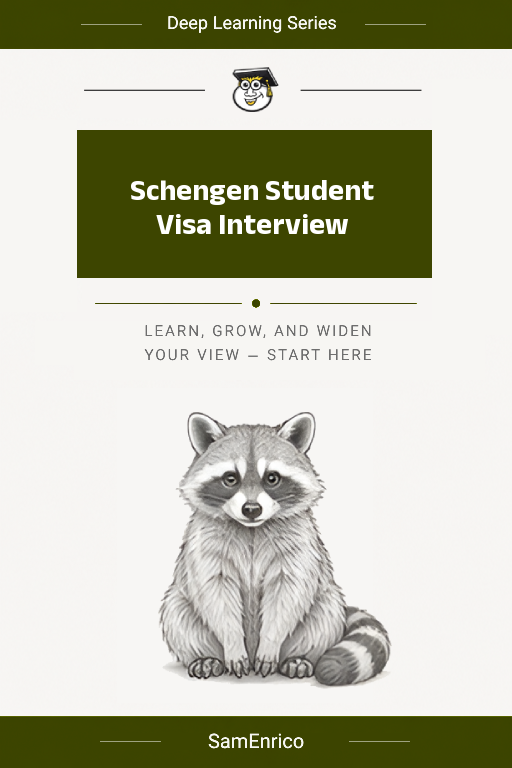
Non-FictionStudent's ShortcutSchengen
Schengen Student Visa Interview eBook
Navigate short-term Schengen student visa intervie
Navigate short-term Schengen student visa interviews for summer schools, exchange programs, and research.
Formats
Free sample
Chapter 1: The Officer’s Fear...–- Most applicants walk into the Schengen student visa interview believing it is about them—their grades, their summer school, their travel plans. They are wrong. The interview is not about you. It is about the visa officer’s fears. Understand those fears, and you have already won half the battle.This chapter reveals what consular officers actually think when they see a short-term student application, why short stays are paradoxically both easier and harder to approve, and how to re-frame your entire approach from “proving how great I am” to “eliminating the officer’s three hidden anxieties.” By the end of this chapter, you will think like a visa officer—and that is precisely when your chances of approval skyrocket.The Fundamental Misunderstanding Let us start with a hard truth.
Every year, thousands of perfectly qualified students are refused Schengen student visas for summer schools, exchange programs, and short-term research. They have acceptance letters from reputable European universities. They have bank statements showing sufficient funds. They have return flight bookings. And still, they are denied.Why?Because they prepared for the wrong interview.Most students prepare to answer questions about themselves: “What are you studying?” “Where will you stay?” “How long will you be gone?” They memorize answers about their program, their accommodations, their itinerary.
They bring thick folders of documents. They dress professionally. And then they sit across from an officer who seems skeptical, uninterested, or even hostile.The student leaves confused. I had everything. Why did they say no?The answer lies not in what the student said, but in what the officer was thinking.
And what the officer was thinking had very little to do with the student’s qualifications. It had everything to do with the officer’s risk assessment.Here is the single most important sentence in this entire book: A Schengen visa officer is not paid to approve you. They are paid to protect their country from people who will overstay, work illegally, or become a public burden.Your application is not a test of your merit. It is a test of your trustworthiness as a temporary visitor. And for short-term students, the officer has three specific, predictable, and avoidable fears.Fear Number One: The Fake Student The first fear is that your summer school, exchange program, or research invitation is not genuine.
The officer worries that you have enrolled in a cheap, low-quality program—or worse, a completely fictitious one—simply to obtain a Schengen visa. Once inside the zone, you have no intention of attending classes. Instead, you plan to work illegally, look for a long-term job, or simply disappear into the European Union as an undocumented overstayer.This fear is not irrational. Consular officers see fraud every single day. They have denied visas to applicants who submitted fake acceptance letters purchased online for fifty euros.
They have interviewed students who could not name a single course in the summer school they claimed to attend. They have caught applicants whose “exchange program” was nothing more than a one-page website created the week before.But here is what you need to understand: even if your program is completely legitimate, the officer will initially assume it might be fake. That is their baseline posture. They are not trusting. They are verifying.This means that your job is not simply to state that you are a student.
Your job is to prove it so thoroughly that no reasonable person could doubt you. And the way you do that is not by showing your acceptance letter—everyone has one—but by demonstrating deep, verifiable, academic integration.Consider two applicants:Applicant A brings a one-page acceptance letter. When asked what they will study, they say, “Some business courses. I think marketing. Maybe international trade.” They cannot name their professors, the course schedule, or how the program fits into their degree back home.Applicant B brings a detailed invitation letter with specific course codes, learning objectives, and professor names.
They say, “I am taking B302: Cross-Cultural Negotiation taught by Professor Maria Schmidt. This course fills a gap in my home university’s international business curriculum because my university does not offer negotiation training with a European legal framework. I have already mapped the credits to my degree requirement, and here is the signed credit transfer approval from my home department.”Which applicant gets the visa?Applicant B, every single time. Not because they are smarter, but because they have eliminated the officer’s first fear. They have shown that their study purpose is specific, researched, and academically necessary.Fear Number Two: The Backpacker in Disguise The second fear is related but distinct.
The officer worries that you are a genuine student, but that your primary motivation is tourism, not study. They envision you attending one day of classes and then spending six weeks backpacking across twelve countries. This matters because the Schengen student visa (Type C) is not a tourist visa with a student label. It is a study visa. The main purpose of your trip must be academic.Many students make a catastrophic mistake during the interview.
They are asked, “Why do you want to go to Europe?” And they answer with enthusiasm: “I have always wanted to see the Eiffel Tower! And the Colosseum! And the beaches of Barcelona! I am so excited to travel!”That answer is a visa death sentence.Here is why. When you sound like a tourist who happens to have enrolled in a program, the officer concludes that your real intent is travel.
And if your real intent is travel, you should apply for a tourist visa, not a student visa. But you did not apply for a tourist visa—because tourist visas have stricter financial requirements, no invitation letter, and higher refusal rates for young people. The officer knows this. They suspect you are using the student visa as a backdoor to enter for tourism.To defeat this fear, you must completely reverse your framing. Never lead with travel.
Lead with study. Then, and only then, can you mention cultural exploration as a secondary benefit.Compare these two answers to the question “Why do you want to go to Germany?”Tourist answer (rejection likely): “I love German culture. I want to see Berlin, visit the museums, try the food, and travel around Europe on weekends. The summer school is a great way to do all that.”Scholar answer (approval likely): “I am attending the Freie Universität Berlin Summer School in Computational Linguistics because my home university does not offer natural language processing courses. The program includes 25 hours of lab work per week.
I will be in class or the library from 9 AM to 4 PM daily. After the program ends, I have booked a three-day cultural visit to Berlin, but the primary purpose of my trip is academic. Here is my daily schedule, signed by the program director.”Notice the difference. The scholar answer leads with academic necessity, provides specific hours, and frames tourism as a minimal add-on. The officer hears this and thinks: This person is serious.
They are not a backpacker.Fear Number Three: The Future Immigrant The third fear is the most subtle and the most…
This is the end of the free sample. Get the eBook to keep going. Buy now
About this book
Details
- Author
- Forney Yolande
- Publisher
- SamEnrico
- Language
- English
- Genre
- Non-Fiction, Student's Shortcut, Schengen
- Released
- 2026-06-01
- Pages (approx.)
- 134
- Available as
- eBook, Audiobook

Read better in the ZLOADR app
Your eBooks on your phone or tablet. Sign in with your SamEnrico account and start reading.
More by Forney Yolande
 Subconscious Rewiring SleepForney Yolande$11.99
 Reading Log ReviewForney Yolande$11.99
 The Healthcare Worker RegulationForney Yolande$11.99
 Invoice Factoring Credit BuilderForney Yolande$11.99
 Slide Minimalism HandbookForney Yolande$11.99
 John Trudell Radio ActivistForney Yolande$11.99
 Habit Formation for AccountantsForney Yolande$11.99
 Detox Facilities DirectoryForney Yolande$11.99
 The Phantom of the Black Forest: Germany's 19th-Century Serial Killer EnigmaForney Yolande$11.99
 The Choreographer Who Outdanced the Cartels: Colombia's Dance RevolutionForney Yolande$11.99
 Service Providers Guide to Vitamin & Supplement StoresForney Yolande$11.99
 How to Become a Grain-wafer-machine OperatorForney Yolande$11.99
You may also like
 Hong Kong Handover 1997Dunn Johnnie$11.99
 Zumba For Postnatal Recovery CourseNeal Christian$11.99
 Zumba for BeginnersLadner Nikia$11.99
 YouTube Comment Mining GuideHumes Pandora$12.99
 Worry Box MeditationCarlin Rudy$11.99
 Workplace Stress MeditationNguyen Lynn$11.99
 Workplace Stress and Sleep RepairHawley Ivory$11.99
 Workplace Perfectionism CureDelaney Jeffry$11.99
 Workplace Injustice Anger GuideWallen Isabelle$11.99
 Work Addiction and Burnout LinkGreenwood Ester$11.99
 Women in Yoga and WellnessBeattie Galina$11.99
 Women in Stand Up ComedyChun Evangeline$11.99