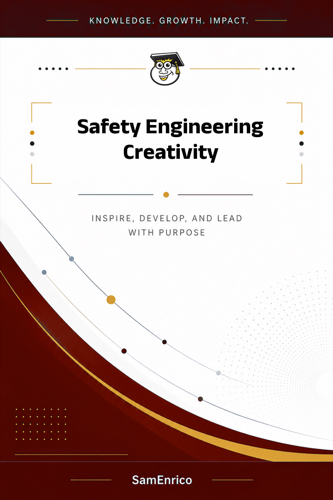
Safety Engineering Creativity eBook
Generate novel hazard controls and fail safe desig
Generate novel hazard controls and fail safe designs using creative thinking.
Formats
Free sample
Chapter 1: The Titanic Syndrome--–- On the night of April 14, 1912, the RMS Titanic carried 2,224 passengers across the North Atlantic. The ship was the largest moving object ever built. Its designers had called it "practically unsinkable." Sixteen watertight compartments, advanced for the era, meant that even if four were breached, the vessel would stay afloat. No one imagined that an iceberg could scrape along the hull, opening six compartments to the sea. No one had designed for that scenario.
The code book of the day did not include it. And so, 1,517 people died not because the ship was weak, but because the imagination of its builders was limited to what had already been seen.This chapter argues that the safety engineering profession has become a prisoner of its own success. Decades of developing codes, standards, checklists, and best practices have created a culture where "compliance" is mistaken for "safety." Engineers take pride in following the rules. Regulators demand proof of adherence. Lawsuits punish deviation from established norms.
And yet, disasters continue to occur—not because the rules were violated, but because the rules did not anticipate the scenario that unfolded.The most significant hazards are not technical failures of materials or machines. They are failures of imagination. This book exists to remedy that failure. But before we can build creative solutions, we must first understand the psychological and organizational barriers that keep safety engineering trapped in reactive compliance rather than proactive creativity.The Paradox of Zero For decades, the safety profession has pursued a noble but misleading goal: zero incidents. Zero recordable injuries.
Zero lost-time accidents. Zero environmental releases. On its face, this seems unobjectionable. Who would argue for more accidents?The problem is that the pursuit of zero creates perverse incentives. When the goal is zero, any incident becomes evidence of failure.
Managers hide near-misses. Operators skip reporting minor deviations. Engineers stick to proven designs because a novel solution that fails carries catastrophic career risk, while a standard solution that fails is simply "bad luck" or "unforeseeable." The organization optimizes for the appearance of safety rather than the reality of resilience.Consider the offshore oil industry before Deepwater Horizon. In the seven years prior to 2010, the industry had experienced no major blowouts in the Gulf of Mexico. Executives pointed to this record as proof of their safety systems.
But what actually happened? A slow, creeping normalization of risk. Well designs that pushed the limits of pressure containment. Cement jobs that were not tested properly. Alarm systems that were so frequently triggered that operators learned to ignore them.
The absence of disaster was not evidence of safety—it was evidence of luck, and luck ran out on April 20, 2010.The paradox is this: past success does not predict future safety. In fact, past success often breeds the very complacency that enables future catastrophe. The more years without an incident, the more confident an organization becomes, the more risks it tolerates, and the more likely a disaster becomes. This is the Titanic Syndrome: the belief that because we have survived so far, we will continue to survive.Normalized Deviance: How the Unthinkable Becomes Routine In her landmark study of the Challenger space shuttle disaster, sociologist Diane Vaughan coined the term "normalized deviance." She observed that NASA engineers had known for years about O-ring erosion in the solid rocket boosters. The O-rings were designed to seal the joints between booster segments, but under cold temperatures, they became stiff and failed to seal properly.
Erosion—a deviation from design specifications—had occurred on multiple previous flights.Yet each time, engineers reviewed the data and concluded that the erosion was "within acceptable limits." They adjusted their mental model of what was normal. A small deviation became acceptable. Then a slightly larger deviation became acceptable. Over time, the organization normalized a condition that was, in fact, a precursor to catastrophic failure. On the morning of January 28, 1986, when the temperature was far below any previous launch condition, the O-rings failed completely.
The shuttle broke apart 73 seconds after liftoff. Seven astronauts died.Normalized deviance is not unique to NASA. It happens in every industry. Consider a chemical plant where a pressure relief valve is routinely blocked "just for a few hours" during maintenance. The first time, it causes anxiety.
The second time, it causes discussion. By the tenth time, it is simply how the plant operates. No one can remember when the policy changed. Then one day, an over-pressure event occurs during those few hours, and the relief valve cannot open. The vessel ruptures.
Investigators find that the plant was operating "within its normal procedures"—because the deviant procedure had become normal.The engineering implication is profound. Traditional hazard analysis assumes that operators and engineers will follow procedures and design specifications. But normalized deviance teaches us that they will not. Over time, the gap between "designed" and "actual" widens. Creative safety design must anticipate this drift.
The best designs are not those that require perfect human behavior, but those that make deviance impossible or harmless.Normal vs. Radical Design: The Comfort of the Known Walter Vincenti, an aeronautical engineer and historian, made a crucial distinction in his study of engineering knowledge. He differentiated between "normal design" and "radical design." Normal design refines and improves existing solutions. It asks: how can we make this lighter, cheaper, faster, more reliable? It operates within established paradigms.
Radical design, by contrast, invents entirely new architectures. It asks: what if we did not use a wing at all? What if we contained pressure by geometry rather than material strength? What if we eliminated the hazard rather than controlling it?The overwhelming majority of engineering work is normal design. This is not a criticism—normal design is how we achieve incremental improvement, cost reduction, and reliability.
The problem arises when normal design is applied to situations that require radical solutions. When a hazard is fundamentally new or when existing controls have repeatedly failed, refining the same approach is not enough. But engineers are pushed toward normal design by powerful forces.Fear of litigation is the first force. If an engineer proposes a novel design and it fails, that engineer can be sued for negligence. The legal system often rewards adherence to industry standards, even if those standards are inadequate, and punishes deviation, even if that deviation was reasonable.
A jury may not understand the technical merits of a radical design. They will understand that the engineer "did not follow the code."Fear of professional reprisal is the second. Engineering is a conservative profession. Peer review, publication, and promotion favor incremental contributions over revolutionary ones. A young engineer who proposes a radical redesign of a pressure vessel may be seen as naive or reckless.
Their career suffers. The safe path—professionally speaking—is to color inside the lines.The "tried and tested" bias is the third. Humans are naturally averse to uncertainty. A design that has worked for ten years feels safe, even if it is objectively riskier than a novel alternative. The novel alternative has no track record.
Its failure modes are unknown. This is the "unknown unknowns" problem, which will be explored in depth in Chapter 9. But for now, recognize that the bias…
This is the end of the free sample. Get the eBook to keep going. Buy now
About this book
Details
- Author
- Shuler Marylou
- Publisher
- SamEnrico
- Language
- English
- Genre
- Non-Fiction, Self-Help, Safety Engineering
- Released
- 2026-06-10
- Pages (approx.)
- 140
- Available as
- eBook, Audiobook

Read better in the ZLOADR app
Your eBooks on your phone or tablet. Sign in with your SamEnrico account and start reading.
More by Shuler Marylou
 Growth Mindset For AnxietyShuler Marylou$11.99
 Overcoming Isolation in AddictionShuler Marylou$11.99
 Inoculation Persuasion TheoryShuler Marylou$11.99
 The Fish and Seafood LongevityShuler Marylou$11.99
 Nefertiti's Veil: The Hidden Queen of the SunShuler Marylou$11.99
 Reverse Charge Mechanism GuideShuler Marylou$12.99
 African Founder YC Cohort GuideShuler Marylou$12.99
 Understanding Trypanosomiasis, East AfricanShuler Marylou$17.99
 How to Start a Dolls Made of Rubber Business (Beginners Guide)Shuler Marylou$11.99
 Construction General LabourerShuler Marylou$11.99