
Non-FictionHealth & WellnessRumination
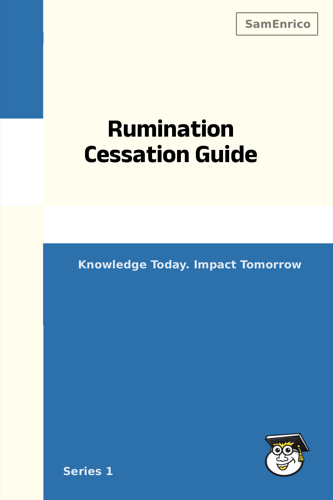
Rumination Cessation Guide eBook
Stop repetitive negative thinking cycles in major
Stop repetitive negative thinking cycles in major depression.
Formats
Free sample
Chapter 1: The Architecture of Spinning--–- At 3:47 AM, Sarah’s eyes opened for the seventh time. She had not been sleeping. She had been thinking. The conversation replayed on a perfect loop: the way her colleague had said “thanks” with a flat tone, the half-second pause before the door closed, the possibility that she had said something wrong. Three years ago.
Three years ago, this conversation happened. And here she was, at 3:47 AM, trying to solve it.Sarah is not real. But you know her. You might be her. This is the architecture of spinning—the mental construction that turns a single brick of experience into an infinite wall of suffering.
This chapter is not about Sarah. It is about the structure she is trapped inside. Because until you understand how the loop is built, you cannot know where to place the wrecking ball.The Wrong Question Most people who ruminate ask themselves a well-intentioned but catastrophically wrong question: “How do I stop thinking about this?”This question seems reasonable. It feels like the right target. If the problem is a thought, then the solution must be the absence of that thought, yes?
No. This is the first and most expensive misunderstanding. The question “how do I stop thinking about this” is actually a trap door that opens onto a basement full of more thinking. Trying to suppress a thought is like trying to hold a beach ball underwater. The effort itself guarantees the return.The correct question is not about stopping.
It is about structure. What is the loop made of? Where does it begin? Where does it get its power? And most importantly: what keeps it spinning long after the original event has ended?This chapter answers those questions by laying bare the anatomy of a depressive thought loop.
You will learn what rumination actually is (and what it is not), the two distinct flavors it takes inside a depressed brain, and the neuroscience that explains why your mind gets stuck in reverse gear. By the end, you will have a map of the enemy. And a map is always the first weapon.What Rumination Is Not (The Clarity of Subtraction)Before we build, we must clear rubble. Most people misuse the word “rumination.” They apply it to any kind of repetitive thinking: worry about the future, obsessive fears, even productive planning. This imprecision is not harmless.
If you cannot name the beast, you cannot hunt it.Rumination is not worry. Worry is future-oriented. “What if I lose my job?” “What if she leaves me?” “What if I get sick?” Worry is anxious, yes, and it can be repetitive, yes. But its temporal direction is forward. Worry says: something bad might happen.
Rumination says: something bad already happened, and I cannot stop examining it. Worry is about anticipation. Rumination is about post-mortem. They are cousins, not twins, and they require different interventions.Rumination is not obsession. Clinical obsessions (as in Obsessive-Compulsive Disorder) are ego-dystonic—meaning they feel alien, unwanted, like a foreign broadcast hijacking your mental radio.
A person with OCD does not believe their obsessive thought; they are horrified by it. Rumination, by contrast, is ego-syntonic. It feels true. It feels important. When you ruminate, you are not being invaded by an alien signal.
You are hosting the broadcast, believing every word, and refusing to change the channel because you think the answer is coming in the next sentence.Rumination is not problem-solving. This is the most seductive counterfeit. Problem-solving is specific, time-limited, action-oriented, and ends with relief or a concrete next step. Rumination is abstract, repetitive, passive, and ends with deepened depression. The difference is not in the content but in the process.
Two people can think about the same failed relationship. One lists what went wrong, identifies her role, decides what she will do differently next time, and stops. She has solved. The other replays the same argument for the thousandth time, asking “Why did he do that?” without ever arriving at a new answer. She has ruminated.
The subject is identical. The architecture is opposite.So here is your first definition, carved cleanly: Rumination is repetitive, passive, abstract thinking about the causes, meanings, and consequences of negative events or moods, which does not lead to active problem-solving and which predicts the worsening of depressive symptoms over time.The Two Engines of Depression: Brooding and Reflective Rumination Not all rumination is the same. This is a critical insight that most self-help books miss, and missing it leads to one-size-fits-all advice that fits no one. The research of Susan Nolen-Hoeksema (who pioneered the study of rumination) identified two distinct subtypes, and they operate like different engines inside the same car.Brooding is the first engine. It is passive, judgmental, and comparative.
Brooding says: “Why am I like this?” “What’s wrong with me?” “Why can’t I just be normal?” “Everyone else seems to handle this, so why am I failing?” Brooding compares your current situation (painful) to an unattained standard (some imagined version of yourself who would not be in this mess). The stance is evaluative and angry. Brooding is the more toxic form of rumination. It is more strongly associated with the onset of major depressive episodes, with longer episode duration, and with the transition from sad mood to clinical depression.Here is how brooding feels in the body: a tightness behind the sternum, a downward pull in the jaw, a sense of being judged by a courtroom that exists only inside your skull. Brooding does not feel like curiosity.
It feels like condemnation.Reflective rumination is the second engine. It is more subtle, and therefore more dangerous, because it disguises itself as insight. Reflective rumination says: “I’m going to figure this out.” “If I just think about this enough, I will understand why I feel this way.” “There’s an answer here, and I just haven’t found it yet.” The person engaged in reflective rumination feels productive. They are not angry at themselves; they are analyzing themselves. They are the detective examining the crime scene of their own mind.But here is the trap: reflective rumination produces no new information.
After the third pass through the same memories, no new evidence appears. After the tenth pass, no new insight emerges. The activity looks like analysis but functions as avoidance—avoidance of the one thing that would actually help, which is action. Reflective rumination is the mind spinning its wheels in mud and calling it transportation.Which engine drives you? Most people have a dominant style.
Take a breath and ask yourself: when you get stuck in a loop, do you feel mostly judged (brooding) or mostly curious (reflective)? The answer tells you which intervention will work better. Brooding responds to compassion and self-forgiveness (Chapters 8 and 11). Reflective rumination responds to behavioral activation and the 70% Rule (Chapters 5 and 9). You cannot treat a diesel engine with gasoline.
Knowing your subtype is not trivia; it is targeting.The Neurological Architecture: Your Brain’s Idle Gear Why does rumination feel so automatic, so involuntary, so much like something that is happening to you rather than something you are choosing? The answer lies in the Default Mode Network (DMN)…
This is the end of the free sample. Get the eBook to keep going. Buy now
About this book
Details
- Author
- Wingfield Ara
- Publisher
- SamEnrico
- Language
- English
- Genre
- Non-Fiction, Health & Wellness, Rumination
- Released
- 2026-06-07
- Pages (approx.)
- 152
- Available as
- eBook, Audiobook

Read better in the ZLOADR app
Your eBooks on your phone or tablet. Sign in with your SamEnrico account and start reading.
More by Wingfield Ara
 Twelve Step Prayer and MeditationWingfield Ara$11.99
 Digital Note Taking GuideWingfield Ara$11.99
 Oppenheimer’s Los Alamos AssemblersWingfield Ara$11.99
 Esports Betting CompulsionWingfield Ara$11.99
 Cuban Camp To Miami LifeWingfield Ara$11.99
 The Study Space SanctuaryWingfield Ara$11.99
 Disappointment In GrandchildrenWingfield Ara$11.99
 Advanced Sleep Phase Syndrome HelpWingfield Ara$11.99
 Boxer Uprising: China's Last Imperial RebellionWingfield Ara$11.99
 Whispers of the Forbidden LibraryWingfield Ara$11.99
 The Composer’s Redemption: How a Fallen Star Reclaimed His SymphonyWingfield Ara$11.99
 Understanding Arroyo–Garcia–cimadevilla SyndromeWingfield Ara$17.99
You may also like
 Hong Kong Handover 1997Dunn Johnnie$11.99
 Zumba For Postnatal Recovery CourseNeal Christian$11.99
 Zumba for BeginnersLadner Nikia$11.99
 YouTube Comment Mining GuideHumes Pandora$12.99
 Worry Box MeditationCarlin Rudy$11.99
 Workplace Stress MeditationNguyen Lynn$11.99
 Workplace Stress and Sleep RepairHawley Ivory$11.99
 Workplace Perfectionism CureDelaney Jeffry$11.99
 Workplace Injustice Anger GuideWallen Isabelle$11.99
 Work Addiction and Burnout LinkGreenwood Ester$11.99
 Women in Yoga and WellnessBeattie Galina$11.99
 Women in Stand Up ComedyChun Evangeline$11.99