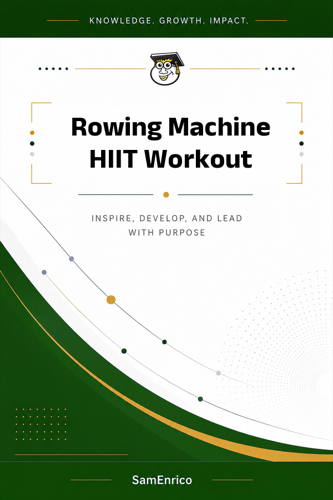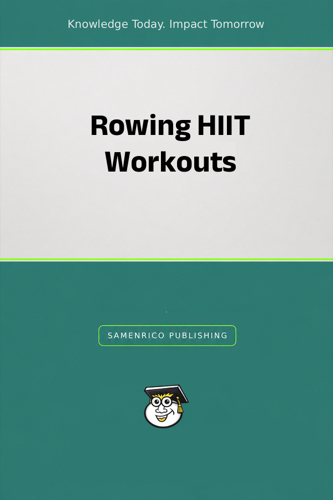
Rowing Machine HIIT Plan eBook
Pull as hard as possible for 1 minute, paddle easy
Pull as hard as possible for 1 minute, paddle easy for 2 minutes.
Formats
Free sample
Chapter 1: The 60-Second Alchemy--–- Sixty seconds. That is all it takes to transform your metabolism from a sluggish, fat-storing furnace into a hyper-efficient, fat-incinerating machine. But here is the paradox that most fitness enthusiasts never grasp: the secret is not in grinding harder for longer. It is in understanding exactly how your body’s energy systems respond to a very specific duration of effort — and then exploiting that response with surgical precision.If you have ever stepped off a rowing machine after twenty minutes of steady, rhythmic pulling, only to feel mildly warm and vaguely disappointed, you have experienced the first great lie of conventional cardio: that more time equals more results. Conversely, if you have ever collapsed after thirty seconds of all-out sprinting, gasping for air with your legs on fire, you have discovered the second great lie: that maximal effort is sustainable or even desirable for structured training.
The truth lies in the space between these extremes — a golden window of metabolic stress that begins at the forty-five-second mark and peaks at exactly sixty seconds.This chapter is not a dry physiology lecture. It is an owner’s manual for your engine. By the time you finish reading, you will understand why the one-minute hard pull, followed by two minutes of active paddling, creates a cascade of hormonal and enzymatic responses that no other interval ratio can match. You will learn why the 1:2 protocol triggers a longer afterburn effect than thirty-second sprints, why it builds more sustainable power than two-minute efforts, and why it is the single most time-efficient method for reshaping your body composition. Most importantly, you will finally understand what is actually happening inside your muscles, your blood, and your lungs during those sixty seconds — and why that understanding is the difference between spinning your wheels and achieving real, measurable transformation.Let us begin with the foundation: the three energy systems that power every movement you have ever made, and why most people train them completely backwards.The Three Engines: ATP-PC, Glycolysis, and Oxidative Phosphorylation Imagine your body has three engines, each designed for a different duration and intensity of work.
They do not turn on and off like light switches; they overlap, blend, and hand off responsibility to one another as time passes. The art of high-intensity interval training lies in understanding these handoffs and designing intervals that stress the right engine at the right time.Engine One: The ATP-PC System (0–10 seconds)The first engine runs on stored adenosine triphosphate (ATP) and phosphocreatine (PC). This is your body’s emergency backup generator — explosive, immediate, and exhausted almost as soon as it starts. When you jump out of the way of a speeding bicycle or explode off the starting line of a hundred-meter dash, you are running on ATP-PC. The beautiful thing about this system is that it requires no oxygen, works almost instantly, and produces no metabolic waste products that cause burning or fatigue.
The terrible thing about this system is that it depletes in roughly ten seconds of maximal effort, and it takes two to three minutes of rest to fully replenish.Here is where most HIIT programs get it wrong: thirty-second sprints are too long for the ATP-PC system to handle alone, but too short to fully engage the second engine. You end up in a no-man’s-land of partial activation, producing metabolic waste without enough time to force meaningful adaptation. The 1:2 protocol avoids this entirely because the sixty-second hard pull is deliberately designed to exhaust the ATP-PC system in the first ten seconds and then force an immediate, hard transition to the second engine.Engine Two: Glycolysis (10 seconds – 3 minutes)The second engine is the star of this chapter. Glycolysis is the process by which your muscles break down stored glycogen (carbohydrates) into usable energy without requiring oxygen — but this anaerobic breakdown produces lactate and hydrogen ions as byproducts. Lactate has been unfairly demonized for decades.
It is not a waste product or a toxin; it is a fuel source. The burning sensation you feel in your legs during a hard row is actually caused by the accumulation of hydrogen ions, which acidify your muscle tissue and interfere with contraction.Here is the crucial insight: glycolysis reaches its maximum activation at approximately sixty seconds of hard effort. At thirty seconds, you are barely tapping into it. At ninety seconds, you are starting to accumulate so much hydrogen ion buildup that your muscles physically cannot maintain the same power output. But at exactly sixty seconds, you have flooded your bloodstream with lactate and hydrogen ions at a level that is high enough to stimulate powerful adaptations — increased mitochondrial density, improved lactate buffering capacity, and enhanced enzymes for clearing metabolic waste — without being so high that you cannot repeat the effort after two minutes of active recovery.This is the alchemy of the sixty-second hard pull.
You are walking a tightrope between stimulus and fatigue. Too short, and you stay in the ATP-PC zone without stressing glycolysis. Too long, and you accumulate so much acidity that your power output crashes, turning the rest of your workout into a miserable slog. Sixty seconds is the sweet spot.Engine Three: Oxidative Phosphorylation (3+ minutes)The third engine is your aerobic system. It requires oxygen, runs primarily on fat and carbohydrates, and can produce energy for hours.
But it produces energy slowly. When you are rowing at a conversational pace for thirty minutes, you are almost entirely aerobic. The 1:2 protocol does not ignore the aerobic system; it deliberately engages it during the two-minute paddle, which is why the paddle must be active rather than passive. You are not resting during those two minutes. You are teaching your aerobic system to clear lactate, replenish phosphocreatine, and maintain elevated heart rate while your anaerobic system recovers.The Lactate Threshold: Why the Burn is Your Friend Let me pause here to address the single most common question I receive from rowers who try the 1:2 protocol for the first time: “Why do my legs feel like they are filled with molten lead by the fourth round?” The answer is lactate, and the feeling is not only normal — it is necessary.Your body produces lactate continuously, even at rest.
At low intensities, your muscles produce lactate at approximately the same rate that your heart, liver, and other tissues can clear it from the bloodstream. This is called lactate steady state. When you increase intensity, you eventually cross a threshold where lactate production exceeds clearance, and blood lactate levels begin to rise exponentially. This is your lactate threshold, and it is one of the single best predictors of endurance performance — not because lactate is bad, but because a higher lactate threshold means you can work harder before the hydrogen ion buildup forces you to slow down.The sixty-second hard pull is deliberately designed to push you slightly above your lactate threshold. Not so far above that you cannot complete the round, but high enough that your bloodstream lactate concentration rises from a resting level of approximately one to two millimoles per liter to ten to twelve millimoles per liter in trained individuals.
For context, elite rowers may reach fifteen to eighteen millimoles per liter during a two-thousand-meter race, but they also spend…
This is the end of the free sample. Get the eBook to keep going. Buy now
About this book
Details
- Author
- Whitmore Octavio
- Publisher
- SamEnrico
- Language
- English
- Genre
- Non-Fiction, Health & Wellness, Rowing
- Released
- 2026-06-07
- Pages (approx.)
- 147
- Available as
- eBook, Audiobook

Read better in the ZLOADR app
Your eBooks on your phone or tablet. Sign in with your SamEnrico account and start reading.
More by Whitmore Octavio
 Follower Count Self WorthWhitmore Octavio$11.99
 Affirmation Morning RoutineWhitmore Octavio$11.99
 Teacher Burnout TriggersWhitmore Octavio$11.99
 Marathon Mental Training HypnosisWhitmore Octavio$11.99
 Consultant Imposter GuideWhitmore Octavio$11.99
 Scarcity Influence ModelWhitmore Octavio$11.99
 Burn Center ReferralWhitmore Octavio$11.99
 The Sultan's Bridge: How a Forgotten Engineer Defied the ImpossibleWhitmore Octavio$11.99
 Ottoman Brushstrokes: The Royal Portraits That Shaped an EmpireWhitmore Octavio$11.99
 How to Produce Fishing ReelsWhitmore Octavio$11.99
 Cooperative Tax Benefits GuideWhitmore Octavio$12.99
 Value Added Service Pricing GuideWhitmore Octavio$12.99