
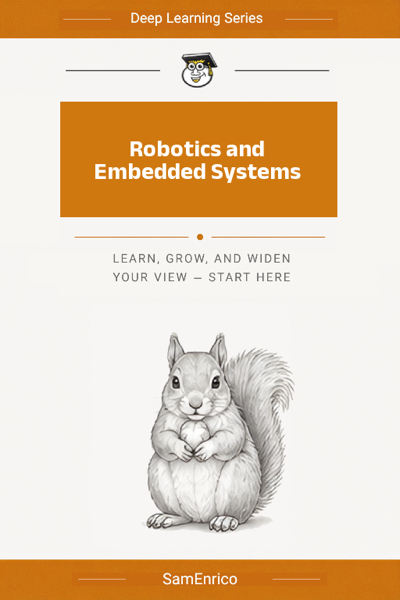
Non-FictionInformativeEducational
Robotics and Embedded Systems eBook
A Coursebook on Robotics and Embedded Systems
A Coursebook on Robotics and Embedded Systems
Formats
Free sample
Chapter 1: The Silent Brain...–- Your toaster has a computer. So does your car, your watch, and the toy that keeps barking until someone steps on it. But none of those computers look like the one on your desk. They have no screen, no keyboard, no mouse, and certainly no patience for you clicking around in a web browser. They are embedded, hidden, single-minded, and absolutely unforgiving when it comes to time.
The robot you are about to build runs on exactly this kind of computer, and if you do not learn to speak its language of deadlines and constraints, it will fail in ways that have nothing to do with bugs and everything to do with physics.This is not a book about programming in the abstract. This is a book about programming when the code meets the real world—when a missed deadline means a motor keeps spinning instead of stopping, when a buffer overflow sends a drone into a tree, when a poorly chosen microcontroller leaves your robot blind and confused in the middle of a room. The robots that work, the ones that vacuum your floor without falling down the stairs and the ones that assemble cars with surgical precision, all rely on a branch of computing that most software engineers never have to think about. They rely on embedded systems.An embedded system is a computer built to do one thing, or a small set of related things, and to do that thing within strict physical constraints. The computer inside a microwave oven reads a keypad, drives a display, and controls a magnetron.
It does not check email. It does not update its own operating system. It runs the same loop, millions of times, for the entire life of the appliance. A robot’s embedded system is similar but far more demanding. It must read sensors, run control algorithms, and command actuators, all while the robot is moving through an unpredictable world.
A late sensor reading means the robot acts on old information, which might mean crashing into a wall. A control loop that takes too long means the motors become jerky and unstable. An embedded system that runs out of memory in the middle of a critical maneuver cannot just show a popup dialog—it fails silently, physically, and often destructively.Before you write your first line of robot code, you need to understand what kind of computer lives inside a robot, what it can and cannot do, and why the rules that work for web development and data science will get your robot killed. This chapter strips away the abstraction and shows you the machine that actually executes your commands. You will learn the difference between microcontrollers and microprocessors, why real-time matters, what happens when a robot misses its timing deadlines, and how to think about resources before you write a single function.
By the end, you will see every line of code differently—not as an instruction to a virtual machine running on infinite hardware, but as a direct command to a small, fast, memory-limited brain that has no patience for laziness.The Robot Controller: More Than Just a Computer Every robot has a controller. In small hobby robots, that controller is a single chip. In industrial arms, it might be a rack of computers talking over a network. In a self-driving car, it is a cluster of processors, each handling a different subsystem. But regardless of scale, every robot controller follows the same fundamental pattern: sense, think, act.Sense means reading the world through sensors.
A wheel encoder produces pulses as the wheel turns. A distance sensor returns a voltage that changes with proximity. A camera streams millions of pixels per second. The controller must capture these signals accurately, without missing events, and convert them into numbers the software can process.Think means running algorithms on those numbers. A PID controller computes how much power to send to a motor.
A state machine decides whether the robot should be searching for a target or aligning with a dock. A path planner figures out how to get from point A to point B without hitting obstacles. These algorithms have to finish their work before new sensor data arrives, or the robot falls behind reality.Act means sending commands to actuators. A motor driver receives a PWM signal and converts it into voltage across the motor terminals. A servo gets a pulse width that tells it where to position its horn.
A solenoid fires, extending a gripper. These outputs must happen at exactly the right time, with exactly the right timing characteristics, or the robot moves incorrectly.The loop repeats. Sense, think, act. Sense, think, act. Hundreds or thousands of times per second.What makes this an embedded problem rather than a general computing problem is the word “exactly.” When you run a program on your laptop, you rarely care if a function call takes 10 microseconds or 10 milliseconds.
The user will never notice. When you fetch a web page, you do not demand that every byte arrives with microsecond precision. But a robot’s physical motion is governed by differential equations that depend on time. If your control loop is supposed to run every 10 milliseconds and it sometimes runs after 12 milliseconds, the motors will receive late corrections, the robot will oscillate, and in extreme cases, it will become unstable and fall over.This is the defining constraint of robotics: real-time. Not fast, though fast helps.
Real-time means correct results delivered at the correct time. A calculation that produces the perfect motor command but arrives too late is worse than useless—it actively destabilizes the robot.Microcontrollers Versus Microprocessors: The Great Divide If you search for “robot computer,” you will find two very different kinds of devices. One costs a few dollars and looks like a black rectangle with metal pins sticking out of its sides. The other costs fifty dollars and looks like a small circuit board with USB ports, an Ethernet jack, and a heat sink. One is a microcontroller.
The other is a microprocessor board. They are not interchangeable, and choosing the wrong one for your robot is the fastest path to frustration.A microcontroller (MCU) is a complete computer on a single chip. It contains a processor core, a small amount of RAM, non-volatile flash memory for your program, and a collection of peripherals—timers, analog-to-digital converters, communication interfaces—all inside the same package. You can power a microcontroller with a battery, connect a few sensors and motors, and it will run your program without any other components. The Arduino Uno, ESP32, STM32 “Blue Pill,” and Raspberry Pi Pico are all microcontrollers.
Their RAM ranges from 2 kilobytes (Arduino Uno) to 520 kilobytes (ESP32). Their flash memory ranges from 32 kilobytes to 16 megabytes. They run at clock speeds between 8 MHz and 240 MHz.A microprocessor (MPU) is just the processor core. It needs external RAM, external flash, and multiple support chips to function. When you buy a Raspberry Pi, you are buying a board that contains a microprocessor plus all those external components.
The processor itself might be an ARM Cortex-A series chip running at 1.5 GHz with a megabyte of cache. The board…
This is the end of the free sample. Get the eBook to keep going. Buy now
About this book
Details
- Author
- Heffner Kennith
- Publisher
- SamEnrico
- Language
- English
- Genre
- Non-Fiction, Informative, Educational
- Released
- 2026-05-07
- Pages (approx.)
- 144
- Available as
- eBook, Audiobook

Read better in the ZLOADR app
Your eBooks on your phone or tablet. Sign in with your SamEnrico account and start reading.
More by Heffner Kennith
 Intuitive Eating And Pregnancy CourseHeffner Kennith$11.99
 Personal Ing For Success Niche DominationHeffner Kennith$11.99
 The Talent Platform EconomyHeffner Kennith$11.99
 SNRI Pain Protocol ManualHeffner Kennith$11.99
 Paycheck to Paycheck PoetHeffner Kennith$11.99
 The Silk Road Heist: How a Teen Hacker Brought Down the Dark WebHeffner Kennith$11.99
 The Unbreakable Pact: How a Forgotten Treaty Almost Split the United StatesHeffner Kennith$11.99
 Understanding Biliary HypoplasiaHeffner Kennith$17.99
 State Sales Tax for Foreign LLCsHeffner Kennith$12.99
 Employer Preference Study GuideHeffner Kennith$12.99
 How to Start a Private Training Providers Business (Beginners Guide)Heffner Kennith$11.99
You may also like
 Hong Kong Handover 1997Dunn Johnnie$11.99
 Zumba For Postnatal Recovery CourseNeal Christian$11.99
 Zumba for BeginnersLadner Nikia$11.99
 YouTube Comment Mining GuideHumes Pandora$12.99
 Worry Box MeditationCarlin Rudy$11.99
 Workplace Stress MeditationNguyen Lynn$11.99
 Workplace Stress and Sleep RepairHawley Ivory$11.99
 Workplace Perfectionism CureDelaney Jeffry$11.99
 Workplace Injustice Anger GuideWallen Isabelle$11.99
 Work Addiction and Burnout LinkGreenwood Ester$11.99
 Women in Yoga and WellnessBeattie Galina$11.99
 Women in Stand Up ComedyChun Evangeline$11.99