
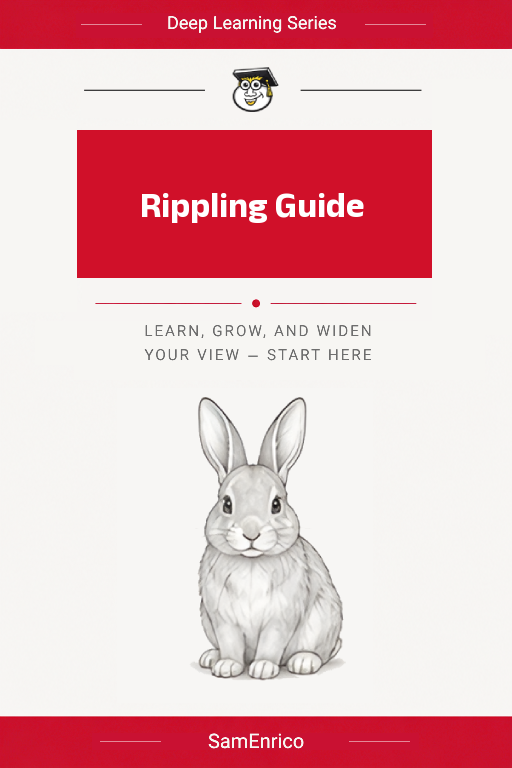
Rippling Guide eBook
Explore operational generalists, product engineeri
Explore operational generalists, product engineering fusion, and rapid scaling across time zones.
Formats
Free sample
Chapter 1: The Comb-Shaped Mind–- Ten years ago, I watched a startup die not because it ran out of money, not because the product was bad, and not because the market disappeared. The company collapsed because a single handoff between two teams—QA in Bangalore and Marketing in San Francisco—took eleven days. By the time the bug got fixed, the competitor had launched, the investor call had failed, and the CEO had given up. The code was beautiful. The engineers were brilliant.
The handoff was a corpse.That experience sent me on a decade-long quest to understand what actually kills speed in modern organizations. The answer surprised me. It wasn't lack of talent, bad strategy, or even time zones themselves. It was the absence of a specific kind of person—someone who doesn't fit neatly into any job description but without whom everything breaks. I call this person the operational generalist.This book is not about management theory.
It is not a collection of abstract frameworks that look good on slides and die on arrival. It is a field manual for becoming the person who makes everyone else faster. It is for the engineer who realizes that the real bottleneck is not the database but the weekly approval meeting. It is for the product manager who knows that the feature is ready but the legal review in Dublin won't happen until Thursday. It is for the leader who understands that scaling across time zones is not a technical problem but a human-friction problem disguised as a technical one.The Rippling Guide is built on a simple premise: small changes create big waves.
A single poorly written handover log ripples into a two-day delay. A single clarified decision right ripples into a product launch that beats the competition by a week. A single operational generalist ripples into an entire organization that moves twice as fast without working twice as hard.This chapter introduces the operational generalist: who they are, why they matter, and how to become one. It dismantles the myth that specialists or full-stack engineers are the ultimate assets in a scaling organization. It replaces that myth with a new archetype—the comb-shaped mind—and gives you the first tools to start thinking like a rippler.The Myth of the Full-Stack Hero For the past decade, startup lore has worshipped the full-stack engineer.
This mythical creature can write React on Monday, spin up a database on Tuesday, configure Kubernetes on Wednesday, and debug a memory leak on Thursday. On Friday, they deploy to production and go surfing. The message is clear: depth across the entire technical stack is the ultimate superpower.This is wrong.Not because full-stack skills are useless. They are valuable. But they are insufficient for the problem that actually kills scaling organizations.
The problem is not that you cannot write a migration script. The problem is that the migration script is waiting for a security review from a team that does not understand why it matters, which is waiting for a product decision from a manager who is asleep in a different time zone, which is waiting for a budget approval from a finance director who does not know what a migration script is.The full-stack engineer solves technical problems. The operational generalist solves systemic problems.Let me be concrete. A full-stack engineer sees a slow API and optimizes the query. An operational generalist sees that the slow API is only slow on Tuesdays because the data science team runs a batch job that was never communicated to engineering.
The generalist does not rewrite the query. They add a five-minute conversation between two team leads, a one-line note in the runbook, and a Slack reminder. The API stays the same. The latency disappears.This is the difference between moving fast on your own and making the whole system move fast. The first is a solo sport.
The second is a team sport played across time zones, cultures, and reporting lines.The Comb-Shaped Mind: A New Archetype If the full-stack engineer is shaped like a capital T—deep in a few areas, broad in many—the operational generalist is shaped like a comb. Long teeth in several domains, but the teeth are not isolated. They are connected by a backbone of systems thinking.What does that mean in practice? A comb-shaped operational generalist has:Enough engineering to read an API contract and spot a coupling that will break across time zones. They do not need to write the perfect sorting algorithm.
They need to know why the team in India cannot build against the US service without a mock endpoint.Enough product to distinguish between a must-have feature and a nice-to-have that can wait. They do not need to run user interviews. They need to know which metrics matter for the current quarter and which are vanity numbers.Enough finance to understand why the approval is taking seven days. They do not need to build a DCF model. They need to know that the budget sign-off requires three people, one of whom is on vacation, and that a single email to the right person can collapse the wait to four hours.Enough sales and support to know what customers are actually complaining about versus what engineering thinks they are complaining about.
They do not need to close deals. They need to know that the bug that seems minor in the logs appears on the front page of Reddit every three weeks.Enough operations to write a handover log that does not require a phone call. This is the secret superpower. Most handovers fail because the writer assumes context the reader does not have. The operational generalist writes for someone who just woke up in a different country and has ten minutes to understand what happened.The backbone that connects these teeth is systems thinking.
You do not just know a little about each domain. You know how they interact. You see that a change in pricing (finance) creates a spike in support tickets (support), which creates a bug report (engineering), which creates a delayed feature (product), which creates a missed revenue target (finance again). The loop is not a straight line. It is a circle.
And circles are where most organizations bleed speed.From "I Wrote the Code" to "I Solved the Revenue Leak"The most important shift the operational generalist makes is identity-based. Traditional engineering culture rewards the person who writes the most code, fixes the most bugs, or deploys the most features. The metric is output. The hero is the builder.The operational generalist shifts the metric to outcome. The question is not "What did you build?" but "What problem did you solve?" And the best problems are rarely pure code.
They are the spaces between functions, the gaps between teams, the handoffs between time zones.Consider two engineers on the same team. Engineer A spends the week optimizing a search query from 200ms to 50ms. A 75% improvement. Impressive. Engineer B spends the week discovering that the legal team needs to approve every new search term before it goes live, a process that takes an average of six days.
Engineer B automates a one-click approval request that cuts the wait to four hours. Which improvement creates more value for…
This is the end of the free sample. Get the eBook to keep going. Buy now
About this book
Details
- Author
- Mcinnis Josefine
- Publisher
- SamEnrico
- Language
- English
- Genre
- Non-Fiction, Strategic Atlas, Talent Intelligence
- Released
- 2026-06-01
- Pages (approx.)
- 148
- Available as
- eBook, Audiobook

Read better in the ZLOADR app
Your eBooks on your phone or tablet. Sign in with your SamEnrico account and start reading.
More by Mcinnis Josefine
 Parenting Conversation GuideMcinnis Josefine$11.99
 Dust Ingestion Prevention GuideMcinnis Josefine$11.99
 Body Scan During Fertility TreatmentMcinnis Josefine$11.99
 Collector Edition Buyer ProfileMcinnis Josefine$11.99
 MBSR for Cancer PatientsMcinnis Josefine$11.99
 Baba Yaga's Lament: The Witch's Forbidden BalladMcinnis Josefine$11.99
 Understanding Pulmonary Artery Familial DilatationMcinnis Josefine$17.99
 FerretsMcinnis Josefine$11.99
 Wholesale Marketing One Page PlanMcinnis Josefine$12.99
 How to Become a Oil-burner-servicer-and-installer HelperMcinnis Josefine$11.99
You may also like
 Zapier GuideGallardo Alica$12.99
 Toast GuidePacheco Lorina$12.99
 Stripe Early Talent GuideHendrick Santo$12.99
 SpaceX Hiring GuideObryan Kyung$12.99
 Snap GuidePeak Berenice$12.99
 Salesforce GuideCuster Cruz$12.99
 Reddit GuideHolton Danyelle$12.99
 Pinterest GuideLindgren Solange$12.99
 Palantir GuideBarrera Shonda$12.99
 OpenAI GuideFay Zack$12.99
 Nvidia GuideOtero Michiko$12.99
 Instacart GuideDailey Michael$12.99