
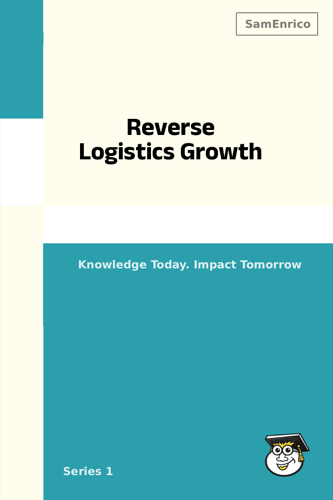
Non-FictionForecast & OutlookReverse Logistics
Reverse Logistics Growth eBook
Five year projection for returns management, repai
Five year projection for returns management, repair logistics, and circular economy freight.
Formats
Free sample
Chapter 1: The Invisible Fortune–- On a Tuesday morning in March 2023, the chief financial officer of a $4 billion home goods retailer walked into the weekly executive review meeting with a problem she could not name. Revenue was up 12 percent year over year. E-commerce sales had doubled since the previous year. The board was pleased. The stock price was healthy.
And yet, something was bleeding cash from the company’s veins, and no one could find the wound.The problem, she would later discover, was not in manufacturing. It was not in procurement. It was not in marketing or logistics or customer service. The problem was everywhere and nowhere at once. It lived in the gap between what the company sold and what came back.
That year, the retailer would process 1.8 million returns. Nearly twenty-three percent of everything sold online would eventually travel in reverse. The cost of processing those returns—shipping, inspection, restocking, discounting, and final disposal—would exceed $140 million. But here was the truly astonishing fact that no one in the room understood: embedded in that $140 million of cost was nearly $90 million of recoverable value. It was sitting in warehouses, trapped in cardboard boxes, decaying at a rate of 3 to 5 percent per month.No one was looking at it.
No one was measuring it. No one had been trained to see it. And that, this book argues, is the single greatest missed opportunity in modern commerce.Welcome to the invisible fortune of reverse logistics. By the time you finish this chapter, you will never look at a return the same way again.The Trillion-Dollar Blind Spot Let us begin with a number that should startle you. The global reverse logistics market was valued at approximately $773 billion in 2024.
By 2030, it is projected to exceed $1.04 trillion, growing at a compound annual rate of 6.1 percent. To put that in perspective, a trillion dollars is larger than the gross domestic product of the Netherlands, Turkey, or Saudi Arabia. It is nearly double the size of the global semiconductor industry. It is bigger than the entire e-commerce market of Europe.And yet, most executives cannot tell you what their reverse logistics operation costs. They cannot tell you what their return rate is by product category.
They cannot tell you how much value they lose per day from returned inventory sitting idle. They have built world-class forward logistics networks—automated warehouses, predictive inventory systems, real-time tracking down to the doorstep—but their reverse logistics remains stuck in the 1990s, a patchwork of manual processes, fragmented data, and resigned acceptance that returns are simply a cost of doing business.This book exists to change that. The central argument is simple, provocative, and supported by every major study on the subject over the past decade: reverse logistics is not a cost center. It is a strategic asset. The companies that learn to manage returns as a source of recovered value rather than a sink for operational expense will gain an insurmountable advantage over the next five years.
The companies that do not will slowly bleed margin until they are acquired or bankrupt.To understand why, we must understand the three irreversible forces that are transforming reverse logistics from an operational afterthought into a competitive battlefield.Force One: The Collapse of the Linear Economy For two hundred years, industrial commerce operated on a simple model: take, make, use, dispose. Raw materials are extracted from the earth. They are manufactured into products. Consumers use those products and eventually throw them away. The system assumes an infinite supply of cheap raw materials and an infinite capacity for waste absorption.
Both assumptions are now dangerously false.Consider the volatility in raw material prices over the past decade. Copper, essential for electronics and electric vehicle batteries, has swung from $2.00 per pound to $4.50 and back again. Cobalt, the most expensive component in lithium-ion batteries, has seen price fluctuations of over 300 percent in a single year. Even cardboard—simple, abundant, recyclable cardboard—increased in cost by more than 40 percent between 2020 and 2022. Each of these price shocks sends ripples through supply chains, eroding margins and forcing difficult trade-offs.Now consider what happens when a product is returned.
In a linear economy, that product is often written off as unsellable, sent to a liquidator, or simply thrown away. The raw materials embedded in it—copper, plastic, glass, rare earth elements, lithium, cobalt—are lost to the manufacturer forever. The manufacturer must then purchase new raw materials on the open market at whatever price prevails. This creates a perverse cycle: every return increases dependence on volatile commodity markets.But what if the manufacturer treated returns not as waste but as a source of supply? A returned smartphone contains gold, silver, copper, palladium, and cobalt.
A returned laptop battery contains lithium that can be extracted and reused. A returned industrial motor contains steel, copper windings, and rare earth magnets. The circular economy, which this book will explore in depth, treats returned products as mines, not landfills. And the companies that build the infrastructure to extract value from those mines will be insulated from commodity price volatility in ways their linear competitors cannot match.Force Two: The E-Commerce Returns Tsunami The second force reshaping reverse logistics is the explosive growth of e-commerce and its unique return dynamics. When consumers buy products online, they cannot touch, try on, or test the item before purchase.
As a result, return rates for e-commerce are dramatically higher than for brick-and-mortar retail. In physical stores, return rates typically range from 5 to 10 percent. In e-commerce, they range from 15 to 30 percent. For certain categories—apparel, shoes, consumer electronics—return rates can exceed 40 percent during peak shopping seasons.To understand the scale of this phenomenon, consider a simple calculation. A mid-sized online retailer generates $500 million in annual revenue with an average return rate of 20 percent.
That means $100 million worth of products come back each year. If the retailer operates on a typical 10 percent net margin, those returns represent the equivalent of two full years of profit tied up in reverse logistics. And every day those products sit in a warehouse waiting to be processed, they lose value.The e-commerce returns tsunami is not a temporary phenomenon caused by pandemic-related shopping shifts. It is a permanent structural change in consumer behavior. Younger consumers, in particular, have been trained by Amazon and Zappos to expect free, frictionless returns as a baseline service level.
They will order multiple sizes of the same shoe and return the ones that do not fit. They will buy a television, use it for the Super Bowl, and return it the next day. They will purchase a dress for a wedding, wear it once, and send it back.Retailers have spent billions building the logistics infrastructure to fulfill this expectation on the forward side—two-day shipping, same-day delivery, free shipping thresholds—but have invested comparatively little on the reverse side. The result is a system that hemorrhages value. Returns are processed slowly, inspected inconsistently, and dispositioned without data.
Products that could be resold as like-new are instead sold to liquidators for pennies on the dollar. Components that could be harvested are instead shredded. Materials that could be recycled are instead landfilled.The gap between what is…
This is the end of the free sample. Get the eBook to keep going. Buy now
About this book
Details
- Author
- Goebel Candida
- Publisher
- SamEnrico
- Language
- English
- Genre
- Non-Fiction, Forecast & Outlook, Reverse Logistics
- Released
- 2026-06-09
- Pages (approx.)
- 131
- Available as
- eBook, Audiobook

Read better in the ZLOADR app
Your eBooks on your phone or tablet. Sign in with your SamEnrico account and start reading.
More by Goebel Candida
 LBO Exit Multiple SensitivityGoebel Candida$11.99
 NVC In Healthcare HandbookGoebel Candida$11.99
 Assertiveness in Group SettingsGoebel Candida$11.99
 The Frank Welker Animal SoundsGoebel Candida$11.99
 Love in the Wilderness: The Siege of Fort Carillon and the Forbidden BondGoebel Candida$11.99
 Oil and Gas Sales Middle EastGoebel Candida$12.99
 Pricing for Introverted FoundersGoebel Candida$12.99
 Structured Cabling TechnicianGoebel Candida$11.99
 Understanding SitosterolemiaGoebel Candida$17.99
 How to Become a Dustless OperatorGoebel Candida$11.99
You may also like
 Hong Kong Handover 1997Dunn Johnnie$11.99
 Zumba For Postnatal Recovery CourseNeal Christian$11.99
 Zumba for BeginnersLadner Nikia$11.99
 YouTube Comment Mining GuideHumes Pandora$12.99
 Worry Box MeditationCarlin Rudy$11.99
 Workplace Stress MeditationNguyen Lynn$11.99
 Workplace Stress and Sleep RepairHawley Ivory$11.99
 Workplace Perfectionism CureDelaney Jeffry$11.99
 Workplace Injustice Anger GuideWallen Isabelle$11.99
 Work Addiction and Burnout LinkGreenwood Ester$11.99
 Women in Yoga and WellnessBeattie Galina$11.99
 Women in Stand Up ComedyChun Evangeline$11.99