
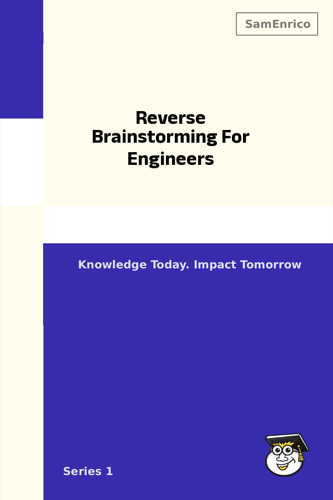
Non-FictionSelf-HelpReverse BrainstormingFailure
Reverse Brainstorming For Engineers eBook
Generate ideas by asking how to cause failure, the
by Gooch Marine
Generate ideas by asking how to cause failure, then reversing those insights.
Formats
Free sample
Chapter 1: The Optimism Trap--–- On a crisp January morning in 1986, Bob Ebeling, an engineer at Morton Thiokol, did something that still haunts him decades later. He stopped asking questions. Not because he didn’t have them—he had plenty. He knew the O-rings on the Space Shuttle Challenger’s solid rocket boosters had eroded during previous launches. He knew the seals were never designed to operate below 53 degrees Fahrenheit.
He knew that the forecast for launch day predicted temperatures below freezing. But when his manager told him to “take off his engineering hat and put on his management hat,” Ebeling complied. He stopped asking, “How do we guarantee this fails?” And seven people died seventy-three seconds after launch.This is not a story about bad engineering. It is a story about good engineers who were trapped by a problem that had nothing to do with physics, materials science, or thermodynamics. It was a problem of psychology, group dynamics, and the seductive power of positive thinking.Engineers are trained to solve problems.
We are rewarded for finding solutions, optimizing systems, and delivering results. From our first year in university to our final design review before retirement, the message is drilled into us: be constructive, be positive, be productive. But there is a dark side to this relentless optimism. When we only ask “How can we make this succeed?” we systematically blind ourselves to the most important question of all: “How will this fail?”This chapter introduces the foundational paradox of reverse brainstorming. The very mindset that makes engineers effective—solution-oriented, forward-looking, and confident—is the same mindset that allows catastrophic failures to slip through undetected.
We will explore the cognitive biases that reward positive thinking and punish negative thinking, the real-world disasters that resulted from unasked negative questions, and the concept of “Failure Debt”—the invisible accumulation of risk that every engineering organization carries.By the end of this chapter, you will understand why traditional brainstorming is not just incomplete but actively dangerous for high-stakes engineering. More importantly, you will be ready to embrace a counterintuitive truth: the fastest path to a robust design is to first try to break it.The Positivity Bias: Why We Can’t Help Ourselves Let’s begin with a simple experiment. Imagine you are in a design review for a new medical infusion pump. Your colleague presents a clever new valve mechanism. The room is nodding.
The project manager is smiling. Then you raise your hand and say, “What if the valve sticks open and overdoses the patient?”What happens next?If you have been in engineering long enough, you know the answer. Someone will say, “That’s unlikely.” Someone else will say, “We’ve already tested for that.” The project manager will remind everyone of the deadline. And you—the person who asked the negative question—will be labeled, fairly or not, as a pessimist, a naysayer, or worse.This is the positivity bias in action. Decades of cognitive psychology research, most famously by Daniel Kahneman and Amos Tversky, has shown that human beings are systematically biased toward optimistic predictions.
We overestimate our ability to control outcomes. We underestimate the probability of rare events. We anchor on success scenarios and neglect failure modes.But there is a specific twist for engineers. Unlike the general population, engineers are trained in root cause analysis, failure mode identification, and risk mitigation. We have the tools to predict failure.
The problem is not a lack of knowledge—it is a lack of permission. Engineering culture, for all its talk of rigor, subtly punishes the person who brings bad news.Consider the concept of loss aversion: the psychological finding that the pain of losing something is approximately twice as powerful as the pleasure of gaining something of equal value. If I offer you a coin flip where heads wins $100 and tails loses $100, most people refuse the bet. The potential loss feels worse than the potential gain feels good.Now apply this to engineering meetings. The person who asks a negative question risks social loss: status, credibility, and belonging.
The potential gain—preventing a failure—is abstract, uncertain, and often invisible. The loss is immediate and personal. So we stay quiet. We nod along. We let the positive brainstorming session continue.This is not weakness.
This is human nature. And it is the first barrier that reverse brainstorming must overcome.The Challenger Disaster: A Case Study in Unasked Questions The Space Shuttle Challenger disaster is often taught as a failure of engineering analysis or management pressure. But at its core, it was a failure of imagination—specifically, the imagination to ask negative questions systematically.Let’s walk through what the engineers at Morton Thiokol actually knew before the launch.The solid rocket boosters were built in segments, joined by three field joints. Each joint contained two O-rings—rubber seals that prevented hot combustion gases from escaping. The O-rings were never tested below 53 degrees Fahrenheit.
On the morning of January 28, 1986, the temperature at Cape Canaveral was 36 degrees.Before the launch, engineers at Thiokol identified a specific failure mechanism: at low temperatures, the O-ring material becomes less elastic. It takes longer to seal the joint. During the first few milliseconds of ignition, there is a window where hot gas can blow past the seal—a phenomenon called “joint rotation.”Now here is the critical point. No one asked the reverse question: “How do we guarantee that the O-ring fails?” If they had, the answers would have been obvious. Lower the temperature.
Increase the pressure. Accelerate the joint rotation. Reduce the safety margin. Every one of these conditions was present on launch day.But the engineers did not ask that question. Instead, they asked positive questions: “How can we prove it’s safe?” “What is the margin of safety?” “Can we launch if we accept some risk?” These are reasonable questions.
But they are the wrong questions when you are trying to prevent catastrophe.The result was the normalization of deviance, a term coined by sociologist Diane Vaughan in her analysis of the disaster. Normalization of deviance is the gradual process by which a team accepts smaller and smaller deviations from safety standards, until the unacceptable becomes routine. Each launch showed some O-ring erosion, but not enough to fail. So the team adjusted their expectations. What was once a warning sign became normal.
What was once unthinkable became acceptable.And then, on that cold January morning, the unacceptable finally happened.The Challenger disaster is not an outlier. It is a template for how engineering failures occur. The Deepwater Horizon oil spill. The Boeing 737 MAX crashes. The Fukushima nuclear disaster.
In every case, the technical warning signs were present. In every case, no one asked the negative question in a structured, systematic way.The Failure of Traditional Brainstorming Most engineers are familiar with traditional brainstorming. A facilitator stands at a whiteboard. The team shouts out ideas. The rule is “no bad ideas.” The goal is quantity over quality.
After thirty minutes, the team clusters the ideas, votes on the best ones, and walks away feeling productive.This method has a fatal flaw for engineering applications. Traditional brainstorming is designed for divergent thinking—generating many possibilities…
This is the end of the free sample. Get the eBook to keep going. Buy now
About this book
Details
- Author
- Gooch Marine
- Publisher
- SamEnrico
- Language
- English
- Genre
- Non-Fiction, Self-Help, Reverse Brainstorming, Failure
- Released
- 2026-06-09
- Pages (approx.)
- 149
- Available as
- eBook, Audiobook

Read better in the ZLOADR app
Your eBooks on your phone or tablet. Sign in with your SamEnrico account and start reading.
More by Gooch Marine
 Test Pilot Risk ManagementGooch Marine$11.99
 Pablo Escobar King of CocaineGooch Marine$11.99
 Downsizing Partner DisagreementGooch Marine$11.99
 Social Entrepreneur Family DynamicsGooch Marine$11.99
 The Balloonist of the Indian Ocean: Courage Above the WavesGooch Marine$11.99
 Silent Sabotage: The Hidden War of the Enigma MachineGooch Marine$11.99
 Presenting Data for Compliance DocumentationGooch Marine$12.99
 Ghana Ecommerce Logistics GuideGooch Marine$12.99
 PuppeteerGooch Marine$11.99
 Understanding Familial Intestinal Polyatresia SyndromeGooch Marine$17.99
 How to Become a Case-finishing-machine AdjusterGooch Marine$11.99
You may also like
 Hong Kong Handover 1997Dunn Johnnie$11.99
 Zumba For Postnatal Recovery CourseNeal Christian$11.99
 Zumba for BeginnersLadner Nikia$11.99
 YouTube Comment Mining GuideHumes Pandora$12.99
 Worry Box MeditationCarlin Rudy$11.99
 Workplace Stress MeditationNguyen Lynn$11.99
 Workplace Stress and Sleep RepairHawley Ivory$11.99
 Workplace Perfectionism CureDelaney Jeffry$11.99
 Workplace Injustice Anger GuideWallen Isabelle$11.99
 Work Addiction and Burnout LinkGreenwood Ester$11.99
 Women in Yoga and WellnessBeattie Galina$11.99
 Women in Stand Up ComedyChun Evangeline$11.99