
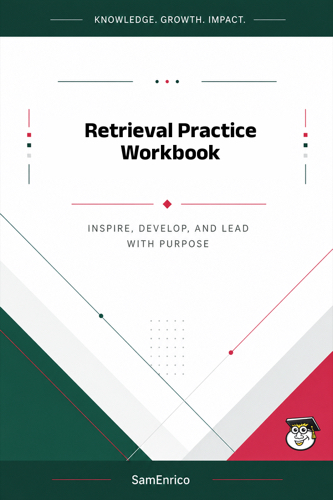
Retrieval Practice Workbook eBook
Self quiz regularly without notes to strengthen me
Self quiz regularly without notes to strengthen memory pathways.
Formats
Free sample
Chapter 1: The Closed-Book Revolution--–- You have been lied to about studying. Not by malicious actors or snake-oil salesmen, but by your own brain. The lie feels so true, so self-evident, that you have never thought to question it. Here it is: If you see something enough times, you must know it.This is the most expensive lie in education. It costs you hours of your life every week.
It costs you the gap between the grade you want and the grade you get. It costs you the sinking feeling of walking out of an exam room knowing you studied for days but somehow the answers evaporated the moment you needed them.The lie survives because it is comfortable. Re-reading a textbook chapter feels productive. Highlighting sentences feels like ownership. Watching a lecture video for the second time feels like diligence.
Your brain rewards these activities with a small hit of familiarity—ah, I remember this sentence—and then confuses that familiarity with genuine mastery. Cognitive psychologists call this the Fluency Illusion. You are about to destroy it.This chapter is not a warm-up. It is an intervention. By the time you finish these pages, you will have done something that most students and professionals never do: you will have closed the book and proven to yourself that re-reading is a trap.
You will have taken the first step toward the only study method that actually strengthens memory pathways. And you will have a new rule—a behavioral contract—that will govern every study session you conduct for the rest of your life.Let us begin with an experiment. You are going to fail at something. That failure will be the most valuable learning experience you have had in years.The Experiment You Will Fail (On Purpose)Take out a blank sheet of paper or open a new digital document. Set a timer for three minutes.
Do not read the next paragraph until you have completed the following instruction:Write down everything you remember from the last thing you studied. It could be a textbook chapter, a work presentation, a You Tube tutorial, a lecture, or even a long article you read yesterday. Do not look at your notes. Do not open the source material. Just write.
If you cannot remember something specific, write down the gaps. If you remember only three things, write those three things. The timer starts now.[Pause here. Complete the exercise before reading further.]Welcome back. How did it feel?
If you are like the vast majority of learners, you experienced some combination of frustration, embarrassment, and surprise. The frustration came from knowing that you had looked at this material recently—perhaps multiple times—and yet could not summon it cleanly. The embarrassment came from realizing how little actually stuck. And the surprise came from the gap between your confidence before the exercise and your performance during it.That gap is the Fluency Illusion. And it is not your fault.Why Your Brain Lies to You About Re-Reading The Fluency Illusion was first identified by cognitive psychologists studying how people learn from text.
They discovered something counterintuitive: the easier a piece of information feels to process in the moment, the less likely you are to remember it later. This is the opposite of what most people believe.When you re-read a paragraph, your brain processes it faster the second time. That speed feels like understanding. You think to yourself, Yes, I’ve got this. This is clear.
But what your brain has actually done is recognize the text, not comprehend it. Recognition and recall are entirely different cognitive operations, and your brain confuses them systematically.Consider this distinction:Recognition is seeing a familiar face on the street and knowing you have seen it before. Recall is generating that person’s name, occupation, and last conversation without any cues. Recognition is passive. It requires only a matching operation.
Recall is active. It requires reconstruction, search, and verification. Recognition feels good. Recall is often painful. And here is the brutal truth that every top-performing learner eventually accepts: recognition is worthless for long-term memory.
Only recall builds durable knowledge.Re-reading gives you recognition. It shows you the text again, and your brain says, Yes, this is familiar. But familiarity is not the same as accessibility. You can recognize a song without knowing the lyrics. You can recognize a historical figure’s face without explaining their significance.
You can recognize the layout of a textbook chapter without being able to summarize its argument. The Fluency Illusion convinces you that because the material looks familiar, it lives inside your head. It does not.The Re-Reading Log: Proving the Illusion to Yourself Before we go any further, you are going to collect evidence against your own intuition. This workbook element is called The Re-Reading Log, and it will transform how you see your study habits.Find a passage of text you have not read before. It could be a textbook section, a professional report, or even a Wikipedia article on a topic you know nothing about.
Read it once, carefully, from start to finish. Then, without delay, read it a second time.As you read the second time, pay attention to one specific thing: how many seconds pass before your attention drifts. Not when you finish the passage—when your eyes continue moving but your mind starts thinking about lunch, or a text message, or a completely unrelated topic. Most people experience attention drift within 30 to 60 seconds on a second read. Log that number.Now close the passage.
Do not look at it again. Write down everything you remember. Not what you recognize—what you can actually generate from memory without looking.Compare what you wrote to the original passage. The gap you see—the information that was in the text but absent from your recall—is the true cost of re-reading. You spent time on a second pass, but that time did not translate into retention.
It translated only into familiarity. And familiarity, as you have just proven to yourself, is not knowledge.The Six Hidden Costs of Re-Reading Most learners believe re-reading is neutral at worst. It might not help, they think, but it certainly does not hurt. This is incorrect. Re-reading carries six distinct costs that actively undermine your learning.Cost One: Opportunity Cost.
Every minute you spend re-reading is a minute you are not spending on retrieval practice. Retrieval practice is harder, less comfortable, and less immediately rewarding. But it works. By choosing the comfortable option, you are forgoing the effective one.Cost Two: The Illusion of Progress. Re-reading makes you feel productive.
That feeling is dangerous because it reduces the anxiety that motivates real studying. When you finish a re-reading session feeling confident, you are less likely to engage in the difficult work of self-quizzing. The illusion of progress is the enemy of actual progress.Cost Three: Context Dependence. When you re-read the same text in the same environment, your brain binds the information to that specific context. You remember the layout of the page, the position of the paragraph, even the font.
But tests rarely replicate that context. In an exam room, stripped of those environmental cues, your memory collapses.Cost Four: Passive…
This is the end of the free sample. Get the eBook to keep going. Buy now
About this book
Details
- Author
- Triplett Desire
- Publisher
- SamEnrico
- Language
- English
- Genre
- Non-Fiction, Self-Help, Retrieval
- Released
- 2026-06-09
- Pages (approx.)
- 112
- Available as
- eBook, Audiobook

Read better in the ZLOADR app
Your eBooks on your phone or tablet. Sign in with your SamEnrico account and start reading.
More by Triplett Desire
 Remote Retreats Conflict ResolutionTriplett Desire$11.99
 Polish Intelligence Enigma BreakTriplett Desire$11.99
 Innovation Landscape PrimerTriplett Desire$11.99
 Cognitive Load Management for Deep WorkTriplett Desire$11.99
 The Pink Panther Heist: The 1978 Diamond Caper That Shocked the WorldTriplett Desire$11.99
 The Lost Voyagers: Polynesian Navigators and the Dawn of Pacific ExplorationTriplett Desire$11.99
 Understanding Chorioretinopathy Dominant Form MicrocephalyTriplett Desire$17.99
 JEE Organic Chemistry GuideTriplett Desire$12.99
 Department Budgeting Software GuideTriplett Desire$12.99
 Phishing Test CoordinatorTriplett Desire$11.99
 10 Ways to Use Cheesecloth (Recipe Book)Triplett Desire$11.99
You may also like
 Hong Kong Handover 1997Dunn Johnnie$11.99
 Zumba For Postnatal Recovery CourseNeal Christian$11.99
 Zumba for BeginnersLadner Nikia$11.99
 YouTube Comment Mining GuideHumes Pandora$12.99
 Worry Box MeditationCarlin Rudy$11.99
 Workplace Stress MeditationNguyen Lynn$11.99
 Workplace Stress and Sleep RepairHawley Ivory$11.99
 Workplace Perfectionism CureDelaney Jeffry$11.99
 Workplace Injustice Anger GuideWallen Isabelle$11.99
 Work Addiction and Burnout LinkGreenwood Ester$11.99
 Women in Yoga and WellnessBeattie Galina$11.99
 Women in Stand Up ComedyChun Evangeline$11.99