
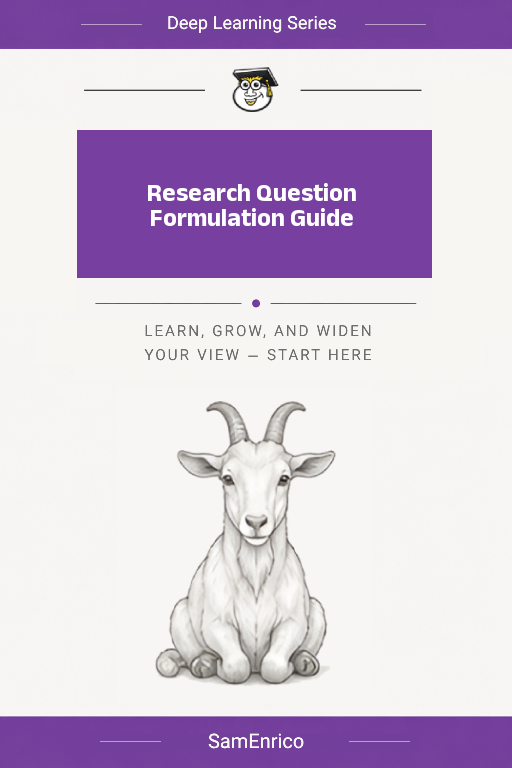
researchStudent's ShortcutQuestion DesignHypothesis Guide
Research Question Formulation Guide eBook
Craft precise research questions and hypotheses th
Craft precise research questions and hypotheses that drive your proposal and make reviewers want to fund your work.
Formats
Free sample
Chapter 1: The $100,000 Topic Sentence--–- The rejection email arrived at 11:47 on a Tuesday. The program officer had written just three sentences. “Your proposal was thoroughly reviewed. The panel found the topic interesting. However, the research question was deemed insufficiently clear to guide the proposed methods.” Six months of work, forty-seven pages, seventeen revisions, and three letters of support—reduced to a single word: “insufficiently.” The researcher, a third-year assistant professor we will call Dr.
Chen, printed the email and taped it to her office wall. She kept it there for two years, through two more rejections, until the day she finally submitted a proposal with a question so precise that reviewers fought over who would fund it. This book is for everyone who has received that email. This book is for everyone who will.The Topic Trap: How Smart People Waste Years Let us name the enemy. The enemy is not reviewer bias, not funding scarcity, not even bad writing.
The enemy is the topic trap—the nearly universal human tendency to mistake a broad area of interest for a specific, answerable research question. Every researcher falls into this trap. The difference between those who get funded and those who do not is not talent. It is the speed with which they recognize and escape the trap.Consider the difference. A topic is a domain of curiosity.
Examples: “climate change anxiety,” “teacher burnout,” “blockchain adoption in supply chains,” “postpartum depression screening.” These are all legitimate areas of inquiry. They are also completely unfundable in their current form. Why? Because a topic does not tell a reviewer what you will actually do, what you will measure, who you will study, or what would count as an answer.A research question, by contrast, is a specific, answerable inquiry that contains within it the seeds of its own methodology. Example: “Does a four-day workweek reduce emotional exhaustion scores on the Maslach Burnout Inventory among intensive care unit nurses at urban teaching hospitals, compared to standard five-day scheduling, over a six-month period?” This question tells you the population (ICU nurses at urban teaching hospitals), the intervention (four-day workweek), the comparison (standard five-day schedule), the outcome (emotional exhaustion scores on a specific instrument), and the timeframe (six months).
A reviewer could take this question and design a study around it. That is the difference between a topic and a question.The tragedy is that researchers spend months—sometimes years—writing proposals organized around topics, not questions. They write beautiful introductions about the importance of climate change anxiety. They cite 147 sources. They describe the urgent need for more research.
And then the program officer writes back: “Insufficiently clear.” Not wrong. Not unimportant. Insufficiently clear.The Goldilocks Grid: Your First Tool for Scoping How do we escape the topic trap? We need a tool that forces specificity without sacrificing ambition. The Goldilocks Grid is that tool.
It is a visual scoping exercise that classifies potential research questions into three categories: Too Big, Too Small, and Just Right. The grid is simple enough to draw on a napkin and powerful enough to save you six months of wasted effort.Too Big Questions: The Moonshot That Will Never Launch A Too Big question is one that cannot be answered with the resources, time, or access available to you. These questions often begin with phrases like “What causes…”, “How does society…”, or “What is the effect of… on all…” They are noble, interesting, and completely unfundable at your career stage.Examples of Too Big questions:“What causes poverty?” (This requires a meta-analysis of every poverty study across multiple disciplines, plus longitudinal data spanning generations.)“How does social media affect adolescent mental health?” (The phrase “affect” is doing enormous work here. Affect how? Positively?
Negatively? Which adolescents? Which platforms? Over what timeframe?)“What is the best way to teach reading?” (Best for whom? In which contexts?
Measuring which outcomes? Compared to what alternative?)The problem with Too Big questions is not that they are unimportant. It is that they are unanswerable within the constraints of a single grant. A reviewer reading a Too Big question thinks: “This person does not understand the scope of a funded project. They are proposing a career, not a study.”Too Small Questions: The Foregone Conclusion A Too Small question is one that has already been answered, is obviously true, or can be resolved with a single afternoon of data collection.
These questions often begin with phrases like “Do people prefer…”, “Is there a relationship between… and…” where the relationship is already well-established, or “What is the prevalence of…” in a population where prevalence has already been measured.Examples of Too Small questions:“Do puppies bring joy to their owners?” (We already know the answer. This is a foregone conclusion disguised as research.)“Is there a relationship between smoking and lung cancer?” (Established for decades. A reviewer will wonder if you have read anything published after 1964.)“What is the rate of hospital readmission among cardiac patients at St. Mary’s Hospital?” (This is a single chart review. It does not require a grant.
It requires an intern with a spreadsheet.)The problem with Too Small questions is not that they are incorrect. It is that they are trivial. A reviewer reading a Too Small question thinks: “Why does this person need funding for this? And why should I care about an answer I already know?”Just Right Questions: The Fundable Sweet Spot A Just Right question sits in the Goldilocks zone: it is specific enough to be answerable, ambitious enough to matter, and constrained enough to fit within a typical grant period. The Just Right question typically includes six elements, which we will call the Six Pillars of Precision:Population (Who specifically?
Not “teachers” but “first-year public school math teachers in urban districts with fewer than five years of experience.”)Intervention or exposure (What is being done or happening? Not “a new curriculum” but “the Bridges in Mathematics curriculum, delivered via 90-minute weekly professional development sessions.”)Comparison (Compared to what? Not just “a control group” but “business-as-usual instruction using the district’s existing Everyday Mathematics curriculum.”)Outcome (What will you measure? Not “student learning” but “student scores on the state’s annual standardized math assessment, scaled 200-800.”)Timeframe (Over what period? Not “over time” but “over one academic year, with pre-test in September and post-test in May.”)Boundary conditions (Under what conditions?
Not “in general” but “in schools where at least 40% of students qualify for free or reduced lunch.”)Examples of Just Right questions:“Among first-year ICU nurses at urban teaching hospitals (population), does a four-day workweek of four 10-hour shifts (intervention), compared to the standard five-day schedule of five 8-hour shifts (comparison), reduce emotional exhaustion scores on the Maslach Burnout Inventory (outcome) over six months (timeframe)?”“In rural counties with no broadband access (boundary condition), does a text-message-based medication reminder system (intervention), compared to no reminders (comparison), increase adherence to antihypertensive medication (outcome) among adults over 65 with newly diagnosed hypertension (population) over 12 months (timeframe)?”Notice what these questions do. They tell a reviewer exactly what will be studied, how it will be measured, and what would count as success or failure. They are specific without being…
This is the end of the free sample. Get the eBook to keep going. Buy now
About this book
Details
- Author
- Lanier Lavonna
- Publisher
- SamEnrico
- Language
- English
- Genre
- research, Student's Shortcut, Question Design, Hypothesis Guide
- Released
- 2026-05-30
- Pages (approx.)
- 145
- Available as
- eBook, Audiobook

Read better in the ZLOADR app
Your eBooks on your phone or tablet. Sign in with your SamEnrico account and start reading.
More by Lanier Lavonna
 LBO Rollover Equity GuideLanier Lavonna$11.99
 Work from Home Tech Addiction GuideLanier Lavonna$11.99
 Parental Addiction and ForgivenessLanier Lavonna$11.99
 Gluten Contamination Avoidance CourseLanier Lavonna$11.99
 Bariatric Surgery Plastic Surgery GuideLanier Lavonna$11.99
 The Ghost of Flight 522: The Pilot Who Vanished Mid-AirLanier Lavonna$11.99
 Echoes of the Silent War: The Secret History of Radio Free Europe’s Cold War Mind GamesLanier Lavonna$11.99
 Understanding Cataract Ataxia DeafnessLanier Lavonna$17.99
 Gram Pea HarvestingLanier Lavonna$11.99
 10 Ways to Use Charentais (Recipe Book)Lanier Lavonna$11.99
 Business Credit Builder MistakesLanier Lavonna$12.99
You may also like
 Scientific Research On TM GuideMartens Nathanial$11.99
 Research Proposal Methodology Section MasteryPauley Debroah$11.99
 Research Proposal Appendix CompilationRaines Tyisha$11.99
 Academic Researcher Distraction GuideFord Virgil$11.99
 TM Research and ScienceCovert Nicki$11.99
 Social Anxiety Research ReviewRoberge Cole$11.99
 Research Proposal Significance Section GuideBock Tory$12.99
 Research Proposal Reviewer PsychologyLugo Tawanda$11.99
 Research Proposal Research Questions DesignLara Robbi$11.99
 Research Proposal References and CitationsPatten Shanice$11.99
 Research Proposal Mixed Methods DesignCameron Omega$11.99
 Research Proposal Data Management PlanAnderson Roberto$12.99