
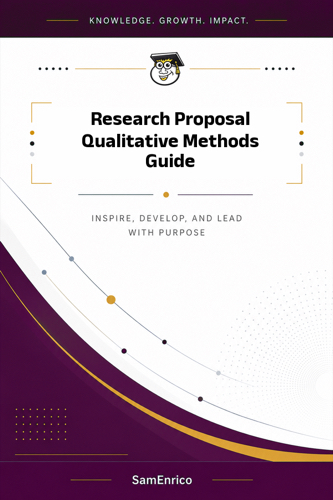
researchStudent's ShortcutQualitative Research
Research Proposal Qualitative Methods Guide eBook
Design interviews, focus groups, ethnography, or c
by Mosley Maren
Design interviews, focus groups, ethnography, or case study research.
Formats
Free sample
Chapter 1: The Alignment Matrix--Chapter 1: The Alignment Matrix--Most proposal drafts fail not because the research idea is weak, but because the writer has not yet learned one deceptively simple skill: translation. You have a topic that keeps you awake at night—teacher burnout, vaccine hesitancy, remote work adaptation, gentrification in your neighborhood. That topic is real. It matters. But a proposal committee cannot approve a topic.
They can only approve a problem that has been translated into a research question, which has then been translated into a methodology, which has then been translated into a data collection plan, which has then been translated into an analysis strategy. Each translation is an opportunity for error. Each mistranslation is a rejection letter waiting to happen.This book exists because the top ten qualitative methods textbooks—Creswell and Poth, Silverman, Merriam and Tisdell, Yin, Saldaña, and others—describe methods beautifully but rarely teach you how to align them. They give you a menu of options: interviews, focus groups, ethnography, case study. You can order anything you like.
But they do not give you the one thing you actually need: a map that shows how every choice connects to every other choice.That map is the Alignment Matrix. It is a single page. It has seven columns. And it will save you months of revision, committee feedback loops, and the particular misery of realizing in Chapter 4 that your methods do not answer your research questions.What This Chapter Will Do for You By the end of this chapter, you will be able to:Distinguish a research topic from a research problem (and explain why the difference determines whether your proposal is funded or rejected)Apply the "So What?" test to any idea, instantly revealing whether it belongs in a proposal or belongs in a journal entry Complete the Alignment Matrix for your own study, linking problem, purpose, questions, methodology, data collection, and analysis on one page Identify the single most common alignment error in qualitative proposals—and never make it yourself You will also meet Dr. Amara, a hypothetical researcher who will appear throughout this book as our running example.
She begins this chapter with a topic. She ends it with a defensible research problem and a completed Alignment Matrix. Your job is to follow her steps with your own topic in hand.The Difference Between a Topic and a Problem Let us begin with a confession. Most graduate students and early-career researchers cannot articulate the difference between a topic and a problem. This is not because they are unqualified.
It is because no one has ever given them a clear, repeatable test for telling the two apart.A topic is an area of interest. Examples: online learning, police accountability, hospice care, microplastics in drinking water. A topic can be the subject of a dinner party conversation, a blog post, or a ten-year research career. But a topic alone cannot be studied. It is too broad, too vague, and—most importantly—it does not contain the word because.A research problem is a specific gap, contradiction, or unanswered question within a topic.
It always contains an implied or explicit "because." Examples:Topic: Online learning. Problem: We do not know how community college instructors adapted their assessment practices during emergency remote teaching because existing research has focused on four-year universities.Topic: Police accountability. Problem: We do not understand how civilian oversight boards influence officer behavior because access to board meetings has been restricted.Topic: Hospice care. Problem: We have conflicting accounts of how family members experience end-of-life decision-making because most studies rely on retrospective interviews conducted after bereavement.Notice the structure. A problem names what is missing (lack of understanding, gap in research, contradictory findings, restricted access) and gives a reason why it matters.
The reason does not need to be earth-shattering. It only needs to be specific enough that someone could imagine collecting data to address it.The "So What?" Test Here is the test that separates topics from problems. Ask three questions about your idea. If you cannot answer all three with specific, non-generic responses, you have a topic, not a problem.Who suffers, loses, or remains ignorant if this is not studied? Be specific.
"Society" is not an answer. "Community college instructors who were forced to teach online without training" is an answer. "Patients with rare diseases who receive conflicting treatment guidelines" is an answer. "Small business owners who cannot access capital" is an answer.What happens in the world if we never answer this question? Again, specificity matters.
"Nothing changes" is an acceptable answer if you can defend it—some research is about understanding, not intervention. But "Nothing changes" is rarely true. More accurate answers include: "Policies will continue to be based on assumptions rather than evidence," "Practitioners will rely on outdated models," or "Affected communities will remain unheard."Why is this the right moment to study this problem? This question forces you to situate your study in time. Is there a policy window?
A recent crisis? A technological change? A demographic shift? An anniversary of a key event? If your problem could have been studied ten years ago and could be studied ten years from now with no difference, you need a stronger temporal justification.Dr.
Amara begins this chapter with a topic: "online learning during COVID." She applies the "So What?" test.Question one: Who suffers if this is not studied? She answers: "Community college instructors who were forced to shift their assessments online in Spring 2020 with no training, no precedent, and no institutional support. Their experiences were documented nowhere. Institutional decisions about assessment policy are being made based on administrator perceptions, not instructor realities."Question two: What happens if we never answer this question? She answers: "The next emergency that forces a rapid educational shift—another pandemic, a natural disaster, a political crisis—will repeat the same failures.
We will have learned nothing from 2020 because we never asked the people who did the actual teaching."Question three: Why now? She answers: "Because the emergency remote teaching period was bounded in time (Spring–Fall 2020). The longer we wait, the more instructors leave the profession, retire, or forget details. If we do not capture their experiences now, the data will be lost forever."That is a research problem. It is specific, temporal, and justifies data collection.
Dr. Amara now has something she can propose.The Alignment Matrix: A One-Page Map The Alignment Matrix is the central tool of this book. It forces you to make every key decision about your proposal on a single page before you write a single paragraph of narrative. This prevents the most common failure mode of proposal writing: discovering in Chapter 4 that your methods do not answer your questions, which forces you to revise Chapter 1, which forces you to redo your literature review, which means you have wasted three months.Here is what the Alignment Matrix looks like. (A blank, fillable version appears in Appendix A.
You may photocopy it, download it from the book's companion website, or recreate it in a spreadsheet.)Column 1Column 2Column 3Column 4Column 5Column 6Column 7Research Problem Purpose Statement Central Research Question Sub-Questions (2-5)Methodology Data Collection Tool(s)Analytic Strategy(What gap are you…
This is the end of the free sample. Get the eBook to keep going. Buy now
About this book
Details
- Author
- Mosley Maren
- Publisher
- SamEnrico
- Language
- English
- Genre
- research, Student's Shortcut, Qualitative Research
- Released
- 2026-06-08
- Pages (approx.)
- 147
- Available as
- eBook, Audiobook

Read better in the ZLOADR app
Your eBooks on your phone or tablet. Sign in with your SamEnrico account and start reading.
More by Mosley Maren
 Debt Collection Agent Stress GuideMosley Maren$11.99
 Ukrainian Family Reunited After InvasionMosley Maren$11.99
 Sector for ParentsMosley Maren$11.99
 Producer Surplus MaximizationMosley Maren$11.99
 Induction Script TechniquesMosley Maren$11.99
 Death Valley Zero TraceMosley Maren$11.99
 Boxing Ring Focus HypnosisMosley Maren$11.99
 The Unstoppable Rise of Yulimar Rojas: From Humble Beginnings to Olympic GloryMosley Maren$11.99
 The Golden Quill of Sappho: A Voice Lost to TimeMosley Maren$11.99
 The Mineral Guide to BruciteMosley Maren$11.99
 How to Become a Buckshot-swage OperatorMosley Maren$11.99
 South Africa Business Credit Score RangeMosley Maren$12.99
You may also like
 Scientific Research On TM GuideMartens Nathanial$11.99
 Research Proposal Methodology Section MasteryPauley Debroah$11.99
 Research Proposal Appendix CompilationRaines Tyisha$11.99
 Academic Researcher Distraction GuideFord Virgil$11.99
 TM Research and ScienceCovert Nicki$11.99
 Social Anxiety Research ReviewRoberge Cole$11.99
 Research Proposal Significance Section GuideBock Tory$12.99
 Research Proposal Reviewer PsychologyLugo Tawanda$11.99
 Research Proposal Research Questions DesignLara Robbi$11.99
 Research Proposal References and CitationsPatten Shanice$11.99
 Research Proposal Mixed Methods DesignCameron Omega$11.99
 Research Proposal Data Management PlanAnderson Roberto$12.99